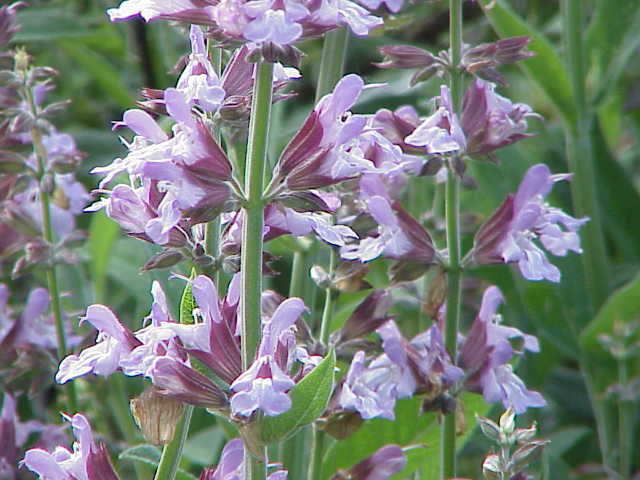
Salvia is the largest genus in the sage family Lamiaceae, encompassing just under 1,000 species — with more than 1,800 described taxa across the broader clade — of shrubs, herbaceous perennials, and annuals. Plants are immediately recognisable by the angled stems characteristic of the mint family, paired with opposite leaves that are entire or occasionally toothed and frequently covered with glandular trichomes. These trichomes secrete volatile oils that give the foliage its distinctive fragrance and serve as a natural deterrent to grazing mammals and insects. Flowers appear in racemes or panicles, are characteristically tube-shaped and two-lipped (bilabiate), and occur in colours ranging from deep blue and violet through pink and red to white and yellow.
The genus is notable for its unique staminal lever mechanism: each flower carries two fertile stamens whose separated thecae form a lever. When a pollinator — bee, bird, or other visitor — probes for nectar, the lever deposits pollen precisely on its body, then resets as the visitor withdraws. This mechanism evolved independently at least twice and is widely considered a key driver of the extraordinary speciation and adaptive radiation of the group.
Salvia's global distribution centres on three distinct hotspots: Central and South America, home to roughly 600 species; the Mediterranean basin and Central Asia, with around 250; and East Asia, with about 90. Within these regions, Mexican salvias have evolved particularly for hummingbird pollination, while Old World species predominantly attract bees. Beyond the wild, hundreds of cultivars and interspecific hybrids have been bred for ornamental use, and several hold the Royal Horticultural Society's Award of Garden Merit.
Etymology
The genus name Salvia derives from the classical Latin salvia, meaning "sage plant," which is itself rooted in salvus, meaning "safe," "secure," or "healthy" — a reference to the genus's long-standing medicinal reputation. Pliny the Elder is the earliest documented author to apply the name to a plant. The English common name "sage" passed through Middle English sawge and Old French sauge before arriving at its Latin origin. The verb salvere ("to be in good health") underlies both the genus name and the persistent folk belief that sage promoted longevity.
Distribution
Salvia is distributed across the Old World and the Americas, with three major centres of diversity. Central and South America harbour approximately 600 species, representing the richest node of diversification. The Mediterranean basin and Central Asia hold around 250 species, with Turkey being a particularly species-rich country. East Asia contributes roughly 90 species. In Europe, the genus reaches Switzerland, where nine taxa are native or naturalised — including S. pratensis, S. officinalis, S. glutinosa, S. sclarea, and S. verticillata — spanning lowland to montane zones. In the Americas, the genus shows special diversity in Mexico and adjacent regions, where species have co-evolved with hummingbirds as primary pollinators.
Ecology
A defining ecological feature of Salvia is the staminal lever mechanism, in which two stamens per flower have spatially separated anther lobes that function as a rocker or lever. When a pollinator enters the flower to reach nectar, it trips the lever and receives a precise dusting of pollen; on visiting an older flower, the stigma contacts the same position on the visitor's body and effects cross-pollination. The mechanism is generalist rather than species-specific, working with a range of bees, wasps, butterflies, and hummingbirds, which has facilitated the genus's broad adaptive radiation.
Glandular trichomes covering leaves and stems produce terpenoid-rich volatile oils that reduce palatability to herbivores and suppress some pathogens. In garden settings, salvias are reliably resistant to deer and rabbit browsing. The genus acts as a significant forage resource: New World species are especially important for hummingbirds, Old World species for bees and bumblebees, while some attract butterflies and seed-eating birds. Salvias can be susceptible to fungal diseases (powdery mildew, rust, stem rot) and insect pests (whiteflies, aphids, spider mites) in moist or poorly drained conditions.
Cultivation
Most cultivated salvias thrive in full sun to light partial shade and insist on well-drained soil — heavy, waterlogged ground is their principal limitation. They tolerate a wide range of soil textures (sandy, loam, clay, rocky) provided drainage is adequate, and are notably drought-tolerant once established. Hardiness spans roughly USDA zones 5a–10b depending on species; tender species from tropical Mexico need frost protection or treatment as annuals in cool climates. Salt tolerance makes them suitable for coastal gardens.
Plant spacing of 30–90 cm is recommended depending on species and mature size. Plants are generally low-maintenance: deer and rabbit resistance reduces pest pressure, and the aromatic foliage deters many insects. In ornamental borders they excel as long-blooming perennials or subshrubs; in herb gardens, culinary and aromatic species provide both harvest and visual interest. Numerous RHS Award of Garden Merit cultivars are available, including S. 'Hot Lips', S. × sylvestris 'Mainacht', and a range of S. × jamensis hybrids offering continuous late-spring-to-frost flowering.
Propagation
Salvia is among the easiest genera to propagate. Stem cuttings taken from half-ripe (semi-hardwood) growth succeed at almost any time during the growing season; they root reliably with minimal intervention and are the most widely used commercial method. Seed is the primary method for annual and biennial species: sow under glass in March or April at warmth, and most species germinate within two weeks. For established clump-forming perennials, division in spring or autumn is straightforward and immediately produces flowering-sized plants. Layering is occasionally used for sprawling subshrubs.
Cultural Uses
Salvia has been a cornerstone of culinary, medicinal, and ritual traditions across multiple cultures. Salvia officinalis (common sage) is one of the canonical European culinary herbs, used fresh and dried to flavour meats, stuffings, and cheeses. Salvia hispanica (chia) was cultivated as a staple food crop by Aztec and other Mesoamerican civilisations; its seeds are rich in protein, omega-3 fatty acids, and fibre, and when wetted form a mucilage that has been drunk as a beverage. Salvia apiana (white sage) holds deep sacred significance for numerous Native American nations, burned as incense in purification ceremonies. Salvia sclarea (clary sage) yields an essential oil widely used in perfumery and as a flavouring.
Medicinally, sage preparations appear across traditions from European herbalism to Traditional Chinese Medicine. Leaf infusions are historically used as blood tonics and treatments for respiratory ailments; seeds have been employed as ocular cleansers, becoming gelatinous on wetting to trap debris. Salvia miltiorrhiza (danshen) is an important herb in Chinese medicine, used for cardiovascular and circulatory conditions. Salvia divinorum, native to a small area of the Sierra Mazateca in Mexico, is used ceremonially by the Mazatec people and contains the potent psychoactive compound salvinorin A; its legal status varies by jurisdiction.
Taxonomy Notes
Salvia was formally described by Carl Linnaeus in Species Plantarum in 1753. The first comprehensive monograph was produced by George Bentham between 1832 and 1836, who arranged the genus into twelve sections within four subgenera, dividing roughly along Old World versus New World lines.
Modern molecular phylogenetics has overturned this view: DNA sequencing demonstrates that Salvia consists of at least three separate clades with distinct evolutionary origins, meaning the genus as traditionally circumscribed is not monophyletic. The staminal lever mechanism — for long considered a defining synapomorphy — is now understood to have arisen independently at least twice through convergent evolution.
A major reclassification published in 2017 proposed broadening Salvia to absorb five formerly separate genera: Dorystaechas, Meriandra, Perovskia (Russian sage), Rosmarinus (rosemary), and Zhumeria. Under this expanded circumscription, the genus encompasses roughly 1,800 taxa and forms one of the largest genera in the flowering plants. The family placement is uncontested: Lamiaceae, order Lamiales.










