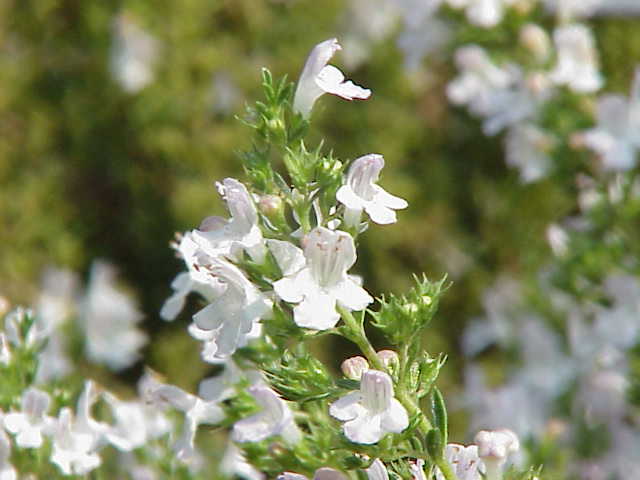
Satureja is a genus of aromatic herbs and subshrubs in the family Lamiaceae (order Lamiales), closely related to rosemary and thyme. The genus comprises annual and perennial species that grow to 15–50 cm tall, bearing small leaves 1–3 cm long and whorled flowers ranging from white to pale pink-violet. Native to southern and southeastern Europe, North Africa, the Middle East, and Central Asia, all currently accepted species are Eurasian in distribution.
The genus has an intricate taxonomic history: it was historically defined broadly to include many species of the subtribe Menthinae from across the world, but modern cladistic analysis redefined it as a narrower, monophyletic group. The most economically important members are the culinary herbs known as savory — summer savory (S. hortensis) and winter savory (S. montana) — widely used in Persian, Armenian, Georgian, Bulgarian, and Italian cooking, particularly with legumes. Savory is also a principal ingredient in the French spice blend Herbes de Provence and is used to flavor black tea in Azerbaijan.
Beyond the well-known culinary species, the genus includes a range of Mediterranean and Middle Eastern herbs with documented bioactive essential oils. Satureja khuzistanica, for instance, has been studied for anti-inflammatory properties, while S. hortensis essential oil acts as a natural herbicide. The genus supports Lepidoptera larvae, with the moth Coleophora bifrondella feeding exclusively on winter savory.
Etymology
The etymology of the Latin name satureia is uncertain. Proposed connections to the Latin saturare (to saturate), to satyrs of classical mythology, or to the Arabic/Hebrew za'atar have all been considered but are not well supported. The ancient Hebrew name for the plant is Tzatrah (צתרה).
Distribution
Satureja is native to southern and southeastern Europe, North Africa, the Middle East, and Central Asia. Following modern cladistic revision, the genus is now understood as strictly Eurasian. Some cultivated species — notably summer savory (S. hortensis) — have become naturalized in parts of the western Mediterranean, the Caribbean, and scattered locations in North America.
Ecology
Satureja species serve as food plants for the larvae of certain Lepidoptera. The moth Coleophora bifrondella feeds exclusively on winter savory (S. montana). Members of the genus grow in sunny, well-drained habitats typical of Mediterranean and steppe environments.
Cultivation
Satureja species require full sun and well-drained soil. They may be grown for culinary use or purely for ornamental effect. Summer savory (S. hortensis) is an annual harvested in summer; winter savory (S. montana) is an evergreen perennial available year-round.
Cultural Uses
Savory — primarily summer savory (S. hortensis) and winter savory (S. montana) — has been used as a culinary herb across southern Europe and western Asia for centuries. It features prominently in Persian, Armenian, Georgian, Bulgarian, and Italian cuisines, particularly in bean dishes. It is a key ingredient in Herbes de Provence and is used to flavor black tea in Azerbaijan. Savory also seasons the traditional Acadian stew known as fricot. Essential oils of several species have been investigated for antimicrobial, anti-inflammatory, and herbicidal properties.
Taxonomy Notes
Historically, Satureja was broadly defined and served as a catch-all for many aromatic species in the subtribe Menthinae from across the world. Modern cladistic revision narrowed the genus to a monophyletic group of strictly Eurasian species. Species formerly placed in Satureja that fall outside this clade have been reassigned to related genera such as Clinopodium, Micromeria, and others within Lamiaceae.










