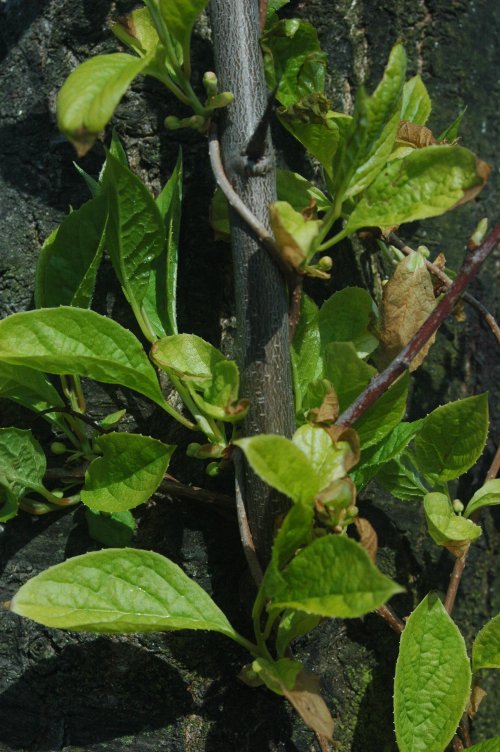
Schisandra is a genus of woody, twining vines in the family Schisandraceae, order Illiciales, commonly known as magnolia vines. Despite that common name, Schisandra is not closely related to true magnolias (family Magnoliaceae). The genus comprises deciduous, climbing shrubs that wind around surrounding vegetation for support. Plants are generally hardy and tolerant of a wide range of soils; in cultivation they perform best on sheltered, shady walls or structures.
The genus is native to eastern and southeastern Asia, with its greatest concentration of species in China, and a smaller presence in North America. This biogeographic pattern — primarily East Asian with a disjunct North American component — is shared with several other ancient plant lineages and reflects Tertiary-era land connections across the Holarctic region.
Schisandra has long attracted attention for the medicinal properties of its fruit. The berries of Schisandra chinensis, known in Chinese as wǔwèizǐ (五味子, "five flavor fruit"), are considered in traditional Chinese medicine to embody all five primary flavors: salty, sweet, sour, pungent, and bitter. They have been used traditionally to combat infections, support skin health, ease insomnia, and relieve coughing and thirst. Several species are also grown as ornamentals in gardens, valued for their attractive hanging clusters of bright berries in shades of red or pink.
The family Schisandraceae, to which Schisandra belongs, has at times been merged with the closely related Illiciaceae (star anise family), reflecting ongoing reassessment of early-diverging angiosperm lineages.
Etymology
The name Schisandra derives from the Greek schizein (to split) and andros (man/stamen), referring to the separated stamens characteristic of the flowers. The genus is also spelled Schizandra. The Chinese name for the most notable species, wǔwèizǐ (五味子), means "five flavor fruit," describing the berry's combination of all five flavors recognized in Chinese herbal medicine.
Distribution
Schisandra is native to eastern Asia (with greatest diversity in China) and has a disjunct presence in eastern North America, where the genus reaches its only New World outpost.
Cultivation
Schisandra species are grown as ornamental climbers in gardens. They are hardy deciduous vines tolerant of most soil types; the preferred position is on a sheltered, shady wall. Propagation is typically by cuttings of half-matured shoots taken in late summer.
Cultural Uses
The dried berries of Schisandra chinensis have been used for centuries in traditional Chinese medicine under the name wǔwèizǐ (五味子). The berries are considered to possess all five flavors of Chinese medicine — salty, sweet, sour, pungent, and bitter — and are prescribed to resist infections, improve skin health, combat insomnia, relieve coughing, and quench thirst.
Taxonomy Notes
Schisandra belongs to Schisandraceae (order Illiciales), though various authors have historically included it in Illiciaceae. The genus name is also spelled Schizandra. The family placement reflects the basal angiosperm affinities of the order Illiciales, distinct from the eudicots despite superficial floral similarities.

