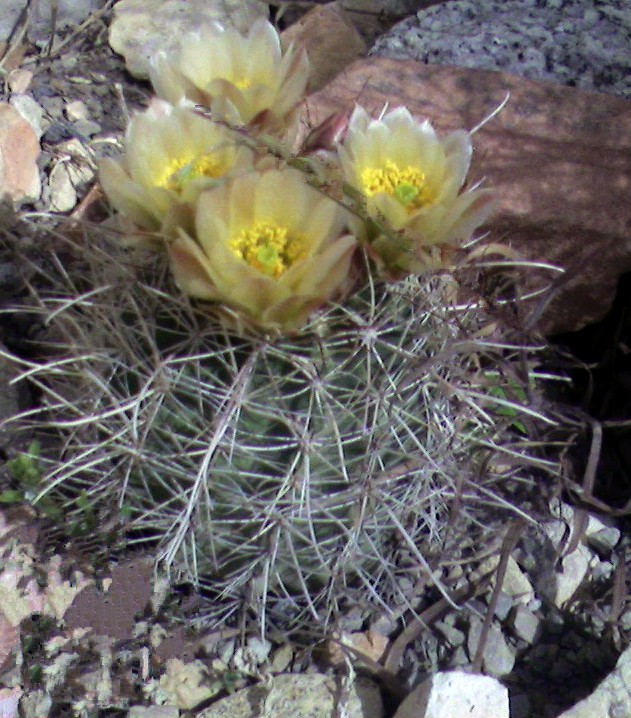
Sclerocactus, commonly called fishhook cacti, is a genus of small barrel-shaped stem succulents in the family Cactaceae, native to the desert regions of the southwestern United States and northern Mexico. The genus was described by Nathaniel Lord Britton and Joseph Nelson Rose in 1922, based on the type species S. polyancistrus.
Plants typically grow as solitary or occasionally clustered stems that are ovoid to elongate-cylindrical in form, reaching 3.5–13 cm in diameter and 3–27 cm in height. The stems bear tubercles coalesced into ribs, and spines arise from areoles in two or three distinct types — the most diagnostic feature being at least one strongly hooked spine per areole. Spine colors range from gray, white, and yellow to red, brown, and pink, and individual spines may reach 7.2 cm in length. Flowers are borne near the stem apex and open 1.5–5.5 cm wide; outer tepals bear greenish-lavender, yellowish-brown, or purple midstripes, while inner tepals are white, yellow, or pink to purple. The thin-walled, cylindrical fruits dry at maturity and split open with 2–4 irregular vertical slits.
The hooked spines serve a dual ecological role: besides defense, they facilitate seed dispersal during the flash floods common in their arid habitats — entire plants become entangled on flood debris and are transported to water-accumulating microsites. All species occupy water-scarce terrain with dramatic seasonal temperature swings, from the Colorado Plateau and Great Basin to the Mojave Desert and Sonoran Desert. Multiple species are federally listed under the US Endangered Species Act and are considered among the most imperiled cacti in North America.
Etymology
The genus name Sclerocactus combines the Greek word skleros ("hard") with kaktos ("spiny plant"). Wikipedia notes the epithet refers specifically to the hard, dry fruit characteristic of these plants; the SEINet treatment alternatively glosses it as referring to the hard or hard-and-cruel spines. Both interpretations reflect the overall rigid, tough character of the plants.
Distribution
Sclerocactus is endemic to the arid interior of North America. Species occur across the southwestern United States — including Utah, Colorado, Arizona, Nevada, California, New Mexico, and Texas — and extend into northern Mexico. Habitats include the Colorado Plateau, Great Basin, Mojave Desert, and Sonoran Desert. Within this range, individual species often have narrow, disjunct distributions tied to specific soil types, elevation bands, and desert scrub communities.
Ecology
All Sclerocactus species are adapted to water-scarce environments with extreme seasonal temperature variation. Their characteristic hooked spines serve not only as a defense mechanism but also as a dispersal adaptation: during the flash floods that periodically sweep desert washes, plants become entangled in debris and are carried to water-accumulating microsites where seedling establishment is more likely. The plants undergo pronounced seasonal deflation during winter dormancy, shrinking and partially collapsing as water reserves are depleted, then rehydrating and expanding after spring rains.
Conservation
Multiple Sclerocactus species are listed as threatened or endangered under the US Endangered Species Act, and the genus is broadly regarded as one of the most imperiled cactus groups in North America. Their restricted ranges, specific microhabitat requirements, and slow reproductive rates make them vulnerable to habitat disturbance from off-road vehicles, livestock grazing, illegal collection, and climate-driven shifts in precipitation and temperature.
Cultivation
Sclerocactus species are cold-adapted desert cacti that require specific conditions to thrive in cultivation. They need mineral-rich, coarse, sandy, and extremely well-draining substrate — heavy or organic soils promote fatal root rot. Full sunlight is essential. A pronounced winter dormancy period is critical; plants naturally "deflate" as temperatures drop and must be kept cool and dry from late autumn through early spring. Overwatering during dormancy is the most common cause of death in cultivation.
Propagation
Seed propagation is the primary method but presents challenges. Seeds carry natural germination inhibitors that must be overcome before germination will occur. Cold stratification — exposing moist seeds to near-freezing temperatures for several weeks — or mechanical scarification of the seed coat are both used to break dormancy. Germination rates are variable and seedling growth is extremely slow, consistent with the species' specialized high-desert ecology.
Taxonomy
Sclerocactus was described by Britton & Rose and published in The Cactaceae 3: 212 (1922), with S. polyancistrus designated as the type species. The genus belongs to family Cactaceae, order Caryophyllales. Circumscription of the genus has been contested: some treatments consolidate Ancistrocactus, Coloradoa, Echinomastus, and Toumeya into Sclerocactus synonymy, while molecular phylogenetic work supports a narrower circumscription that includes Toumeya but excludes Ancistrocactus, Echinomastus, Glandulicactus, and Pediocactus as distinct genera. The number of recognized species consequently varies by authority — Wikipedia recognizes approximately 15 species in three sections (Coloradoa, Parviflori, Sclerocactus), while SEINet and GBIF list up to 27–38 taxa depending on the scope applied.










