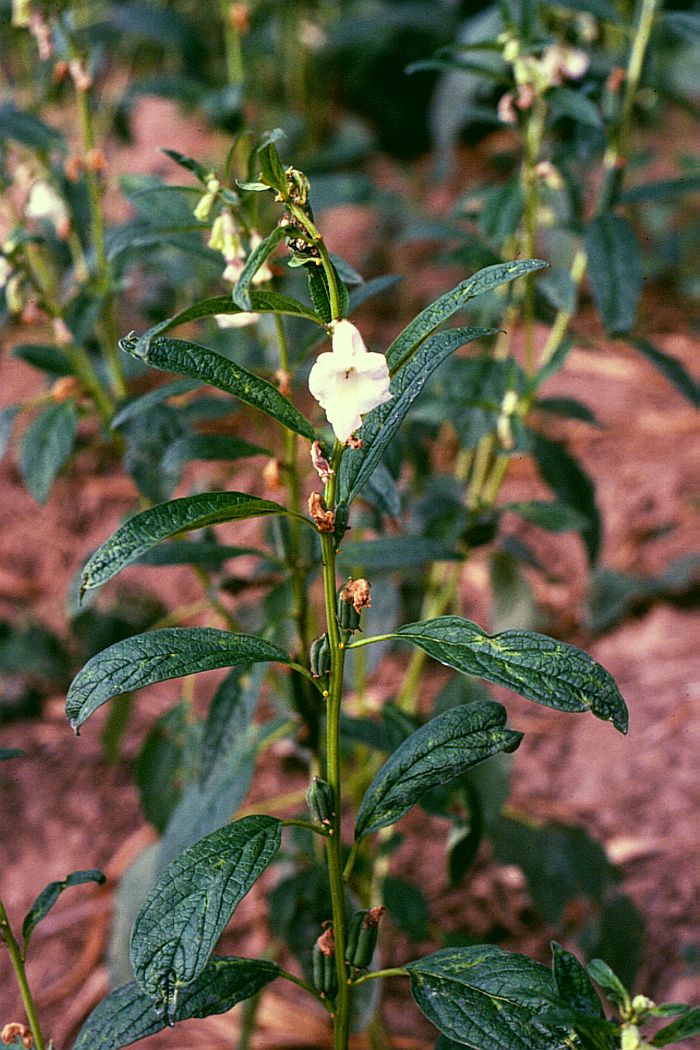
Sesamum is a genus of approximately 31 species of flowering herbs in the family Pedaliaceae, placed in the order Lamiales. The genus was established by Linnaeus in 1753 in his Species Plantarum. Plants in this genus are annual or perennial herbs bearing opposite or alternate leaves, tubular two-lipped flowers, and elongated capsule fruits containing numerous small, oil-rich seeds.
The great majority of species are native to sub-Saharan Africa, though a handful extend into the Indian subcontinent, Sri Lanka, and China. By far the most economically significant member is Sesamum indicum, commonly known as sesame, one of humanity's oldest oilseed crops. Sesame seeds yield a stable, flavourful oil used globally in cooking, and the seeds themselves are a staple ingredient in cuisines from East Asia to the Middle East and West Africa. The origin of S. indicum is uncertain because of its antiquity in cultivation and its widespread naturalization across tropical regions.
Other members of the genus — including Sesamum radiatum (black sesame leaf, cultivated as a vegetable in West Africa), Sesamum alatum (wild sesame), and Sesamum angolense — are largely wild African species of regional ecological and ethnobotanical importance but lack the global prominence of S. indicum.
Etymology
The genus name Sesamum derives from the Ancient Greek sēsamon (σήσαμον) and related Semitic words (cf. Arabic simsim, Akkadian šamaššammū), all referring to the sesame plant and its seeds. The name was adopted by Linnaeus directly from classical usage when he formally described the genus in 1753.
Distribution
Sesamum species are distributed primarily across sub-Saharan Africa, where the genus reaches its greatest diversity. A smaller number of species occur in South Asia — notably India and Sri Lanka — and in parts of China. Sesamum indicum is now pantropical through centuries of cultivation and naturalization, making its precise native range difficult to establish.
Cultivation
Sesamum indicum (sesame) is one of the world's most ancient oilseed crops, cultivated for its seeds and the highly stable, flavourful oil they yield. It grows best in well-drained soils under full sun in warm to tropical climates and tolerates drought once established. Seeds are typically sown directly after the last frost; the plant matures in 90–120 days. Harvesting is traditionally done by cutting stems when capsules begin to turn yellow, then drying them upright so seeds fall out when threshed. Sesamum radiatum is grown as a leafy vegetable in West Africa, with young leaves harvested regularly.
History
Sesame (Sesamum indicum) holds one of the longest records of any oilseed crop, with archaeological and textual evidence of cultivation in the Indian subcontinent and Mesopotamia dating back more than 3,000 years. It was a significant trade commodity in ancient Near Eastern civilizations and spread along early trade routes to East Asia, Africa, and eventually the Americas. Linnaeus formally described the genus Sesamum in 1753 in Species Plantarum, codifying a name that had been in use in European botanical literature since antiquity.

