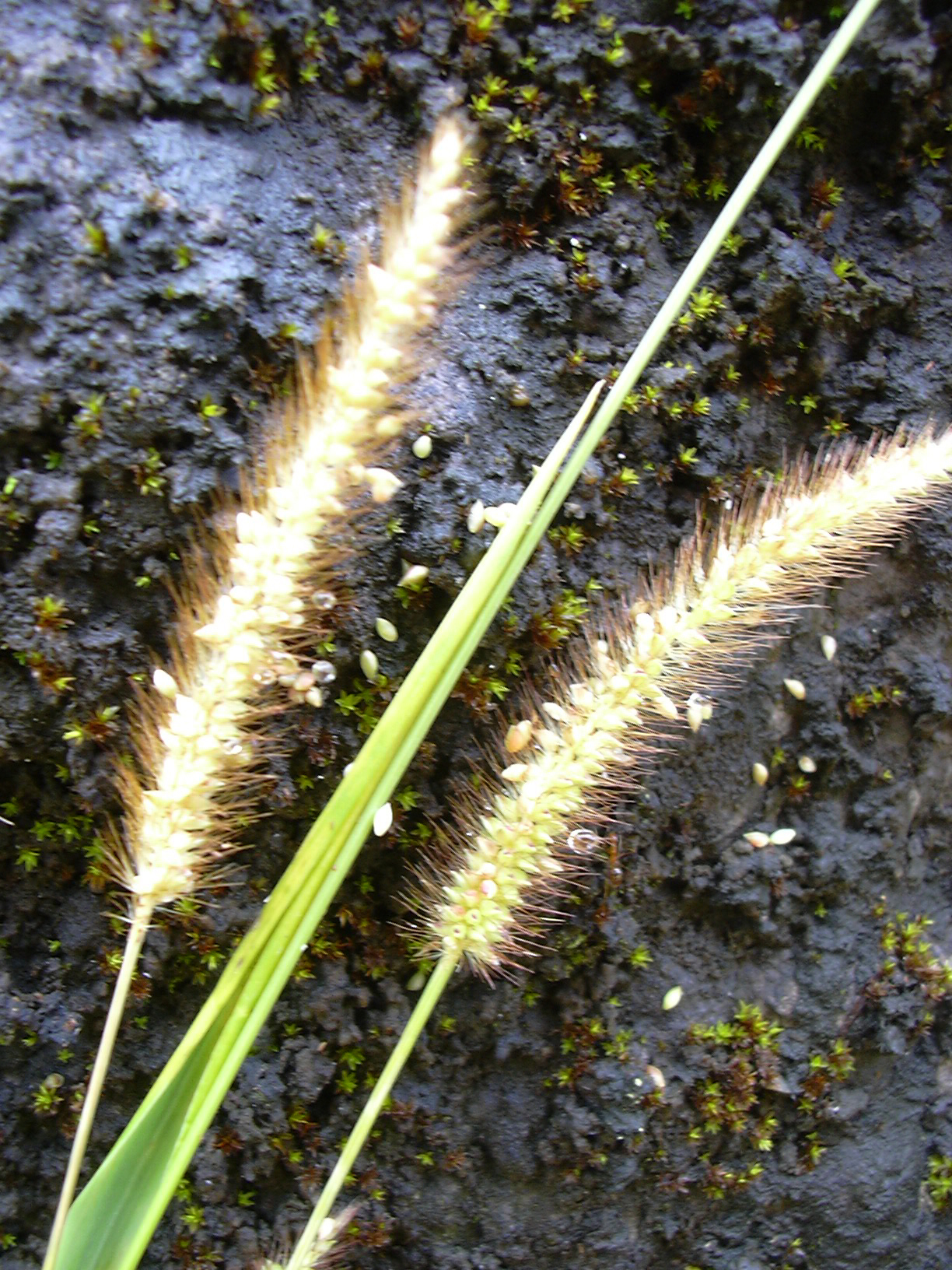
Setaria P.Beauv. (1812) is a genus of annual and perennial grasses in the family Poaceae, subfamily Panicoideae, tribe Paniceae. Commonly known as foxtail grasses or bristle grasses, the genus encompasses approximately 136 accepted species (Kew/POWO) and is distributed across tropical and temperate regions on every inhabited continent, making it effectively cosmopolitan in range.
The name Setaria derives from the Latin seta, meaning "bristle" or "hair," a direct reference to the genus's most distinctive feature: the dense, cylindrical panicle-like inflorescences armed with persistent bristles that surround each spikelet. The seed heads tend to droop when ripe, and the small seeds measure less than 6 mm in length. Plants are typically cespitose (clump-forming), either annual or perennial, and range in height from around 0.5 m for smaller crop relatives up to considerably taller for tropical species.
The genus is perhaps best known through two economically significant species. Setaria italica (foxtail millet) is one of the oldest cultivated cereals in East Asia, valued as a drought-tolerant grain crop and livestock fodder. Setaria viridis (green foxtail), its wild ancestor, has become an important genetic model organism for research into monocot biology and bioenergy grass genetics. Other members of the genus include S. pumila (used as a grain crop in India), S. palmifolia (palm grass, used as a vegetable in Papua New Guinea), and S. sphacelata (a widely planted tropical forage grass). Several species are also naturalized weeds in agricultural and disturbed habitats worldwide.
Etymology
The genus name Setaria is derived from the Latin word seta, meaning "bristle" or "hair." This name directly references the defining morphological characteristic of the group: the bristle-like structures (sterile branchlets) that surround and persist around each spikelet in the inflorescence, giving the seed heads their distinctive shaggy or brushy appearance. The name was formally applied by the French botanist Ambroise Marie François Joseph Palisot de Beauvois (P.Beauv.) in his 1812 work Essai d'une nouvelle Agrostographie (p. 51).
Distribution
Setaria has a cosmopolitan distribution, occurring natively across Africa, Asia, Europe, the Americas, Australia, and Pacific island regions. It is most diverse in warm tropical and subtropical zones but extends into temperate areas; it has also been introduced into northern Canada, Scandinavia, and New Zealand. In North America, multiple species are documented across the southwestern United States, including S. arizonica, S. faberi, S. grisebachii, and S. italica (the last as a cultigen and escape). The GBIF occurrence dataset records presence in more than 20 TDWG regions globally, with additional records indicating the genus extends across all inhabited continents.
Ecology
Setaria species are annual or perennial grasses that grow in cespitose (clump-forming) habits, rarely rhizomatous. They thrive across a wide range of disturbed and open habitats—roadsides, field margins, croplands, savannas, and grasslands—typically preferring warm climates and full sun. The dense, spike-like panicle with persistent bristles is the genus's defining ecological signature, aiding in dispersal through attachment to animal fur and clothing.
Several species, most notably S. viridis (green foxtail) and S. faberi (giant foxtail), are significant agricultural weeds in cereal-growing regions. Smaller-seeded species are eaten by granivorous birds, making foxtail grasses an important food source for wildlife in open landscapes. S. italica and S. viridis have been adopted as genetic model systems for research into C4 photosynthesis, drought tolerance, and bioenergy grass biology.
Cultivation
Setaria italica (foxtail millet) is cultivated as a grain crop on well-drained soils under full sun. It prefers temperatures of 16–26°C but tolerates a range of 5–35°C and is notably drought-resistant once established, making it valuable in semi-arid regions. Optimal soil pH is 6–6.8 and annual rainfall requirements are approximately 500–700 mm. Under rain-fed conditions, yields average 800–900 kg/ha, rising to up to 1,800 kg/ha with improved agronomic practices. The crop matures in 60–120 days from sowing. Several ornamental foxtail grass species are also grown in gardens for their attractive, bristly seed heads.
Cultural uses
Setaria italica (foxtail millet) is one of the earliest domesticated cereals, with archaeological evidence of cultivation in China dating back approximately 8,000 years. The grain is eaten cooked as a rice substitute or ground into flour for porridge, cakes, and puddings. Seeds can also be sprouted to increase sweetness. Most cultivars are non-glutinous and are therefore suitable for individuals with celiac disease. The nutritional profile per 100 g includes approximately 384 calories, 10.7 g protein, 3.3 g fat, and 84.2 g carbohydrates, with meaningful amounts of phosphorus (275 mg) and iron (6.2 mg).
Beyond direct human food use, straw from foxtail millet is used for thatching and animal bedding, particularly in India. Bran yields up to 9% oil by weight. S. sphacelata (African bristle grass) is widely planted as a pasture and fodder grass in tropical regions. In Papua New Guinea, the young shoots of S. palmifolia (palm grass) are consumed as a vegetable known as highland pitpit. Traditionally, yellow-seeded germinated varieties have been used medicinally as digestive aids and to treat dyspepsia, while white seeds have been used to address cholera and fever symptoms.
Taxonomy notes
Setaria P.Beauv. (1812) is a conserved name (nom. cons.) under the International Code of Nomenclature. It is placed in Poaceae, subfamily Panicoideae, tribe Paniceae. The type species is Setaria viridis. POWO recognizes 136 accepted species; GBIF records 257 descendant taxa (including infraspecific ranks and synonyms).
Six heterotypic synonymous genera have been subsumed into Setaria: Acrochaete Peter (1930), Camusiella Bosser (1966), Chaetochloa Scribn. (1897), Cymbosetaria Schweick. (1936), Paspalidium Stapf (1920), and Tansaniochloa Rauschert (1982). The genus has homonyms in other kingdoms (fungi, nematodes) but the grass genus with GBIF key 2702955 is the accepted plant taxon.
Propagation
Setaria species are propagated primarily from seed. Seeds germinate readily under warm soil conditions and good moisture. For foxtail millet (S. italica), direct sowing after the last frost is standard practice, with maturity reached in 60–120 days. Perennial species can also regenerate vegetatively from cespitose crowns, though seed propagation is the norm across the genus.










