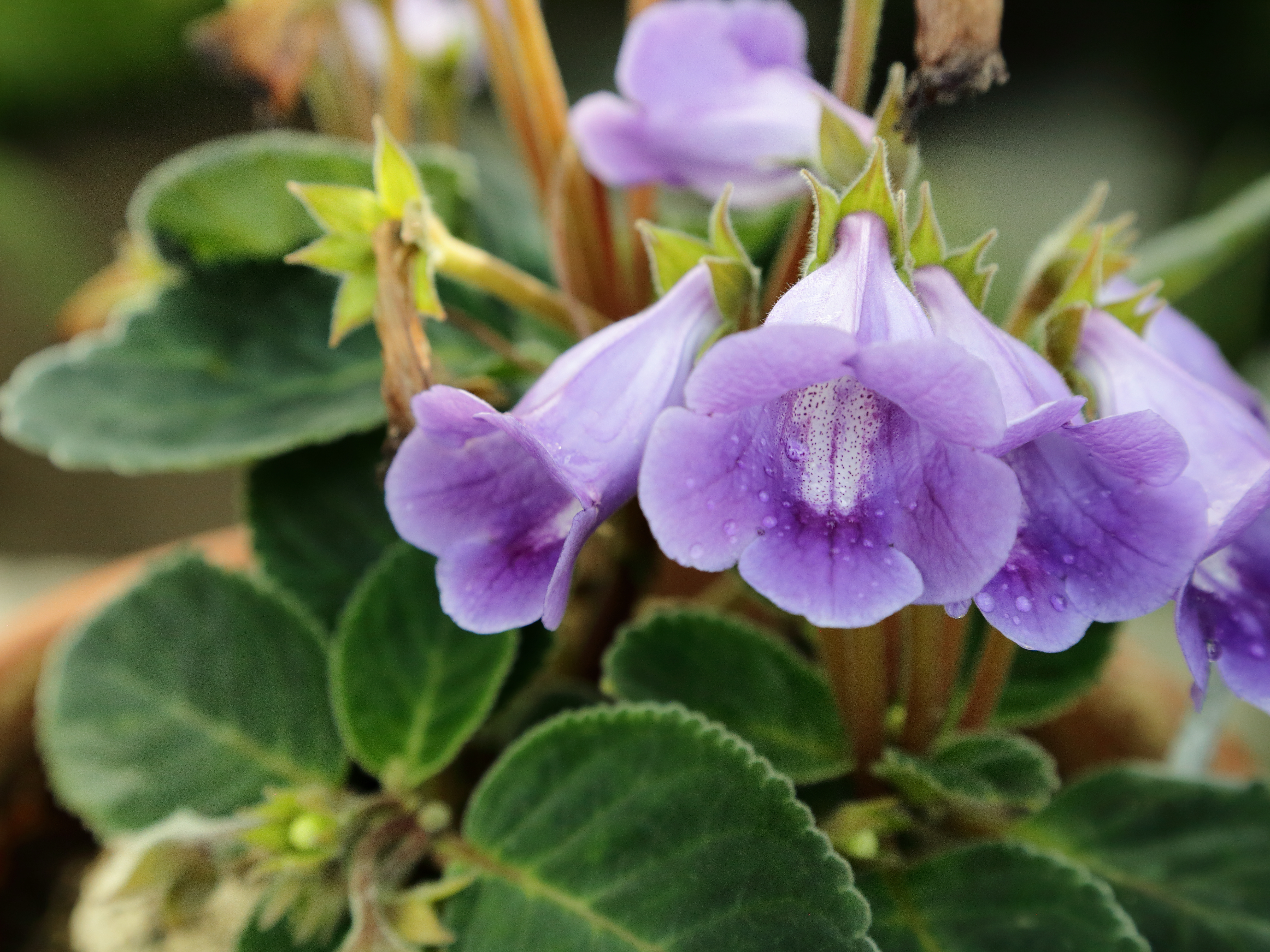
Sinningia is a genus of around 65 to 81 accepted species of tuberous herbaceous perennials in the family Gesneriaceae (order Lamiales), native entirely to Central and South America. The genus shows its greatest diversity in southern Brazil, where many species grow on rocky outcrops and cliff faces.
The flowers are typically large and vividly coloured, adapted to a range of pollinators: most species are visited by hummingbirds or bees, while Sinningia brasiliensis is bat-pollinated and Sinningia tubiflora — bearing large, powerfully fragrant tubular white flowers — is pollinated by sphinx moths. This floral diversity has made the genus popular with specialist horticulturalists, and numerous species, hybrids, and cultivars are grown as houseplants.
The most familiar member is Sinningia speciosa, long cultivated and still widely sold under the horticultural name "gloxinia." The plant was introduced to cultivation as Gloxinia speciosa, and the common name persists in the trade even though Sinningia and Gloxinia are now recognised as distinct genera: true Gloxinias bear scaly rhizomes rather than tubers.
Several species are prized for exceptionally large tubers and are grown as caudiciforms by succulent enthusiasts. Sinningia leucotricha, sometimes listed under its older name Rechsteineria leucotricha and nicknamed "Brazilian edelweiss," bears a dense covering of silvery silky hairs; other large-tubered species include S. iarae, S. lineata, and S. macropoda.
Taxonomically, the genus has expanded considerably through synonymisation: the genera Corytholoma, Rechsteineria, and Lietzia, among others, have been absorbed into Sinningia. The closely related Brazilian genera Paliavana and Vanhouttea — shrubby and lacking tubers — are now understood by morphological and molecular analyses to represent nontuberous Sinningia lineages, and all three genera are placed together in tribe Sinningieae, distinct from the former tribe Gloxinieae of Hans Wiehler's classification.
Etymology
The genus name Sinningia honours Wilhelm Sinning (1792–1874), a gardener at the Botanische Gärten der Friedrich-Wilhelms-Universität Bonn in Germany.
Distribution
All species of Sinningia are native to Central and South America. The genus reaches its greatest species richness in southern Brazil, where many members occupy rocky outcrops, cliff ledges, and montane habitats.
Cultivation
Sinningias thrive in warm, humid conditions with well-drained soil rich in organic matter — typically a mix of leaf mold or peat moss with coarse sand or perlite to ensure good porosity. They need bright indirect light, protected from direct strong sun. The cultivars 'Empress Purple Spotted' and 'Empress Red' hold the Royal Horticultural Society's Award of Garden Merit. Species with large tubers (such as S. leucotricha, S. iarae, and S. macropoda) are also cultivated by cactus and succulent enthusiasts as caudiciforms.
Taxonomy Notes
The genus has been substantially broadened through synonymisation of related genera including Corytholoma, Rechsteineria, and Lietzia. Paliavana and Vanhouttea, two Brazilian genera of shrubby non-tuberous plants, are considered by recent morphological and molecular analyses to represent nontuberous Sinningia lineages. All three genera are now placed in tribe Sinningieae, superseding their former placement in tribe Gloxinieae under Hans Wiehler's classification system.










