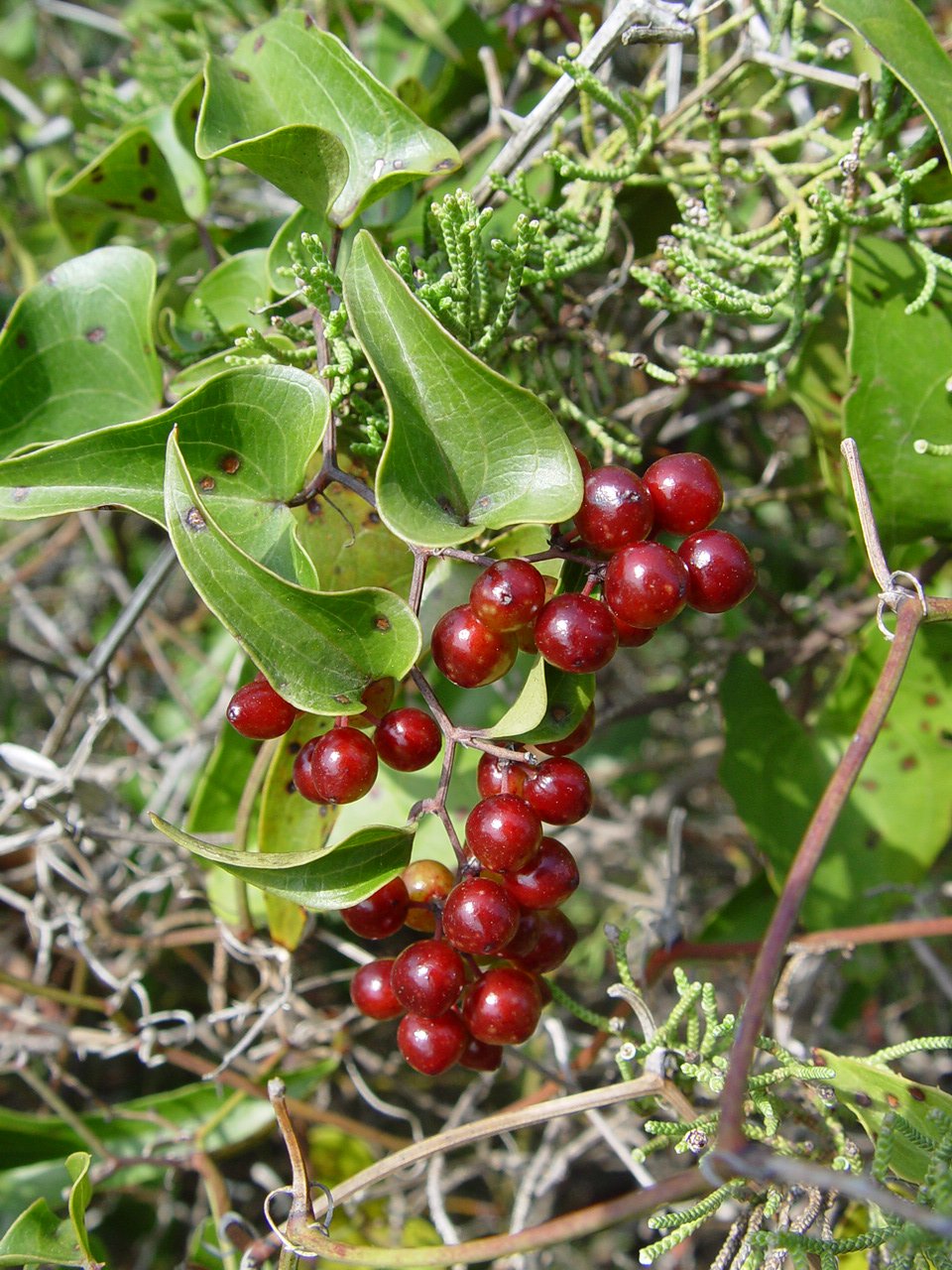
Smilax is a large genus of roughly 300–350 species of climbing and scrambling flowering plants in the family Smilacaceae, described by Linnaeus in 1753. Commonly known as greenbriers, catbriers, or sarsaparilla, these plants occur on every inhabited continent, with their greatest diversity in tropical and subtropical regions. The genus spans both deciduous and evergreen growth forms, typically producing woody or semi-woody stems armed with hooked thorns that the plants use to clamber through surrounding vegetation, reaching heights of up to 10 metres.
Leaves are simple, alternate, and broadly heart-shaped to ovate, ranging from 4 to 30 cm long, often with a pair of tendrils at the base of the petiole. Flowers are small, white-green, and arranged in clustered umbels, appearing in late spring to early summer. The fruits are spherical berries, 5–10 mm in diameter, ripening to bright red or blue-black in autumn. Berries are consumed by birds and small mammals, which serve as primary seed dispersers across the genus's wide range.
Smilax is unusual among climbing plants in its reliance on rhizomes for vegetative spread and regeneration. Many colonies consist of single-sex clones, which means fruit production may be absent in patches where only one sex is present. The plants tolerate fire and repeated cutting, regenerating vigorously from underground rhizomes — a trait that makes them persistent in disturbed habitats. Seeds require a period of cold exposure before they will germinate readily.
The genus is best known outside botany for the roots of certain species, particularly the so-called sarsaparilla species, which have been used for centuries to flavour beverages and in traditional medicine across Latin America, Asia, and Europe.
Etymology
The name Smilax derives from Greek mythology. According to the myth, Crocus, a mortal youth, and Smilax, a woodland nymph, fell into a tragic and unfulfilled love. Their story ends in transformation: Crocus is turned into a flower, while Smilax is transformed into a brambly, clinging vine — an image that corresponds well to the thorny, scrambling character of the plant. The mythological name was formalised by Linnaeus when he published the genus in Species Plantarum in 1753.
Distribution
Smilax has a pantropical distribution that extends into adjacent warm-temperate zones. China is the centre of species richness, supporting approximately 80 species (of which 39 are endemic). North America north of Mexico hosts around 20 species, while Central America and the Caribbean together account for 29 recognised species. The genus also occurs across Africa, South and Southeast Asia, Australia, and — through S. aspera — the Mediterranean basin and Macaronesia. Vernacular names documented from the United States, United Kingdom, and France reflect its presence across both hemispheres.
Ecology
Smilax plants are typically found in moist woodlands, forest edges, thickets, and scrublands, favouring soils with a pH of around 5–6. They are dioecious — individual plants are either male or female — and spread clonally via rhizomes, often forming single-sex colonies. Where both sexes are absent from a patch, fruit production does not occur.
The fleshy berries are eaten by birds and small mammals, which are the principal seed dispersers. Seeds require cold stratification before germinating effectively. The plants have strong regenerative capacity: above-ground growth is readily replaced from rhizomes after cutting, grazing, or fire, which makes Smilax persistent in frequently disturbed habitats.
Several Lepidoptera species are associated with Smilax, including the small grass yellow butterfly (Eurema smilax) and Thyrocopa moths, as well as Nymphalidae caterpillars such as the blue admiral and common leopard butterfly. Certain species — including S. aristolochiifolia, S. bona-nox, S. tamnoides, and S. officinalis — are recorded as significant nectar sources for pollinators and have value for honey production.
Cultivation
Most Smilax species are not widely cultivated ornamentally, though some are grown for screening and wildlife habitat in warm climates. The genus tolerates a range of soil textures from light sandy to heavy clay, provided drainage is adequate. Plants prefer moist, mildly acid to neutral soils and can grow in semi-shade or full sun. Hardiness varies considerably across the genus: tropical sarsaparilla species are suited only to USDA zones 10–12, while North American natives such as S. rotundifolia tolerate much colder climates. The vigorous rhizomatous growth that makes Smilax ecologically resilient also makes it difficult to eradicate once established in a garden setting.
Propagation
Propagation details are poorly documented in generalist horticultural sources. From ecological data, it is known that Smilax spreads readily from rhizomes — division of rhizome sections is therefore the most straightforward vegetative method. Seed propagation requires cold stratification to break dormancy; seeds germinate most reliably after freeze exposure, reflecting the natural requirement for overwintering before spring germination.
Cultural Uses
Smilax has a long and geographically broad record of human use. The most commercially significant application has been the extraction of compounds from the roots of "sarsaparilla" species, particularly Jamaican sarsaparilla (S. ornata), to flavour soft drinks, root beers, ice cream, confectionery, and bakery products. The root has a bitter, liquorice-like quality. In pharmacy, powdered Jamaican sarsaparilla root was known as "Rad. Sarzae. Jam." and used as a traditional gout treatment in Latin America.
In China, S. glabra (土茯苓, tǔfúlíng) has been used in traditional medicine and gives its distinctive gel-setting properties to guīlínggāo, a popular herbal jelly dessert. A Beijing street snack known as fúlíng jiābǐng (茯苓夹饼) also incorporates the plant. By 1569 the Persian physician Imad al-Din Mahmud ibn Mas'ud Shirazi had provided a detailed evaluation of the medicinal properties of chinaroot in a treatise on syphilis, reflecting how widely these roots circulated in early modern trade. In 18th-century England, "china-ale" was brewed by infusing china-root with coriander seeds in ale.
Young shoots of various Smilax species are edible raw or cooked, with a flavour likened to asparagus. The berries are also consumed by people in some regions. Active phytochemical compounds in the genus include diosgenin (a steroidal sapogenin found in S. menispermoidea), parillin, sarsapic acid, sarsapogenin, and sarsaponin — the last of which underpins the traditional and modern use of the roots for inflammatory and skin conditions including psoriasis.
Taxonomy
Smilax L. was published by Carl Linnaeus in Species Plantarum (1028, 1753) and is the type genus of the family Smilacaceae within the order Liliales, class Liliopsida. GBIF records 449 descendant taxa under the accepted name. Molecular phylogenetic work has reorganised the genus into four biogeographic clades (A–D) rather than the morphological sections used historically. Clade B is predominantly New World; clades C and D are Old World; and S. aspera occupies a distinctive position as sister to all remaining species with a tri-continental (Europe, Africa, Asia) distribution. The confusion with the superficially similar Asparagus asparagoides — sometimes sold as "smilax" in the florist trade — is well established; the two genera are not closely related.










