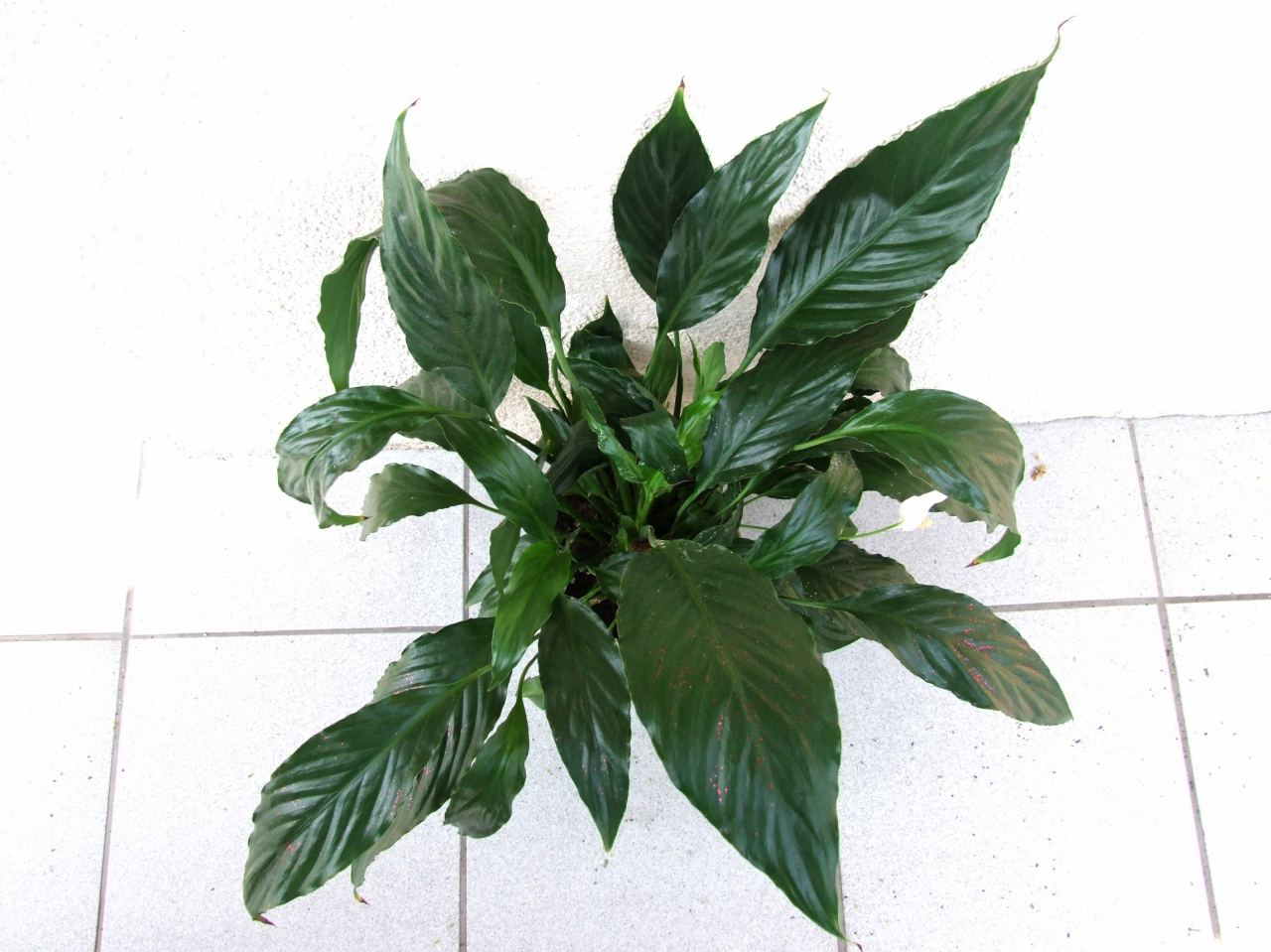
Spathiphyllum Schott (1832), commonly known as peace lily, spathe flower, or white sails, is a genus of approximately 59–60 perennial herbaceous plants in the family Araceae (subfamily Monsteroideae, tribe Spathiphylleae). The genus was formally described by the Austrian botanist Heinrich Wilhelm Schott in 1832 in Schott & Endlicher's Meletemata Botanica.
Plants in the genus form basal rosettes of simple, dark green, glossy leaves that are ovate-lanceolate to elliptic-oblong, ranging from 4 to 25 inches (10–64 cm) long and 1 to 10 inches (2.5–25 cm) wide. The distinctive flowering structure consists of a white spathe — a large, modified leaf-like bract — surrounding a spadix bearing small, densely packed flowers. The spathe typically measures 4–12 inches (10–30 cm) and turns pale green after about 10 days, remaining ornamental for a month or more. Mature plants typically reach 3 feet (90 cm) in height and width indoors, though some cultivars such as 'Sensation' may exceed 5 feet (1.5 m), while dwarf cultivars remain under 12 inches.
Spathiphyllum is native to the tropical humid forests of Mexico, Central America, and northern South America, with additional Pacific species occurring on Cocos Island and in the Philippines and Indonesia. Plants naturally colonize forest floors in shaded, moist to wet environments, often growing along rivers and in periodically flooded zones.
The genus is widely cultivated worldwide as a houseplant and for interiorscape use, prized for its tolerance of low light and its attractive, long-lasting flowers. Well-known cultivated species include S. wallisii, S. cochlearispathum, S. floribundum, and S. cannifolium. All parts of the plant contain calcium oxalate crystals and are considered mildly toxic to humans, cats, dogs, and horses — causing oral pain, burning, excessive drooling, and vomiting if ingested — though, unlike true lilies, Spathiphyllum does not cause kidney failure.
Etymology
The name Spathiphyllum derives from the Greek words spathe (σπάθη, meaning a blade or spathe) and phyllon (φύλλον, meaning leaf), together translating literally as "leaf spathe." The name refers to the characteristic large, leaf-like spathe that subtends and encloses the inflorescence — a defining morphological feature of the genus. The genus was established and named by Heinrich Wilhelm Schott in 1832.
Distribution
Spathiphyllum is native to the Neotropics and parts of Malesia. The core of its natural range spans Mexico, Central America, and northern South America. At least two species extend into the Pacific, occurring on Cocos Island (an oceanic island off Costa Rica) and in the Philippines and Indonesia. The genus is now cultivated throughout the world and is among the most widely grown tropical houseplants globally.
Ecology
In their natural habitat, Spathiphyllum species inhabit the floors of tropical humid forests, favouring shaded, moist to wet conditions. Plants are frequently found along rivers and streams, where they often form colonies in periodically flooded zones. Their preference for deep shade and consistently moist soils reflects these riparian and understorey origins. Under cultivation they retain this tolerance for low light and moist growing media, making them exceptionally well-suited to indoor environments with limited natural light.
Cultivation
Peace lilies are among the most adaptable and widely grown indoor plants. They perform best in partial to deep shade and should not be exposed to direct sunlight, which causes brown leaf tips and scorching. Optimum temperatures range from 68–85°F (20–29°C); temperatures below 40°F (4°C) can cause damage. Growth is most vigorous between 70–90°F (21–32°C).
Watering should keep the soil moist but not waterlogged; allowing the surface to dry slightly between waterings reduces the risk of root rot. A growing medium high in organic matter with good drainage is recommended — a mix of peat, pine bark, vermiculite, and coir is suitable. Plants prefer being somewhat pot-bound and should only be repotted when visibly rootbound.
Fertilise at one-quarter of the recommended strength to avoid salt buildup; flush the soil periodically between applications. Mealybugs are the most common pest indoors, with purple mite also reported. Low humidity or underwatering commonly causes brown leaf tips. Regular leaf cleaning helps maintain plant vigour.
Popular cultivars include 'Mauna Loa' (large, with 3-foot leaves), 'Sensation' (over 5 feet tall), 'Petite' (compact dwarf), and several S. wallisii selections: 'Domino' (variegated), 'Gemini' (12 inches, white-striped), and 'Variegata' (prominent white stripes).
Propagation
The primary propagation method for Spathiphyllum is division. Established clumps are separated at the rhizome to produce new plants, typically carried out when repotting. Each division should have at least a few leaves and a portion of the root system to establish successfully.
Conservation
No species in the genus Spathiphyllum is listed in the Global Invasive Species Database (IUCN GISD), and the genus does not appear on major invasive species watchlists. No specific IUCN Red List conservation assessments were identified for the genus as a whole. All parts of the plant contain calcium oxalate crystals and are classified as mildly toxic (severity: medium) to humans, cats, dogs, children, and horses, causing oral burning, excessive drooling, vomiting, and difficulty swallowing if ingested.
Taxonomy
The genus Spathiphyllum was established by the Austrian botanist Heinrich Wilhelm Schott, published in Schott & Endlicher, Meletemata Botanica: 22 (1832). It is placed in the family Araceae, subfamily Monsteroideae, tribe Spathiphylleae, within the order Alismatales (class Liliopsida, phylum Tracheophyta). GBIF records 82 descendants (including varieties and uncertain names) under the genus; Wikipedia and NCSU cite approximately 59–60 accepted species. The genus is accepted and not synonymised under any other name.










