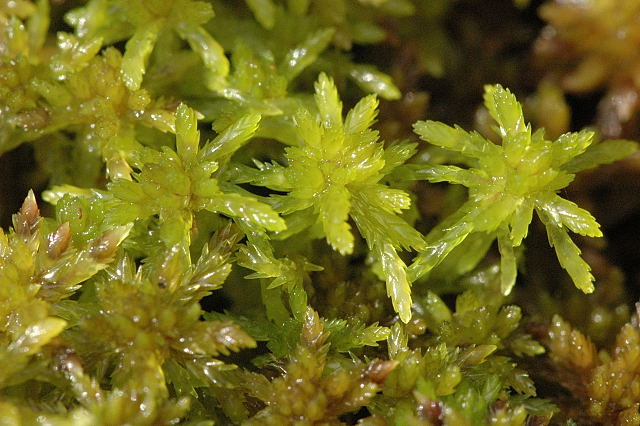
Sphagnum, commonly known as bog moss or peat moss, is a large genus of approximately 380 accepted species of mosses in the class Sphagnopsida, family Sphagnaceae. Formally described by Carl Linnaeus, the genus is the sole member of the order Sphagnales and stands apart from almost all other land plants in its extraordinary ecological influence.
The genus is distributed mainly across the Northern Hemisphere, forming vast carpets in peat bogs, conifer forests, and moist tundra from temperate regions to the High Arctic (reaching Svalbard at 81°N). Disjunct populations occur in the Southern Hemisphere in Chile, Argentina, New Zealand, and Tasmania.
What makes Sphagnum exceptional among plants is the structure of its leaves: each leaf consists of a network of large, dead hyaline cells interspersed with narrow living chlorophyll-bearing cells. The hyaline cells act as water reservoirs, allowing a clump of Sphagnum to hold 16 to 26 times its dry weight in water. This property drives the genus's role as a powerful ecosystem engineer. By releasing hydrogen ions and acidifying surrounding water, Sphagnum suppresses competing vascular plants and creates the waterlogged, oxygen-depleted conditions in which its own dead tissue accumulates as peat. Peat deposits many meters deep — representing thousands of years of carbon storage — are largely the product of Sphagnum growth.
GBIF records 428 descendant taxa under the genus. The exact species count is contested: taxonomists recognize varying numbers depending on how broadly or narrowly they define species boundaries, a controversy explicitly noted in authoritative floristic treatments including Flora of North America.
Etymology
The genus name Sphagnum is a Latin term formally established by Carl Linnaeus. The Latin word itself is thought to derive from Greek sphagnos, a name used by ancient writers for a fragrant moss or plant. Linnaeus applied it consistently to this distinctive group of bog mosses when he formally described the genus, and it has remained the accepted name ever since.
Distribution
Sphagnum is predominantly a Northern Hemisphere genus, growing in peat bogs, conifer forests, and moist tundra. Its range extends from temperate zones northward to the High Arctic, with populations documented as far north as Svalbard at 81°N latitude. In the Southern Hemisphere, Sphagnum occurs in southern South America (Chile and Argentina), New Zealand, and Tasmania — regions sharing cool, wet climates. Within its range it favours wet and boggy ground on peaty, lime-free, acid soils, often near heather on upland mountains and moorlands.
Ecology
Sphagnum species function as ecosystem engineers, actively shaping the environments in which they grow rather than merely responding to them. Their leaf anatomy — large dead hyaline cells embedded among narrow chlorophyllous cells — gives individual plants the capacity to hold 16 to 26 times their dry weight in water, creating and sustaining waterlogged conditions even in upland settings. At the same time, Sphagnum continuously releases hydrogen ions, strongly acidifying surrounding water. This acidity, combined with the near-anaerobic, waterlogged conditions the plants create, inhibits microbial decomposition of dead plant material. The result is the slow accumulation of peat: dead Sphagnum tissue that can build to depths of many meters over millennia, locking away vast quantities of atmospheric carbon. Raised and blanket bogs — among the world's most carbon-dense terrestrial ecosystems — are largely the product of Sphagnum growth over thousands of years.
Within these habitats Sphagnum gradually colonises open water bodies such as ponds and lakes, filling them in over centuries. The strongly acidic, nutrient-poor conditions it creates exclude many vascular plant competitors while supporting a characteristic community of bog-adapted species.
Cultivation
Sphagnum is fully hardy to UK hardiness zone 2 and tolerates both full sun and semi-shade. It can grow in light, medium, or heavy soils provided they remain consistently moist, and tolerates mildly acid to neutral pH. The critical requirement is clean, acid water free of lime; Sphagnum does not tolerate manure or nutrient-enriched conditions that would favour competing vegetation. In horticulture it is cultivated primarily as a potting medium for orchids, a soil conditioner in compost mixes, and a moisture-retaining mulch. It is not frost-tender.
Propagation
Sphagnum is straightforwardly propagated by division. The whole plant can be chopped into small pieces and each fragment will grow into a new plant, making vegetative propagation simple and reliable. In natural populations, fragmentation and dispersal by water, wind, and animals serves the same function. Spores are also produced; they mature from August to September.
Cultural Uses
Sphagnum has been used by humans across many cultures and over centuries. In medicine its antiseptic properties — attributed to phenolic compounds and its strongly acidic, oxygen-excluding character — were exploited as wound dressings centuries before germ theory; during World War I, dried Sphagnum pads reportedly saved soldiers' lives when conventional surgical dressings ran short. Tar derived from decaying moss has historically been applied topically to treat eczema, psoriasis, and other skin conditions.
In horticulture, dried Sphagnum is valued as a potting medium for orchids and as a soil conditioner in composts, leveraging its capacity to absorb up to 16 times its own weight in water. This same absorbency led to its use in sanitary products and diapers. As a packing material it cushions and maintains moisture around fragile plant roots during transport.
Outside mainstream horticulture, Sphagnum has been used in swimming pool sanitation as an alternative to conventional chemicals, and in septic system treatment. Historical records note use of Sphagnum bread during Finnish famines.
Conservation
Sphagnum bogs are under significant pressure worldwide. Over 90% of English bogs have been historically damaged or destroyed, largely through drainage for agriculture, forestry, and peat extraction. Commercial peat harvesting for horticultural use has been a major driver, with large-scale extraction occurring in Chile, Canada, and New Zealand. In Chile, regulatory restrictions were introduced between 2018 and 2024, culminating in a complete peat extraction ban enacted in April 2024. The UK has been moving toward a phase-out of horticultural peat use.
Because peatlands store enormous quantities of carbon and require centuries to millennia to form, damaged bogs release their stored carbon as CO₂ and methane when drained or extracted. Restoration is slow and technically challenging. The conservation importance of Sphagnum-dominated habitats is therefore recognised well beyond the genus itself, as the mosses are the foundational architects of these globally significant carbon sinks.
Taxonomy Notes
Sphagnum L. is the sole genus in the order Sphagnales and family Sphagnaceae, within the class Sphagnopsida. Linnaeus formally established the genus. GBIF records 428 descendant taxa; Wikipedia estimates approximately 380 accepted species. The discrepancy reflects ongoing taxonomic revision and the acknowledged controversy surrounding species delimitation in the genus: different specialists recognise different numbers of species depending on how they weight morphological and molecular characters. This is explicitly flagged in the Flora of North America treatment by McQueen and Andrus.
Structurally, Sphagnum plants have upright stems with young branches spirally arranged at the growing apex into a capitulum. Branches are typically dimorphic, consisting of spreading and pendent forms in fascicles. The distinctive leaf anatomy — alternating hyaline (dead, water-storing) and chlorophyllous (living) cells — is diagnostic for the genus and shared by all species.










