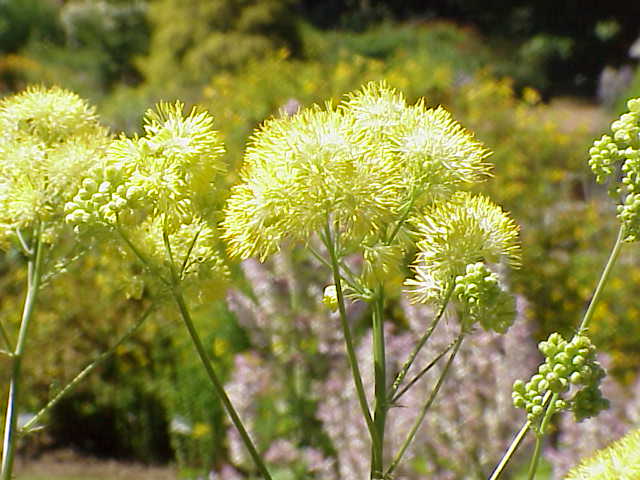
Thalictrum, commonly known as meadow-rue, is a genus of 120–200 herbaceous perennial flowering plants in the buttercup family (Ranunculaceae). The plants are recognised by their alternate, bipinnately compound leaves that are typically glaucous blue-green in colour, giving them a delicate, lacy appearance that provides ornamental value even when the plants are not in bloom.
The flowers are among the most distinctive features of the genus: they are apetalous, meaning they lack true petals entirely. Instead, the floral display is provided by clusters of numerous long, often brightly coloured stamens in shades of white, yellow, pink, or pale purple. In most species the small sepals drop quickly after the flower opens, leaving the airy stamen clusters exposed. A few species, however, retain large petal-like, colourful sepals that add additional colour to the bloom.
The genus has a sub-cosmopolitan range across most of the Northern Hemisphere, extending southward into southern Africa and tropical South America, but is absent from Australasia. Twenty-two species are recorded in North America; the European flora hosts representatives in alpine, lowland, and submediterranean zones; and several species are native to East Asian woodlands in Japan and Korea.
Pollination biology varies across the genus. Some species are wind-pollinated (anemophilous), while others — such as T. sparsiflorum — are insect-pollinated (entomophilous). The foliage also serves as a larval food source for certain Lepidoptera, including the Setaceous Hebrew Character moth (Xestia c-nigrum).
In gardens, meadow-rues are prized for their clouds of airy flowers and elegant foliage. Multiple cultivars have earned the Royal Horticultural Society's Award of Garden Merit, among them 'Black Stockings', 'Elin', 'Splendide White', and 'Tukker Princess'. The plants are adaptable to a range of soil types — sandy, loamy, or clay — and tolerate pH from neutral to slightly alkaline. They perform well in sun or semi-shade and are rarely browsed by deer, making them a low-maintenance choice for temperate perennial borders.
Taxonomically, Thalictrum is considered a difficult genus with poorly understood species boundaries, and the accepted species count varies by authority — GBIF records 429 taxa including synonyms across its datasets, while circumscribed treatments cite 120–200 accepted species. The genus name was formally published by Linnaeus in Species Plantarum (p. 545, 1753) and the name holds conserved status (nom. cons.) under the International Code of Nomenclature.
Taxonomy
Thalictrum L. was formally described by Linnaeus and published in Species Plantarum (p. 545) in 1753. The genus name holds conserved status (nom. cons.) under the International Code of Nomenclature for algae, fungi, and plants, reflecting its long-established use in botanical literature. It is placed in the order Ranunculales, family Ranunculaceae, class Magnoliopsida, within the vascular plant phylum Tracheophyta.
The genus is widely acknowledged to be taxonomically difficult, with poorly understood species boundaries and a need for further taxonomic revision and field research. Accepted species counts vary considerably by authority: circumscribed treatments cite 120–200 species, while the GBIF backbone records 429 entries including synonyms and infraspecific taxa. In Switzerland, Info Flora recognises ten taxa including several subspecies of T. minus and T. simplex; Go Botany records six species for New England.
Distribution
Thalictrum has a sub-cosmopolitan distribution centred on temperate regions of the Northern Hemisphere, with extensions southward into southern Africa and tropical South America. The genus is absent from Australasia. Twenty-two species are recorded for North America; in New England specifically, six species are documented: T. dasycarpum, T. dioicum, T. pubescens, T. revolutum, T. thalictroides, and T. venulosum.
In Europe, the genus is represented across alpine, lowland, and continental zones. Switzerland's Info Flora checklist records ten taxa, including T. alpinum (alpine meadow-rue), T. aquilegiifolium, T. flavum, T. foetidum, T. lucidum, T. minus (with three subspecies), and T. simplex (with two subspecies). In East Asia, species such as those native to Japan and Korea grow in woods in hills and mountains.
Ecology
Pollination strategy varies across the genus. Some species are anemophilous (wind-pollinated), relying on air currents to transfer pollen, while others — notably T. sparsiflorum — are entomophilous, attracting insects as pollinators. This variation reflects adaptation to diverse habitats from open meadows and streamsides to woodland margins.
Thalictrum foliage serves as a larval food plant for certain Lepidoptera, including the Setaceous Hebrew Character moth (Xestia c-nigrum). The plants grow in moist, well-drained soils and are tolerant of both sun and semi-shade, occurring in habitats ranging from alpine meadows to lowland floodplains and montane woodlands.
Cultivation
Meadow-rues are adaptable garden perennials that succeed in most reasonably fertile soils, including light sandy, medium loamy, and heavy clay types, provided drainage is adequate. They prefer moist conditions and perform well in both full sun and semi-shade, making them suitable for borders, woodland edges, and streamside plantings. Soil pH from neutral to slightly alkaline is preferred.
Several cultivars have been awarded the Royal Horticultural Society's Award of Garden Merit, among them 'Black Stockings', 'Elin', 'Splendide White', and 'Tukker Princess'. The plants are rarely browsed by deer and may inhibit the growth of nearby leguminous plants, a consideration when planning mixed plantings.
Propagation
Thalictrum can be propagated by seed or by division. Seeds should be sown in autumn directly into cold frames, or in spring into outdoor seedbeds. Division is carried out in spring or autumn; smaller divisions benefit from being potted and grown on in a greenhouse before being planted out into their final positions.
Cultural Uses
Young leaves of some Thalictrum species have been recorded as edible when cooked. However, the genus belongs to Ranunculaceae, a family that includes many toxic species, and caution is advised despite no specific toxicity records for the genus. The edibility value is considered low (1 out of 5 by PFAF's rating system), and the genus is not considered a significant food or medicinal plant in mainstream horticultural literature.










