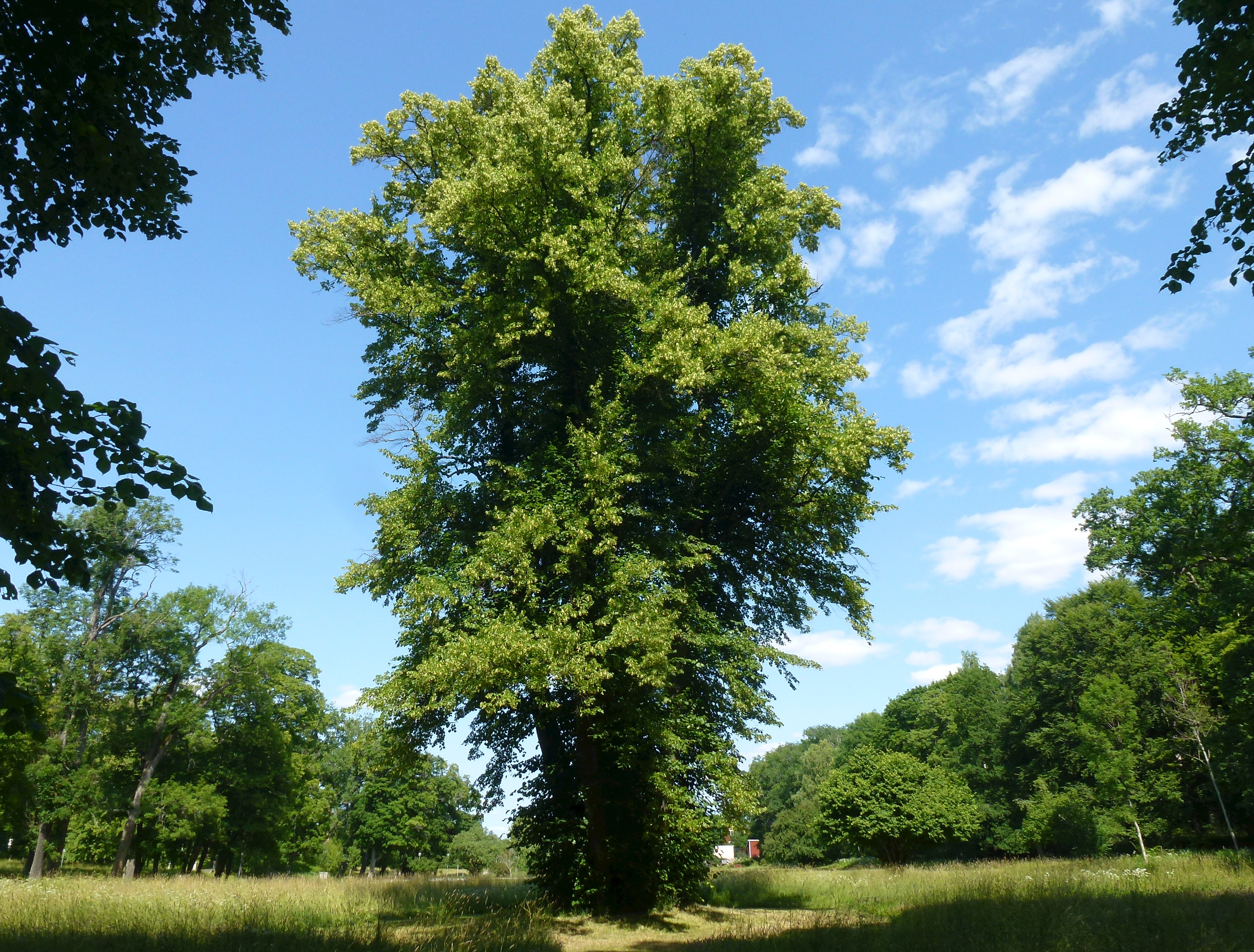
Tilia, commonly known as linden, lime, or basswood, is a genus of deciduous trees in the family Malvaceae (subfamily Tilioideae). The genus was formally described by Carl Linnaeus in 1753 in his Species Plantarum. Around 30 to 50 accepted species are recognized (authorities differ), distributed across temperate regions of the Northern Hemisphere, with the greatest diversity concentrated in Asia and significant representation across Europe and eastern North America.
Trees typically grow 20 to 40 metres tall and are recognized by their heart-shaped, asymmetrical leaves 4 to 20 centimetres across, and by the distinctive arrangement of small, fragrant flowers — each cluster borne on a peduncle fused for part of its length to an elongated, strap-like bract. Flowers are 10 to 15 mm across, yellow to greenish-yellow, and hermaphroditic. The wood is soft, white, and fine-grained, with minimal figuring.
Tilia is the only ectomycorrhizal genus in Malvaceae, forming associations predominantly with Ascomycota fungi. The sweetly scented flowers are a magnet for bees and other pollinators; the nectar contains tiliaside, a compound active against Crithidia bombi, a gut parasite of bumblebees. Aphids frequently colonize the foliage, drawing ants that farm them for honeydew.
Lindens have been economically and culturally significant across their range for millennia. The fibrous inner bark (bast) has been used for cordage and textiles, the pale, even-grained timber is prized for carving and instrument-making, and the flowers yield a pale, richly flavoured monofloral honey. Flower infusions have a long history in European herbal medicine. Some individual trees are of extraordinary age — a coppiced stool of Tilia cordata at Westonbirt Arboretum in England is estimated at around 2,000 years old.
Etymology
The genus name Tilia is Latin in form and traces ultimately to the Greek ptelea and Proto-Indo-European \ptel-ei̯ā, meaning "broad" — a reference to the wide, heart-shaped leaves. The English common name "lime" (in British usage) descends from Middle English lind or line, itself from Old English lind, which is cognate with Latin lentus* ("flexible"), an allusion to the pliable bast fibres of the inner bark. "Linden" began as an adjective meaning "made of linden wood" before it was adopted as a standalone noun in the late sixteenth century; it remains the standard term in North American and Continental European English.
Distribution
Tilia is distributed across the temperate Northern Hemisphere. Its centre of diversity is Asia, particularly China, where northern-central, south-central, and southeastern regions all support multiple species. In Europe the genus is widespread from the British Isles east through Russia (including Central European Russia, the Altay, and the Amur region), with Tilia cordata and Tilia platyphyllos being the dominant native species; Switzerland, for example, records four native or naturalised taxa. Eastern North America holds several native species including Tilia americana (basswood), which ranges through much of the eastern United States and adjacent Canada. Tilia mexicana extends the genus's range into Mexico and represents the genus in the southwestern borderlands. The World Checklist of Vascular Plants (via GBIF) records occurrence across North America, Europe, and Asia, with the full dataset noted as non-exhaustive.
Ecology
Tilia trees are keystone resources for pollinators. Their hermaphroditic flowers, produced in summer, are strongly scented and exceptionally attractive to bees; large linden trees in flower can be heard from a distance due to the volume of visiting insects. The nectar contains tiliaside, a compound demonstrated to be active against Crithidia bombi, a gut parasite of bumblebees, suggesting a possible mutualistic dimension to the relationship. Aphids are consistently attracted to the sugary sap; ants exploit these colonies as a honeydew source, creating multi-species associations on individual trees. Larvae of various Lepidoptera feed on Tilia foliage. At the root level, Tilia is remarkable as the only ectomycorrhizal genus in the Malvaceae family, forming symbiotic associations predominantly with Ascomycota fungi rather than the Basidiomycota typical of other ectomycorrhizal trees.
Cultivation
Tilia species are adaptable to a wide range of soil types — sandy, loamy, or clay — provided drainage is reasonable. They tolerate mildly acidic to alkaline conditions. In cultivation they perform best in full sun but will grow in semi-shade. Consistent soil moisture is preferred; waterlogged or excessively dry sites cause decline. Most species used in horticulture and street planting span USDA hardiness zones 3 to 9. Growth is relatively rapid when conditions are favourable, but trees are susceptible to aphid damage, which can lead to unsightly honeydew drip beneath the canopy — a recognized drawback in urban plantings. Tilia is widely used as a street tree, park tree, and avenue tree across temperate Europe and North America.
Propagation
Seed propagation is complicated by deep dormancy. Freshly collected autumn seed may germinate after a period of cold stratification, but seed that has dried typically enters a prolonged dormancy that can last 18 months or more without intervention. A reliable treatment is sequential stratification: approximately five months of warm conditions (10–30°C) followed by five months of cold, after which germination becomes more predictable. Without treatment, natural germination may take up to eight years. Vegetative propagation is more practical for ornamental selections. Layering in spring is effective but slow, taking one to three years to produce a rooted plant. Suckers, where produced, can be detached during dormancy with intact root tissue and replanted immediately. Cultivars are commonly propagated by budding or grafting onto seedling rootstock.
Cultural uses
Tilia has an exceptionally broad record of human use across its range. The bast — the fibrous inner bark — has been processed into cordage, thread, yarn, and textile fabric since at least the Bronze Age; archaeological evidence from Britain documents its use for clothing, and the Ainu and Manchu peoples of East Asia both exploited bast fibres for similar purposes. After soaking, boiling, and stripping, the fibres are strong and workable.
The pale, fine-grained, easily worked timber has long been valued for carving and turning. Sculptors of the calibre of Tilman Riemenschneider and Grinling Gibbons favoured it for detailed relief work. Modern uses include guitar bodies, wind-instrument components, drum shells, and window-blind slats — applications that exploit the wood's resonance, lightness, and dimensional stability.
Tilia is among the most important honey plants in the temperate world. Bees visiting the flowers in quantity produce a pale, delicately flavoured monofloral honey; "Tilia honey" from northeastern China is counted among China's three famous honeys.
Almost all parts of the tree have culinary or medicinal application. Young leaves are eaten raw or cooked; the sap can be reduced to a syrup; flowers are brewed as a tea substitute or used in herbal infusions. In European herbal tradition, linden flower tea is considered antispasmodic, diaphoretic, and mildly sedative, and is used to address mild hypertension and digestive complaints. Inner bark tea has historically been applied to burns and respiratory ailments. A note of caution: excessive consumption of linden flower preparations has been associated with cardiac effects in some reports. The flowers contain flavonoids and tannins, and an attempt was made to commercialize ground fruits and flowers as a chocolate substitute, though the product deteriorated too rapidly to be viable.
History
Individual Tilia trees can attain extraordinary longevity. A coppiced stool of Tilia cordata at Westonbirt Arboretum in Gloucestershire, England, is estimated to be approximately 2,000 years old, making it one of the oldest documented broadleaved trees in Britain. In Slovenia, the Najevnik linden (T. cordata) is around 700 years old and is recognized as the thickest tree in the country. In China, linden trees planted within the precincts of the Forbidden City in Beijing are believed to date to approximately 500 years ago.
The genus has deep symbolic resonance across Central and Eastern Europe, where village lindens historically served as communal gathering places, courts of justice, and sites of celebration. The lime tree (linde) is a recurring motif in German literature and folk tradition.
Taxonomy notes
Tilia L. was formally described by Carl Linnaeus in 1753 in Species Plantarum (1: 514). It is placed in the family Malvaceae, subfamily Tilioideae — a placement reflecting the broader circumscription of Malvaceae that now incorporates the former families Tiliaceae, Bombacaceae, and Sterculiaceae following molecular phylogenetic revision. The GBIF backbone accepts it as a valid genus with usageKey 3152041 and records 271 descendant taxa (including synonyms and infraspecific entities). The genus is the sole ectomycorrhizal lineage in Malvaceae, a phylogenetically anomalous trait. The number of accepted species varies by authority: Wikipedia cites approximately 30–32 accepted species, while SEINet references approximately 50 northern-temperate species; the GBIF total of 271 includes synonyms, cultivars, and infraspecific taxa and cannot be taken as an accepted-species count.










