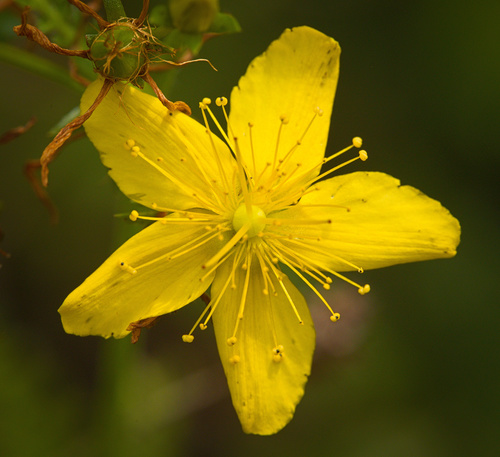
Triadenum, commonly known as marsh St. John's worts, is a small genus of flowering plants belonging to the family Hypericaceae, which also contains the familiar St. John's worts of genus Hypericum. The genus encompasses around six species of wetland herbs distributed across North America and eastern Asia, typically growing in marshes, bogs, wet meadows, and the margins of streams and ponds.
Plants in this genus are characterized by opposite, blunt-tipped leaves and pink flowers bearing nine stamens arranged in three clusters of three — a feature reflected in the genus name (tri-aden, "three glands"). The flowers are notably distinct from the yellow blooms typical of Hypericum, instead producing soft pink to rose-colored petals, making them recognizable among wetland flora.
The taxonomic standing of Triadenum is an active point of contention. Kew's Plants of the World Online and the Database of Vascular Plants of Canada treat it as a junior synonym of Hypericum, while the Flora of North America and Flora of China maintain it as a separate genus. This disagreement traces to a 2011 molecular phylogenetic study by Ruhfel et al. that placed Triadenum within Hypericum, though subsequent genetic analyses have challenged this conclusion. When subsumed into Hypericum, the species are treated under section Hypericum sect. Elodea.
Etymology
The name Triadenum derives from the Greek tri- (three) and aden (gland), referring to the characteristic arrangement of stamens in three clusters of three found in the flowers of this genus.
Distribution
Triadenum species are native to North America and eastern Asia. North American species, including T. virginicum, T. fraseri, T. walteri, and T. tubulosum, occupy wetland habitats across the eastern United States and Canada; T. japonicum and T. breviflorum represent the Asian range.
Ecology
Members of Triadenum are obligate or facultative wetland plants, growing in marshes, bogs, wet meadows, and along stream and pond margins. Their pink flowers are adapted for insect pollination. The genus is closely associated with wetland ecosystems and is sensitive to habitat drainage and degradation.
Taxonomy Notes
The genus boundary between Triadenum and Hypericum is unresolved. Kew's Plants of the World Online and VASCAN treat Triadenum as a synonym of Hypericum, while the Flora of North America and Flora of China retain it as distinct. The controversy stems from Ruhfel et al. (2011), a molecular phylogenetic study that placed Triadenum within Hypericum; later genetic work disputed this result. When lumped, the species are assigned to Hypericum sect. Elodea.










