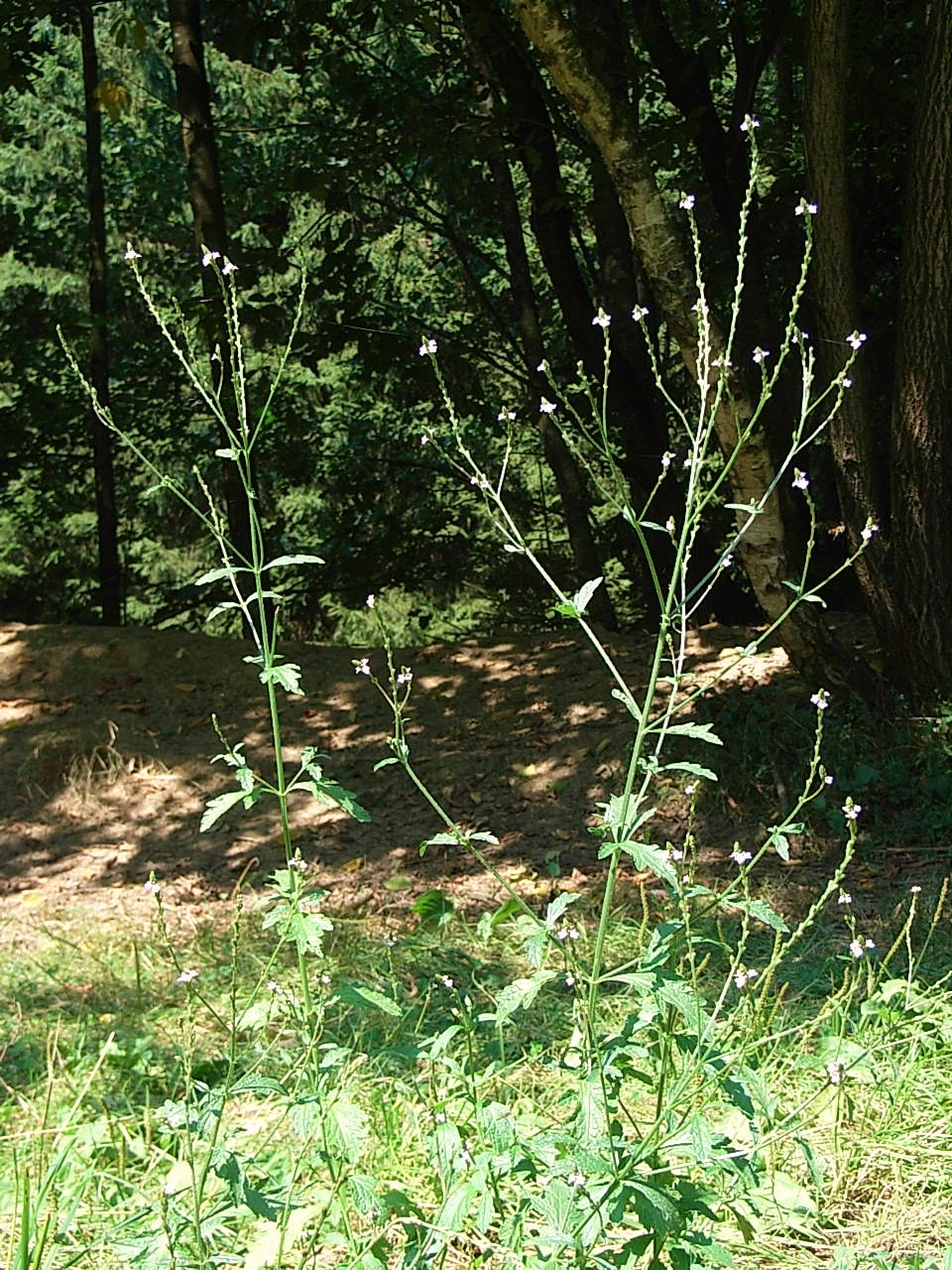
Verbena is a genus of about 150 annual and perennial flowering plants in the vervain family, Verbenaceae, formally established by Carl Linnaeus in Species Plantarum in 1753. The genus sits within the order Lamiales and the eudicot class Magnoliopsida, and global checklists currently index several hundred described names beneath it. Most members are herbaceous or weakly woody at the base, with square or four-angled stems and leaves that are usually opposite, simple, and often clothed in short stiff hairs that give the foliage a slightly rough texture.
The flowers, though individually small, are the genus's calling card. Each one carries a tubular calyx and a five-lobed corolla that is salverform or funnel-shaped, with four stamens tucked inside the throat. The blooms are packed into dense terminal spikes or rounded heads that open gradually from the base upward, so a single inflorescence can carry buds, fresh flowers, and developing fruit at the same time. Colours run from the violet-blues that dominate the genus through lilac, magenta, pink, and pure white, and the corolla often shows a pale eye where the tube meets the lobes. When the flowers fade the fruit splits into four small nutlets, a feature shared with the related mint and dead-nettle families.
Verbenas are predominantly New World plants, with the great bulk of the species native to the Americas; a smaller number reach Asia, and a handful — most prominently the type species Verbena officinalis — extend across Europe and into the Old World. They favour open, sunny ground: prairies, dry meadows, roadsides, streambanks, and disturbed soils where competition is thin. In gardens the genus has become one of the staples of summer colour, valued for long flowering, drought tolerance, and an unusually strong appeal to pollinators. Butterflies, day-flying moths such as the hummingbird hawk-moth, native bees, and hummingbirds all work the spikes, and beekeepers grow several species as minor honey plants. Beyond horticulture, Verbena carries an unusually thick layer of cultural history, having served as a sacred herb in ancient Egypt, Greece, and Rome, and a folk medicine across medieval Europe — a legacy preserved in the common names vervain and verveine still used for the genus today.
Etymology
The genus name Verbena is the classical Latin word for a sacred herb. Pliny the Elder used verbena as a general term for "any sacrificial herb considered very powerful," and the word was carried into botanical Latin by Linnaeus when he established the genus in 1753. The English vernacular "vervain" and the French "verveine" descend from the same root, and GBIF records "vervains" as the registered common name for the group. The ancient associations were already in place long before the scientific name: in Egypt the herb was poetically called "tears of Isis," and in Greco-Roman tradition it was known as "Juno's tears," tying the plant to female deities and to the rites in which sprigs were carried by priests at the altar.
Distribution
The genus is overwhelmingly American. Wikipedia describes the majority of Verbena species as native to the Americas and Asia, and SEINet — a Southwest US herbarium consortium — calls the genus "mostly New World" with around 250 named species, recording numerous native taxa across Arizona, New Mexico, and southward into South America. Familiar examples of this distribution include Verbena californica, V. brasiliensis, and V. bonariensis. The type species, Verbena officinalis, is the major Old World outlier: it is native to Europe and is one of the few members of the genus that originated outside the Americas. It has since become widely naturalised beyond Europe, including in North America, where its weedy persistence in pastures and roadsides has helped fix the name "vervain" in English usage on both sides of the Atlantic.
Ecology
Verbena is a pollinator magnet. Wikipedia lists the genus as a staple of butterfly gardens, drawing Lepidoptera such as the hummingbird hawk-moth and the pipevine swallowtail along with hummingbirds, and notes that several species are grown as honey plants for managed bees. The dense, long-blooming spikes with their narrow corolla tubes are well suited to long-tongued insects, and the staggered opening of flowers up the spike keeps nectar available for weeks at a time. Most species occupy open, sunny habitats — prairies, meadows, roadsides, and other disturbed ground across the Americas — where their drought tolerance and tap-rooted habit let them persist through dry summers.
Cultivation
Garden verbenas are grown for long, low-maintenance summer colour. Wikipedia notes that the genus is drought-resistant, tolerates full to partial sun, and thrives in well-drained, average soils. The Missouri Botanical Garden's Plant Finder highlights several of the most reliable garden species, including Verbena bonariensis (tall verbena, designated a Plant of Merit), V. hastata (American blue vervain), V. stricta (hoary vervain), and the bedding hybrid V. × hybrida, along with popular cultivars such as 'Imagination', 'Homestead Carpet Red', 'Snow Flurry', and 'Sterling Star'. The Royal Horticultural Society describes Verbena rigida as a tuberous perennial to 60 cm grown as an annual, producing clusters of fragrant bright purple flowers on branched stems in late summer, and notes that Verbena species span UK hardiness ratings from H1a through H7 — so growers should match species to their local minimum temperatures rather than assume the genus as a whole is hardy. In milder climates many verbenas behave as short-lived perennials; in colder zones they are most often used as half-hardy annuals or bedding plants.
Cultural uses
Few garden plants carry as long a cultural shadow as Verbena. The common vervain, V. officinalis, was associated with divine forces in ancient Egypt — where it was poetically named "tears of Isis" — and in Greco-Roman tradition, where it was called "Juno's tears" and used as one of the sacrificial herbs that Pliny the Elder described as "very powerful." In medieval Europe the herb acquired a Christian gloss: it was said to have been used to staunch Jesus's wounds after the crucifixion, which earned it the epithet "Holy Herb." Wikipedia notes its persistent appearance in witchcraft traditions and in Romani love magic. Herbalists have long valued it as a soporific aid, a fever herb, and a treatment for infections; it is one of the constituents of the Bach flower remedies and is still brewed as the herbal tea "verveine" in France and across Mediterranean Europe.
History
The name verbena predates botany. Pliny the Elder used it as a general Roman term for sacred herbs gathered for ritual use, and Linnaeus took the classical word as the genus name in 1753 when he established Verbena in Species Plantarum. The type species, V. officinalis, carries a corresponding weight of folk history: Wikipedia documents its use in Egyptian, Greco-Roman, medieval Christian, and modern herbal traditions, where it has been variously called tears of Isis, Juno's tears, and Holy Herb, and used as a soporific, a fever remedy, and a love charm. The Linnaean genus has been remodelled several times since 1753, most recently by the separation of Glandularia and other segregates, but the core circumscription — opposite leaves, spike-borne five-lobed flowers, and a four-nutlet fruit — has held since the eighteenth century.
Taxonomy notes
GBIF treats Verbena L. as an accepted genus in Verbenaceae, placed in the order Lamiales within the eudicot class Magnoliopsida, and published by Linnaeus in Species Plantarum (1753) at page 20. The GBIF backbone currently indexes 304 documented descendant taxa under the genus, while Wikipedia summarises a working figure of about 150 species and SEINet about 250 — the spread reflects ongoing transfers of species in and out of the closely related New World genus Glandularia, which is sometimes treated as part of Verbena and sometimes as separate. Several plants sold in the trade as "verbena" actually belong to neighbouring genera: the Missouri Botanical Garden notes that Glandularia (prairie verbena, rose verbena) and Aloysia (lemon verbena) are commonly marketed under the same vernacular umbrella.
Propagation
Wikipedia notes that verbenas are usually grown from seed, with some species treated as half-hardy annuals that are started indoors and planted out after the last frost. Many of the showier garden hybrids do not come true from seed and are propagated vegetatively from softwood cuttings to preserve cultivar colour and habit.










