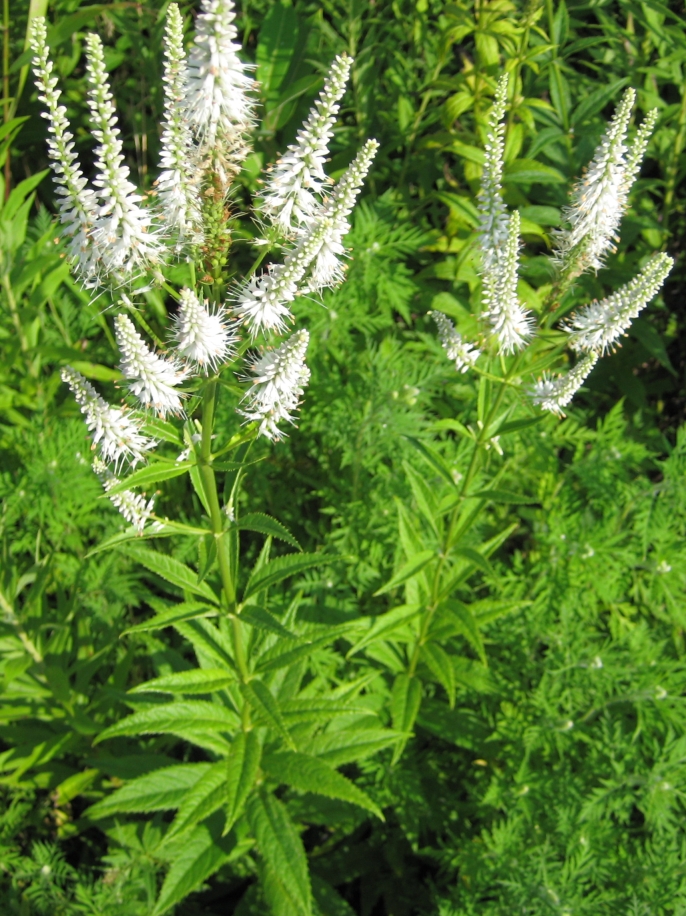
Veronicastrum is a genus of herbaceous perennial flowering plants in the family Plantaginaceae, order Lamiales. The genus comprises around a dozen species distributed across the temperate Northern Hemisphere, with the majority native to East Asia (China, Japan, Taiwan) and one well-known species — Veronicastrum virginicum (Culver's root) — native to eastern North America, from Ontario and Manitoba south to Alabama and Texas.
Plants in the genus are upright perennials typically reaching 1–2 metres in height, bearing whorled leaves and long, tapering terminal spikes of small, tubular flowers in white, pale pink, or lavender. The floral spikes are a distinctive feature, resembling a candelabrum, which has made the genus — particularly V. virginicum and V. sibiricum — popular in naturalistic garden design and prairie planting schemes.
Veronicastrum was historically included in the family Scrophulariaceae and is closely allied to the large genus Veronica, into which some taxonomic treatments have merged it. Molecular phylogenetic studies resulted in the transfer of the genus to Plantaginaceae, where it is currently accepted by GBIF and other major databases. The relationship to Veronica remains a point of taxonomic discussion, with some authorities treating Veronicastrum as a distinct genus and others subsuming it.
The most widely cultivated species, V. virginicum, carries multiple common names including Culver's root, Bowman's root, and Black root. It was used medicinally by several Native North American peoples as a cathartic and liver tonic, and remains of interest in Western herbalism for its hepatic properties, though the plant is considered potentially toxic in large doses.
Etymology
The name Veronicastrum is a Latinised diminutive form combining Veronica (the closely related genus) with the suffix -astrum, meaning “resembling” or “inferior to” in botanical Latin — indicating a plant resembling Veronica but regarded as distinct.
Distribution
The genus has a disjunct Northern Hemisphere distribution. Veronicastrum virginicum (Culver’s root) is native to eastern North America, ranging from Ontario and Manitoba south to Massachusetts, Alabama, and Texas, in habitats including meadows, rich woods, thickets, and prairies. The remaining species are centred in East Asia, including China, Japan, Taiwan, Korea, and Siberia.
Ecology
Veronicastrum virginicum grows in meadows, rich deciduous woodlands, thickets, and tallgrass prairies. It prefers moist, well-drained soil and full sun, tolerates a range of soil textures (sandy to clay), and is an important nectar source for butterflies and other insects. The East Asian species occupy analogous habitats in temperate forests and montane meadows.
Cultivation
Veronicastrum species are easily grown in moderately fertile, moisture-retentive, well-drained soil in a sunny position. They prefer cool summers and are very cold-hardy (to at least −20°C). Several cultivars of V. virginicum and V. sibiricum have been selected for ornamental use, valued for their tall, candelabra-like flower spikes in late summer borders and naturalistic prairie plantings.
Cultural Uses
The root of Veronicastrum virginicum was employed medicinally by several Native North American peoples to treat a range of complaints. The dried root acts as a cathartic, hepatic, laxative, and tonic; it gently stimulates liver function and increases bile flow. Infusions were used for diarrhoea, coughs, chills, fevers, and backache. The fresh root is a more violent cathartic and was used cautiously; dried root is milder. Roots are harvested in autumn and traditionally stored for at least a year before use. The plant is potentially toxic and should be used with caution.










