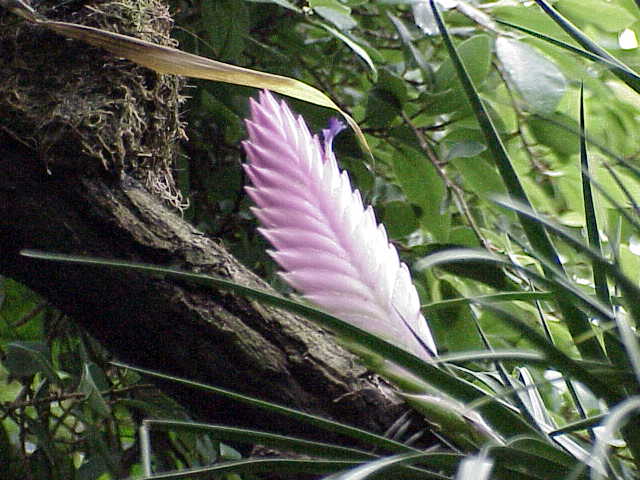
Wallisia is a small genus of epiphytic flowering plants in the family Bromeliaceae, placed within the subfamily Tillandsioideae — the air plant group. The genus was segregated from the much larger genus Tillandsia and comprises a handful of species native to Tropical America, ranging from Central America through to northern South America, with additional representation in Trinidad and Tobago.
Like other tillandsioid bromeliads, Wallisia species are typically epiphytes, anchoring themselves to trees or rocks and absorbing moisture and nutrients through specialized leaf scales (trichomes) rather than through roots. They produce rosettes of strap-shaped leaves and are known for their striking, long-lasting inflorescences. The most familiar member, Wallisia cyanea (the pink quill plant, formerly Tillandsia cyanea), produces a flattened, paddle-shaped pink bract from which small violet-blue flowers emerge in succession — making it one of the most widely cultivated ornamental bromeliads in the world.
The genus name honours Gustav Wallis (1830–1878), a German plant collector who gathered specimens throughout tropical South America. Wallisia was first formally described in 1870 in Annales d'Horticulture Belge et Étrangère.
Etymology
The genus name Wallisia honours Gustav Wallis (1830–1878), a German botanical collector who explored tropical South America and collected numerous plant specimens. It was first described and published in Annales d'Horticulture Belge et Étrangère, volume 20, page 97, in 1870.
Distribution
Wallisia is native to central and southern Tropical America, with species recorded in Belize, northern Brazil, Colombia, Costa Rica, Ecuador, French Guiana, Guatemala, Guyana, Honduras, Nicaragua, Panamá, Peru, Suriname, and Venezuela, as well as Trinidad and Tobago in the Caribbean.
Taxonomy Notes
Wallisia was segregated from the broad genus Tillandsia (family Bromeliaceae, subfamily Tillandsioideae, order Poales). The most commonly cultivated species, Wallisia cyanea, was long treated as Tillandsia cyanea and is still widely sold under that name. GBIF records 4 accepted descendants for the genus.










