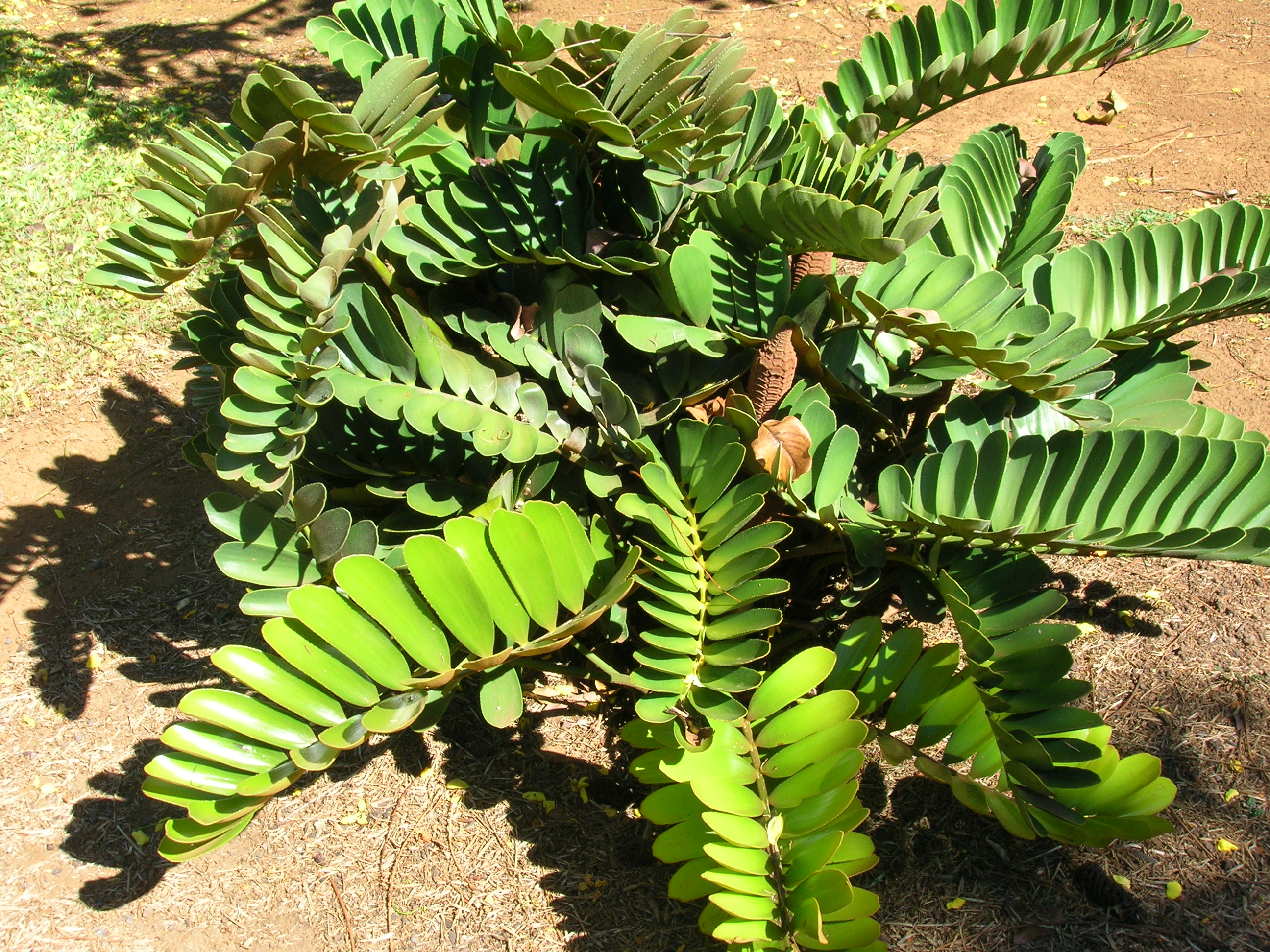
Zamia is a genus of cycads in the family Zamiaceae and the only genus of cycad native to the Americas across its entire range, with roughly 86 to 90 currently recognised species — though some catalogues such as GBIF list more than 150 descendant taxa once subspecies and synonyms are counted. The genus extends from Georgia and Florida through the West Indies and Central America south to Bolivia, and is the only cycad lineage that reaches the United States.
Plants are deciduous, shrubby, and superficially palm- or fern-like, with leafy crowns rising from stems that are 3 to 25 centimetres in diameter. Habit varies dramatically between species: some keep their entire stem underground and appear stemless, others form short above-ground trunks, and a few arboreal species reach about 5 metres in height. Each plant carries 2 to 15 spirally arranged pinnate leaves, with anywhere from 5 to 60 pairs of leaflets. The leaflets are linear to ovate, with entire or coarsely dentate margins, and — unlike most pinnate leaves — lack a true midrib; their venation is dichotomous but looks parallel to the eye. Emerging leaves are often striking, flushing red or bronze in many species, and Z. picta is regarded as the only truly variegated cycad.
Like all cycads, Zamias are gymnosperms that reproduce via cones rather than flowers. The cones are distinctly peduncled, with pollen cones more slender than the larger seed cones; both heat up through thermogenesis at different times of day, releasing scents that attract specialist pollinating beetles in the genera Pharaxonotha and Rhopalotria. Seeds are fleshy and brightly coloured — red, orange, yellow, or rarely white — and are dispersed by birds and small to medium mammals in a few species. Most Zamia species harbour nitrogen-fixing cyanobacteria in specialised "coralloid" roots, allowing them to thrive in nutrient-poor soils.
The genus has an ancient lineage stretching back roughly 68 million years to the Late Cretaceous, though the modern species radiation is far more recent, beginning only around 9.5 million years ago. It is also unusual among cycads in showing chromosome-number variation between species, with diploid counts ranging from 16 to 28.
Distribution
The genus Zamia is restricted to the Americas, ranging from the southeastern United States — northern Florida and, historically, southeastern Georgia — through Mexico, Central America, and the West Indies, and southward across most of tropical South America to Bolivia. Almost all species are strictly Neotropical; only Z. integrifolia crosses into the Nearctic realm in Florida and Georgia. SEINet's Flora of North America treatment notes that species are concentrated in tropical and subtropical regions, with hotspots in Mexico, the Caribbean, and Amazonian South America.
Ecology
Zamia species depend on a tight mutualism with specialist beetles for pollination. Members of the genera Pharaxonotha and Rhopalotria visit both pollen and seed cones, which heat up through thermogenesis at offset times to broadcast scents synchronised with beetle activity. Sperm cells in Zamia are unusually large for plants — those of Z. roezlii are around 0.4 mm and visible to the unaided eye. Coralloid roots host nitrogen-fixing cyanobacteria, allowing many species to grow in poor soils, though those bacteria also produce the neurotoxin BMAA. Seed dispersal is reported for birds and small-to-medium mammals in a few species. The genus is also at the centre of a celebrated plant–insect coevolution story: caterpillars of the lycaenid genus Eumaeus are obligate cycad herbivores that sequester Zamia toxins for their own chemical defence.
Cultivation
In horticulture, Zamia species are grown as evergreen shrubs, container plants, and houseplants, and are commonly used in interiorscaping for their architectural palm-like foliage. NCSU recommends full sun — at least six hours of direct light daily — and a well-drained soil kept moist but not wet; allowing the potting mix to stay soggy invites root rot. Maintenance is generally low, although the genus as a whole is slow-growing and known to be difficult to propagate, which is one reason mature specimens command high prices and remain attractive targets for poachers in the wild.
Conservation
Most Zamia species are valued as ornamentals, and that demand has put the genus under sustained pressure: plants grow slowly, are hard to propagate, and have been heavily over-collected from the wild for horticulture. Researchers studying Zamia routinely withhold the precise locations of wild populations from published work to reduce poaching risk. The genus as a whole appears on CITES appendices through the family-level listing of Zamiaceae, though specific Red List statuses vary by species.
Cultural uses
Despite its toxicity, Zamia has a long history of human use. Indigenous communities across the Americas have ground the starchy stems and seeds, then repeatedly washed the flour to leach out cycasin and related glucosides before using it as food. The same compounds — cycasin, macrozamin, neocycasins, and BMAA produced by symbiotic cyanobacteria — make untreated plant material acutely toxic, and grazing livestock can develop two distinct syndromes: a hepato-gastrointestinal form and a neurological form known as "Zamia staggers." In modern landscaping, Zamia is sold under common names such as cardboard palm, chigua, cycad, and fern palm; NCSU lists it as highly toxic to cats, dogs, and horses, with seeds and fruits causing vomiting, nausea, abdominal pain, and diarrhoea in people.
History
The genus name Zamia was formally published by Linnaeus in the second edition of Species Plantarum (1763, page 1659). Although the genus is named by a relatively recent author in botanical terms, the lineage itself is ancient: phylogenetic studies place the stem age of Zamia in the Late Cretaceous, roughly 68 million years ago, while crown-group diversification of modern species is much more recent — only about 9.5 million years old.
Taxonomy notes
Zamia L. is the type genus of the family Zamiaceae (order Cycadales, class Cycadopsida), with Z. pumila L. as its type species. The Flora of North America treatment cited by SEINet gives a base chromosome number of x = 8, but Zamia is the only cycad genus with significant chromosome-number variation between species (diploid counts 2n = 16–28, sometimes multiple counts within a single population). Species totals differ by source: Wikipedia reports 86–90 currently recognised species, while GBIF's backbone lists 155 descendants. A 2024 molecular phylogeny by Lindstrom and colleagues partitions the genus into seven geographically coherent clades spanning the Caribbean and Florida, the Mexican Gulf coast, two "Mega Mexico" groups, an isolated Z. soconuscensis lineage, an Isthmian clade from Nicaragua to northern Colombia, and two South American clades on either side of the Andes.










