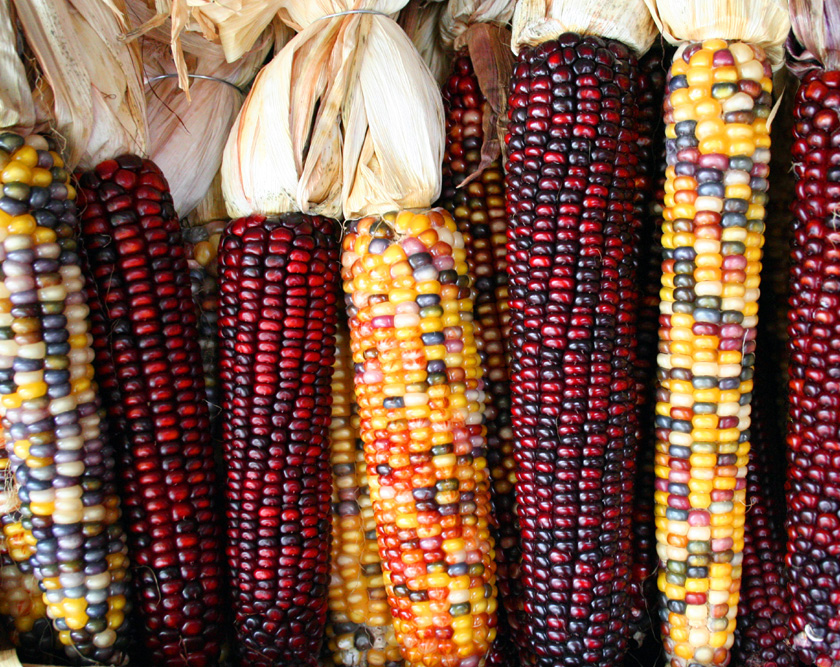
Zea is a small genus of flowering plants in the grass family Poaceae, order Poales, comprising five accepted species. The genus is best known for Zea mays, maize or corn, one of the world's most economically important crops and the only domesticated taxon in the genus. The remaining four species — Z. diploperennis, Z. luxurians, Z. nicaraguensis, and Z. perennis — are collectively called teosintes and are native to Mesoamerica, where wild populations still persist in fragmented, often highly threatened habitats.
The genus is divided into two sections: section Luxuriantes (the four teosinte species) and section Zea (containing Z. mays). Species in section Luxuriantes are typified by dark-staining heterochromatin knobs that are terminal on most chromosome arms, while most Z. mays subspecies carry few such knobs. All Zea species are diploid with chromosome number n=10, with the exception of Z. perennis, which is tetraploid (n=20). Both annual and perennial growth forms occur: Z. diploperennis and Z. perennis are perennial, while all other species are annual.
Teosintes strongly resemble maize in tassel (male inflorescence) morphology but are distinguished by their numerous lateral branches, each bearing clusters of small female inflorescences. These mature into a two-ranked "ear" of five to ten triangular or trapezoidal, hard-cased seeds that disarticulate at maturity — an adaptation that protects seeds from digestion by grazing ruminants and aids dispersal. The ancestor of modern maize is considered to be the teosinte subspecies Z. m. parviglumis (Balsas teosinte).
Scientific interest in wild teosintes remains high because they possess traits — including nitrogen fixation capacity, insect resistance, perennialism, and flood tolerance — that breeders would like to introduce into cultivated maize, though introgression is complicated by linked deleterious traits.
Etymology
The genus name Zea is derived from the ancient Greek word ζειά (zeiá), which referred to another cereal grain — possibly spelt or emmer wheat. The name was applied to this New World grass genus by Linnaeus in the eighteenth century.
Distribution
Wild species of Zea (the teosintes) are native to Mesoamerica, primarily Mexico and Central America. Zea nicaraguensis has the most restricted range of any member, surviving in a narrow strip of approximately 200 metres along a coastal estuarine river in northwest Nicaragua at elevations around 200 m. Mexican and Nicaraguan governments have enacted in situ and ex situ conservation measures to protect remaining wild populations.
Ecology
Zea species serve as larval host plants for numerous Lepidoptera, including the fall armyworm (Spodoptera frugiperda), the corn earworm (Helicoverpa zea), stem borers of the genera Diatraea and Chilo in the Americas, and the European corn borer (Ostrinia nubilalis) in the Old World. Virtually all wild teosinte populations are considered threatened or endangered: Z. diploperennis persists in only a few square miles of habitat, while Z. nicaraguensis is known from roughly 6,000 plants in a patch measuring 200 × 150 m.
Conservation
Wild teosinte populations are broadly threatened. Zea diploperennis occupies only a few square miles; Z. nicaraguensis is critically restricted to approximately 6,000 plants in a 200 × 150 m area of coastal Nicaragua. Mexican and Nicaraguan governments have implemented both in situ reserves and ex situ seed-bank programmes. Z. nicaraguensis is considered the most phenotypically distinctive and the most threatened teosinte. Scientific efforts focus on conserving this genetic diversity as a reservoir of traits — flood tolerance, perennialism, insect resistance — not yet present in cultivated maize.
History
Maize (Zea mays subsp. mays) was domesticated from the wild teosinte Z. m. parviglumis in Mesoamerica, making Zea one of the most consequential plant genera in human history. Domestication transformed the disarticulating, small-seeded teosinte ear into the large, non-shattering maize cob over thousands of years of selection. The genus was formally described by Linnaeus, who borrowed the Greek name ζειά for the group.










