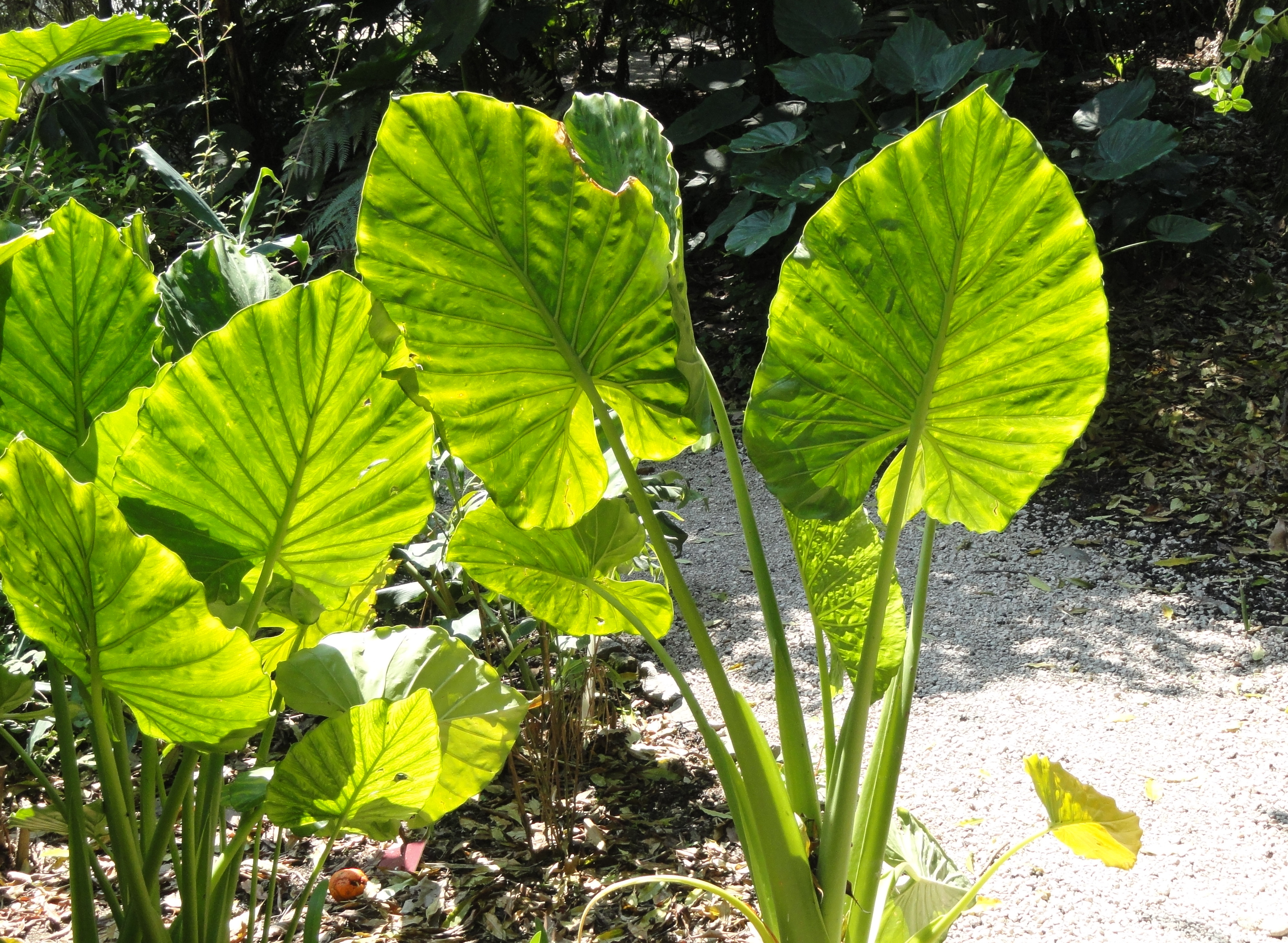
Alocasia is a genus of roughly 90 species of rhizomatous and tuberous perennial herbs in the arum family (Araceae), placed in the subfamily Aroideae and the tribe Colocasieae. The genus was established by Heinrich Wilhelm Schott and given its currently accepted authorship as Alocasia (Schott) G.Don in R. Sweet's Hortus Britannicus in 1839, with Alocasia cucullata as the type species.
The plants are best known for their dramatic foliage. Leaves are large, cordate or sagittate (heart- or arrow-shaped), often 20 to 90 centimetres long, and held on long petioles that rise directly from a fleshy underground rhizome or tuber. Many wild and cultivated forms feature heavily textured, ribbed, or strongly veined blades that have earned them the common name "elephant's ear." Most species grow rapidly, with mature plants ranging from about 60 centimetres up to three metres tall depending on the species and cultivar.
The inflorescences are far less showy than the leaves. They take the typical aroid form of a fleshy spadix wrapped in a spathe and are usually carried on short stalks that are partly hidden among the leaf bases. Flowering is uncommon on indoor specimens.
The genus is native to tropical and subtropical Asia and eastern Australia, with a centre of diversity in island Southeast Asia. Recorded native countries include Bangladesh, India, Thailand, Vietnam, Indonesia, Malaysia, the Philippines, Borneo, the Solomon Islands, and Queensland in Australia, where Alocasia brisbanensis and A. macrorrhizos are accepted by the Australian Plant Census. Several species, particularly A. macrorrhizos and various ornamental hybrids and cultivars, are now grown well beyond the natural range as houseplants and tropical-garden subjects.
All parts of Alocasia plants contain calcium oxalate raphides, needle-like crystals that cause an intense burning and swelling of the lips, mouth, and throat if chewed, as well as skin irritation on contact and gastrointestinal upset if swallowed. Pets and small children are most at risk. Despite this toxicity, several species – most notably the giant taro, A. macrorrhizos – have a long history as starch crops in Asia and the Pacific, where the corms and basal stems are made safe to eat by prolonged boiling, sometimes with acidic ingredients such as tamarind.
Taxonomy
Alocasia sits in the family Araceae, subfamily Aroideae, and tribe Colocasieae, alongside its close relatives Colocasia (taro) and Xanthosoma. The genus was first segregated from Arum by Heinrich Wilhelm Schott; its currently accepted authorship is (Schott) G.Don, published in R. Sweet's Hortus Britannicus, third edition, in 1839. The type species is Alocasia cucullata. POWO and Wikipedia recognize roughly 90 accepted species, while the GBIF backbone lists 140 descendants once synonyms and infrageneric names are counted. The genus continues to receive active revision, with many recently described species attributed to specialists such as Peter C. Boyce and Alistair Hay.
Distribution
Alocasia is native to tropical and subtropical Asia and to eastern Australia, with a centre of diversity in island Southeast Asia. Native-range countries include Bangladesh, India, Thailand, Vietnam, the Philippines, Indonesia, Malaysia, Borneo, and the Solomon Islands, extending east and south to Queensland in Australia. The Australian Plant Census accepts three species in Australia – Alocasia brisbanensis, A. macrorrhizos, and A. zebrina. Beyond this natural range, A. macrorrhizos and numerous ornamental hybrids and cultivars are cultivated widely in tropical and subtropical regions worldwide, and many cultivars are grown as houseplants in temperate climates.
Ecology and toxicity
All parts of Alocasia plants contain raphides – microscopic needle-shaped crystals of calcium oxalate – along with associated irritant proteins. Chewing raw plant material causes intense burning and swelling of the tongue, mouth, and throat, while skin contact can cause dermatitis. Ingesting larger amounts may bring on nausea, vomiting, and diarrhoea. Concentrations are highest in the lower parts of the plant. Cats, dogs, horses, and small children are most at risk, and people with rheumatism, arthritis, gout, or kidney stones are advised to avoid contact altogether. Thorough cooking or complete drying breaks down the irritants, which is why species such as giant taro can be used as food once correctly prepared.
Cultivation
Alocasia species are warm-climate plants, generally rated USDA hardiness zones 10–12, with optimum daytime temperatures of about 20–25 °C (68–77 °F); a small number of cultivars are reported as hardy to zone 7b with winter dieback. They prefer dappled sunlight or partial shade – roughly 2–6 hours of direct sun a day – and burn in full midday sun, but as houseplants they also tolerate dim light. They thrive in well-drained, moist, humus-rich loam with an acidic to neutral pH (about 5.7–6.3 is ideal) and appreciate high humidity and generous rainfall (2,500–3,500 mm per year in habitat). Indoor culture demands frequent fertilization, medium-to-high humidity, and regular cleaning of the large leaves; cold winters and the dry air of central heating are a common cause of decline. Spider mites are the most frequent indoor pest; aphids, mealybugs, leaf spots, and root rot from overwatering are also reported. Mature plants reach anywhere from about 60 cm to 3 m depending on the species and cultivar.
Propagation
Alocasia is most commonly propagated vegetatively. Mature plants form basal offsets and produce daughter tubers, which can be separated from the parent rhizome and either potted up directly or stored before replanting. Rootstock division is the standard method used by both home growers and commercial nurseries. Seed propagation is also possible where flowering and fruiting occur, with germination reported to be best around 24 °C.
Cultural uses
Several Alocasia species are long-standing food crops in tropical Asia and the Pacific, with giant taro (A. macrorrhizos) the most important. Corms and the lower, peeled stem sections are boiled thoroughly to break down the calcium oxalate raphides and irritants that make the raw plant inedible; cooks sometimes add an acidic ingredient such as tamarind to help neutralize the compounds. The cooked starch is eaten directly, added to soups and stews, or processed into an easily digestible flour. Traditional medicinal uses are also recorded, including stem sap applied externally for earache, boils, cuts, and headaches, and dried rhizome decoctions taken for colic and vomiting at daily doses of around 10–20 g; leaves are credited in folk medicine with antimicrobial, antifungal, and antioxidant properties. Globally, however, the most important modern role of the genus is ornamental: Alocasia are among the signature foliage plants of tropical landscaping and the contemporary houseplant trade, with cultivars such as Alocasia × amazonica – an artificial hybrid that has received the Royal Horticultural Society's Award of Garden Merit – sold worldwide.










