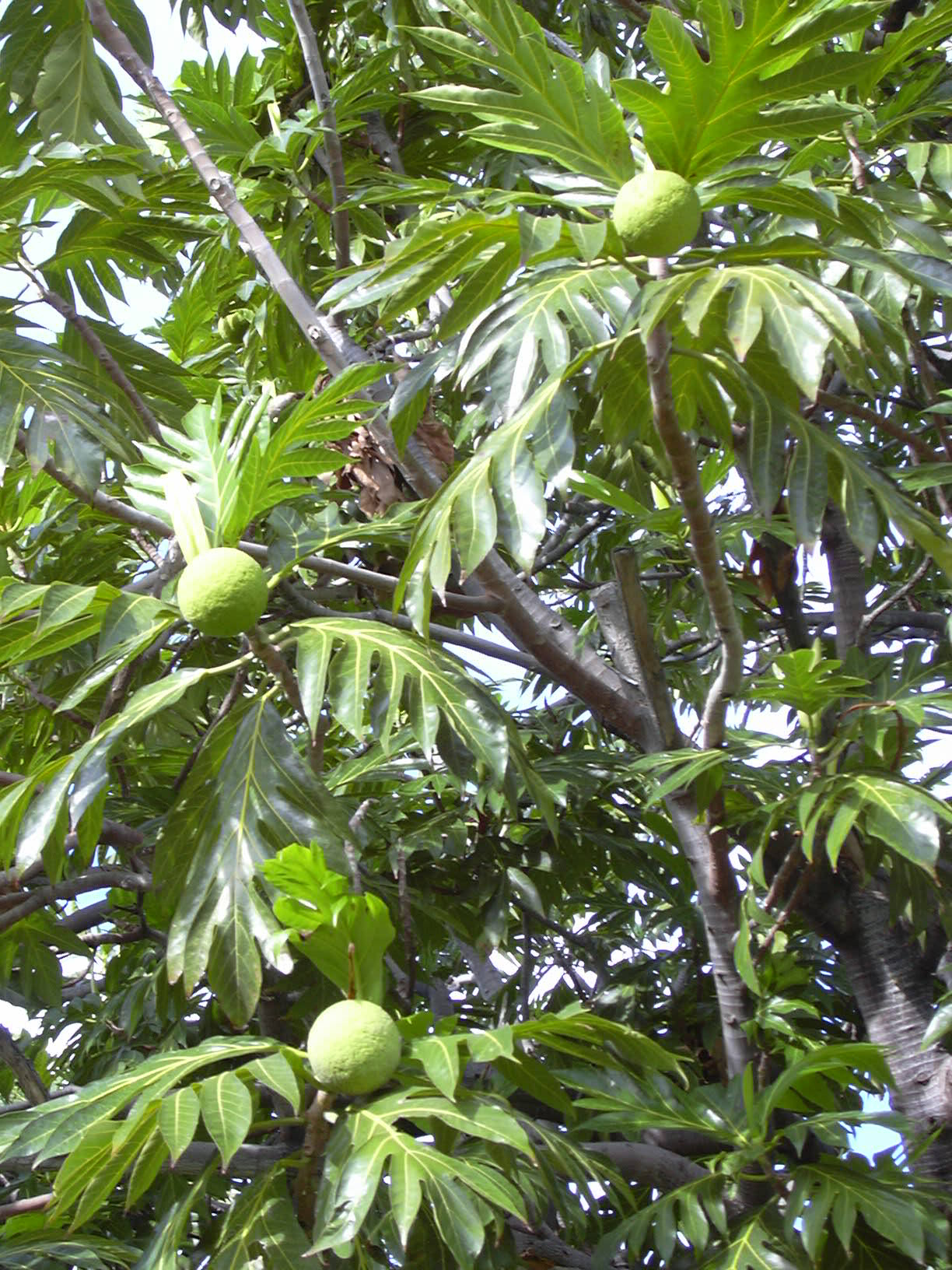
Artocarpus J.R.Forst. & G.Forst. is a genus of approximately 60 species of trees and shrubs in the family Moraceae (the mulberry family), order Rosales. Native primarily to Southeast Asia and the Pacific, the genus is best known for producing some of the world's most important tropical fruits, including breadfruit (A. altilis) and jackfruit (A. heterophyllus).
All Artocarpus species are laticiferous, meaning they produce a characteristic milky white latex sap throughout their tissues. The plants are monoecious, bearing separate male and female flowers on the same individual; the female flowers develop into large, syncarpous (compound) fruits formed from the fusion of many individual fruitlets. Leaves across the genus vary considerably in size and shape, ranging from small and entire to large, deeply lobed forms with cordate bases.
The genus was described by Johann Reinhold Forster and Georg Forster in 1776 in Characteres Generum Plantarum, based on collections made during James Cook's second voyage of exploration aboard HMS Resolution. Three subgenera are recognized — Artocarpus, Pseudojaca, and Cauliflori — distinguished primarily by leaf arrangement and stipule characteristics.
Species are cultivated across the humid tropics for their edible fruits, nutritious seeds, timber, and a range of traditional uses. The genus favors lowland humid tropical climates with annual rainfall of 1,500-2,500 mm and temperatures of 21-32°C, though individual species vary in their tolerances. Evolutionary evidence suggests the last common ancestor of all living Artocarpus originated in the vicinity of Borneo, from which the genus dispersed across Asia and Oceania. The fossil record extends back to the Late Cretaceous, with fossil material recovered from sites as distant as West Greenland, Alaska, and California.
Etymology
The genus name Artocarpus derives from two Greek words: artos ("bread") and karpos ("fruit"). The name was coined by the father-and-son botanist team Johann Reinhold Forster and J. Georg Adam Forster, who sailed aboard HMS Resolution during James Cook's second Pacific voyage (1772-1775). The name directly references the starchy, bread-like quality of the most celebrated fruit in the genus — the breadfruit (A. altilis) — which was already well known to Pacific Islander communities long before European botanical classification.
Distribution
Artocarpus is native to Southeast Asia and the Pacific region. Most species are restricted to Southeast Asia, with the center of diversity in the Malay Archipelago. The genus likely originated in the vicinity of Borneo, from which it dispersed across Asia and Oceania. The native range of breadfruit (A. altilis) encompasses Indonesia, Papua New Guinea, the Philippines, Micronesia, and Vanuatu, among other Pacific island groups. Jackfruit (A. heterophyllus) originates from the Indian subcontinent and Southeast Asia. Through cultivation, the two most economically significant species — breadfruit and jackfruit — are now grown throughout the tropics worldwide.
Ecology
Artocarpus species are plants of the humid lowland tropics. They grow best at elevations below 650 metres, though some species succeed up to 1,550 metres. The genus thrives where annual rainfall is 1,500-2,500 mm, tolerating short dry seasons; mean annual temperatures of 21-32°C are optimal, and trees are injured below 5°C. Young plants require partial shade, with light requirements increasing as the tree matures; adult trees are light-demanding and cannot grow in full shade.
The genus plays a significant ecological and agroforestry role across its native range. Artocarpus trees are important components of traditional agroforestry systems in the Pacific Islands, where they are intercropped with yams, root crops, bananas, and cash crops such as black pepper and coffee. They also serve as windbreaks and shade trees within these systems. Flowers are pollinated by bees; the trees are not self-fertile. Artocarpus species are generally noted for attracting wildlife.
Cultivation
Artocarpus trees are grown in USDA hardiness zones 10-12. They require deep, fertile, well-drained soils, though they are adaptable to light, medium, and heavy soils, including those with neutral, basic, or saline conditions. Annual rainfall of 1,500-2,500 mm is typical; trees tolerate short dry periods but perform best with consistent moisture.
Trees generally begin fruiting 3-6 years after planting and can produce two crops per year, with yields of up to 700 fruits per tree annually under favorable conditions. Young trees benefit from partial shade; mature trees require full sun exposure. The genus is tolerant of strong winds but not prolonged maritime exposure.
Propagation
Artocarpus can be propagated from both seeds and vegetative material. Seeds should be extracted from ripe fruits and sown immediately, as viability drops sharply within a few weeks. Sown at a depth of approximately 1 cm and spaced 5 cm apart, seeds germinate at 24-27°C with around 85% germination within two weeks. Seedlings are transplanted to individual containers upon sprouting and reach field-planting size at approximately one year old.
Vegetative propagation is preferred when genetic uniformity is required. Root cuttings (1.5-4 cm in diameter, about 25 cm long) are placed horizontally in sand during the wet season and typically root after 10 or more weeks, followed by a hardening-off period. Additional vegetative methods include root suckers, marcottage (air layering), budding, and conventional air layering.
Cultural uses
Artocarpus species have been integral to the food systems and material cultures of tropical Asia and the Pacific for millennia. Fruits are eaten at all stages of development — unripe fruits have a texture resembling artichoke hearts and are used as vegetables, while ripe fruits are eaten fresh or fermented. Seeds contain approximately 8% protein together with minerals including niacin, and are consumed boiled or roasted. Male flower spikes are eaten as vegetables or used in sweetmeats.
In traditional medicine, various parts of the plant address a wide range of conditions. Toasted flowers are applied to aching gums; latex is used to treat broken bones, bruises, sprains, and fungal skin diseases. Leaf infusions are used in some traditions to help lower blood pressure and manage diabetes; other applications include treatments for ear infections, respiratory ailments, fever, and digestive disorders.
The timber of Artocarpus is light, durable, and notably resistant to termites despite its relatively low density. It has been used historically in house and canoe construction and remains valued for bowls, carvings, and surfboards. Inner bark is processed into bark cloth (tapa), which holds cultural significance across Pacific Islander societies for clothing and ceremonial use. The latex also serves as a caulking material for canoes and as a general-purpose adhesive.
History
Artocarpus has a deep fossil record, with material recovered from Late Cretaceous deposits in West Greenland, Alaska, California, and Oregon, and from Oligocene strata in Italy — evidence of a once much wider distribution across the Northern Hemisphere during warmer geological epochs. The genus was formally described and named by Johann Reinhold Forster and Georg Forster in 1776, based on specimens collected during James Cook's second voyage of Pacific exploration. Their choice of name — combining the Greek for "bread" and "fruit" — reflected the already well-documented importance of breadfruit to Pacific Island peoples. The jackfruit (A. heterophyllus) had long been cultivated on the Indian subcontinent and in Southeast Asia before European contact, and breadfruit (A. altilis) became the subject of significant colonial botanical interest, most famously associated with the voyage of HMS Bounty in 1787-1789.
Taxonomy
Artocarpus was formally described by J.R. Forster & G. Forster in Characteres Generum Plantarum (1776) and is accepted as the valid name for the genus. It is placed in the family Moraceae, tribe Artocarpeae, order Rosales, class Magnoliopsida. GBIF records 171 descendant taxa under this genus (usageKey 2984563).
Three subgenera are recognized: Artocarpus, Pseudojaca, and Cauliflori, differentiated by leaf arrangement and stipule characteristics. A number of historical names are now accepted as synonyms, including Sitodium Parkinson (1773), Rima Sonn. (1776), Rademachia Thunb. (1776), Polyphema Lour. (1790), Gigotorcya Buc'hoz (1783), and Saccus Rumph. ex Kuntze (1891).










