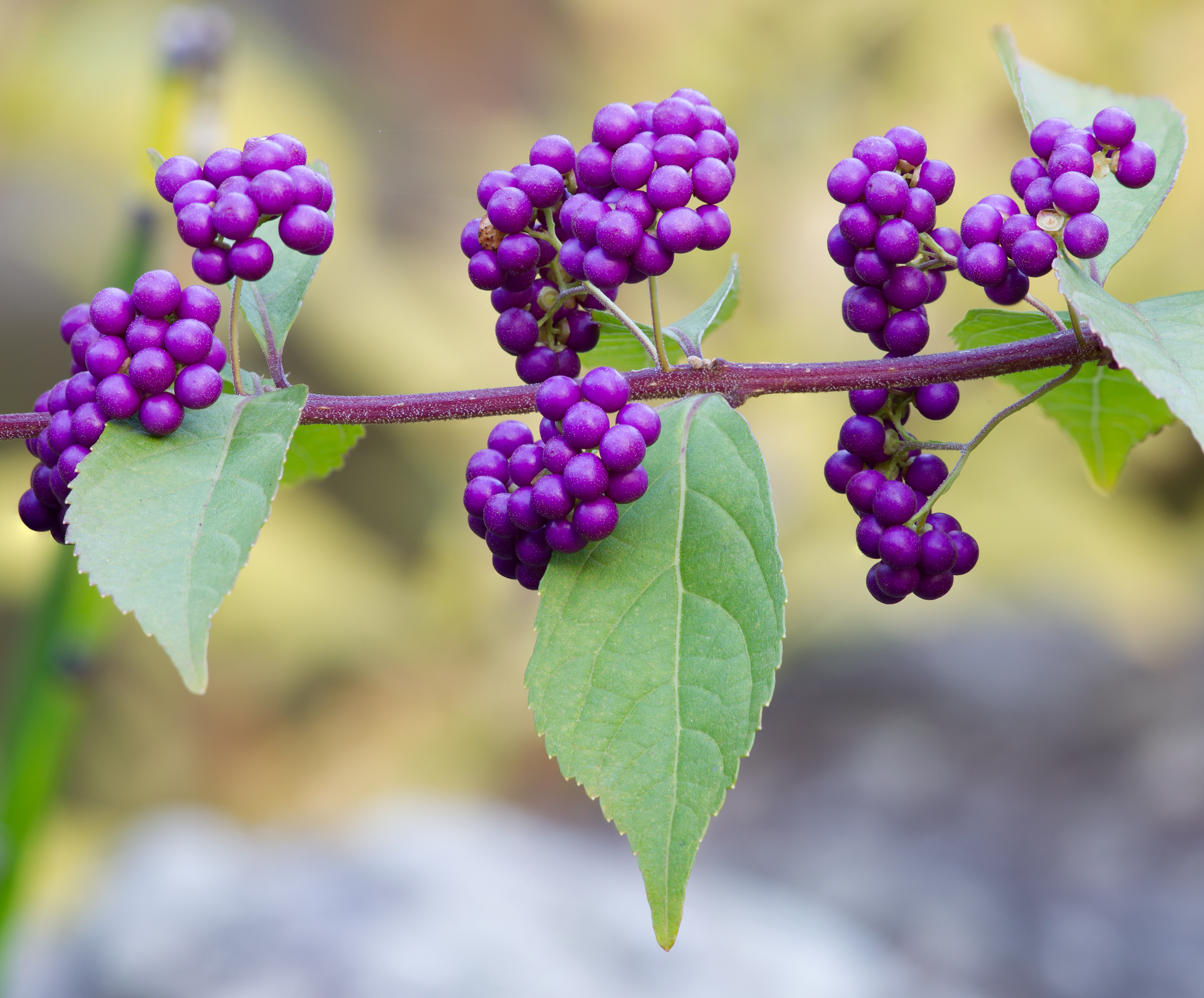
Callicarpa, commonly known as beautyberry, is a genus of approximately 164 accepted species of shrubs and small trees in the mint family (Lamiaceae). The genus is best known for its remarkably ornamental fruit clusters — small, globose berries up to 5 mm across that display a striking metallic lustre and range from vivid pink to deep violet-purple. Temperate species are deciduous while tropical members are evergreen. Leaves are simple and opposite, typically 5–25 cm long, and flowers are small, white to pinkish, and borne in axillary cymes in late spring to early summer.
The berries ripen in late summer and persist well into winter, providing critical food for songbirds, small mammals, and other wildlife when alternative food sources have been exhausted, though animals tend to consume them only as a last resort due to their pronounced astringency. In addition to their wildlife value, the berries have been processed into wines and jellies.
The genus is native primarily to east and southeast Asia, where the greatest diversity of species occurs, with additional native representation in southeastern North America, Australia, Madagascar, and South America. Plants inhabit open meadows, thickets, woodlands, and forest margins, tolerating a range of soil types provided drainage is adequate.
Callicarpa is widely cultivated in temperate gardens for its spectacular autumn fruit display. The most commonly grown species include Callicarpa bodinieri from west-central China — noted for cold tolerance and suitability to northwestern European gardens — and Callicarpa americana, the American beautyberry, native across the southeastern United States from Virginia to Texas and into the Caribbean. Most species perform best in full sun to part shade and require pruning in late winter to stimulate vigorous new growth on which flowers and fruit are borne the following season. Propagation is readily achieved by seed or by softwood and hardwood stem cuttings.
Beyond ornamental use, Callicarpa species have a documented history in traditional medicine and pest management. Native American communities employed roots and leaves to treat fevers, rheumatism, malaria, and gastrointestinal complaints. Research by the USDA Agricultural Research Service identified callicarpenal — a compound from crushed beautyberry leaves — as an effective natural mosquito repellent, subsequently patented alongside three related compounds: borneol, intermedeol, and spathulenol. The berries of certain species are edible raw, described as juicy, sweet, and slightly aromatic, though with a modest culinary rating.
Etymology
The genus name Callicarpa derives from two Greek words: κάλλος (kállos), meaning "beauty," and καρπός (karpós), meaning "fruit" — translating literally as "beautiful fruit," a direct reference to the genus's most distinguishing characteristic, its brilliantly colored berry clusters. The genus was established by Carl Linnaeus and published in Species Plantarum in 1753. In the best-known North American species, Callicarpa americana, the species epithet is Latin for "American," reflecting its native range.
Distribution
Callicarpa is distributed across tropical and warm-temperate regions worldwide, with its center of diversity in east and southeast Asia. Additional native populations occur in southeastern North America (from Virginia and Missouri south through Florida and Texas, and into Bermuda and Cuba), Australia, Madagascar, and South America. In North America, Callicarpa americana grows naturally in open meadows, thickets, woodlands, and along the margins of ponds, ditches, and streams. The genus spans a broad latitudinal range; cold-tolerant species such as Callicarpa bodinieri from Sichuan, Hubei, and Shaanxi in west-central China extend garden cultivation into northwestern Europe.
Ecology
Callicarpa shrubs play a notable role in supporting wildlife, particularly during winter. Their persistent berry clusters supply food for songbirds and small mammals when alternative food sources are scarce, though the fruit's high astringency means wildlife consume them only after other options are depleted. In Asia, several species serve as larval host plants for Lepidoptera, including Endoclita malabaricus and Endoclita undulifer. North American species attract pollinators during flowering and are recognized as valuable wildlife plants — Callicarpa americana was designated North Carolina Wildflower of the Year in 2021. The genus is generally resistant to honey fungus, and most species require cross-pollination for optimal fruit set.
Cultivation
Callicarpa species are low-maintenance shrubs suited to a range of garden conditions. Most tolerate full sun to part shade but are intolerant of deep shade; adequate light is important for fruit production. Plants accept a wide range of soils — clay, loam, and sand — provided drainage is good, and tolerate pH from acidic to mildly alkaline. Hardiness varies by species: Callicarpa americana suits USDA zones 6a–10b, while Callicarpa bodinieri performs well across northwestern Europe. Because flowers and fruit are produced on new growth, pruning hard in late winter (to roughly 30 cm above ground) is recommended to generate vigorous new shoots and maximize the autumn berry display.
Propagation
Callicarpa can be propagated by seed or by stem cuttings. Seeds should be sown in late winter (around February) and germinate within one to three months at approximately 18 °C. Vegetative propagation is equally practical: half-ripe wood cuttings taken in July or August root reliably under suitable conditions, and mature hardwood cuttings can be taken in early spring. Cross-pollination between two or more individuals improves fruit set.
Cultural uses
Callicarpa has a well-documented history of human use spanning food, medicine, and pest management. Several species produce berries that are edible raw — described as juicy, sweet, fleshy, and slightly aromatic — and can be processed into wine and jelly. In traditional Native American medicine, roots were prepared as teas to treat dysentery, stomach aches, and colic; root-bark decoctions served as diuretics; and leaf-and-root sweat baths were used to treat malaria, rheumatism, and fevers. Crushed leaves were rubbed on skin or woven into clothing as a mosquito deterrent — a use later confirmed by the USDA Agricultural Research Service, which isolated four active compounds (borneol, callicarpenal, intermedeol, and spathulenol) and patented callicarpenal as a natural insect repellent. The Japanese beautyberry (Callicarpa japonica) carries the vernacular name Murasakishikibu, honoring the literary figure Murasaki Shikibu — illustrating the genus's cultural resonance in Japan.
Taxonomy notes
Callicarpa L. was established by Linnaeus in Species Plantarum (1753) and is placed in the family Lamiaceae, order Lamiales. The genus comprises approximately 164 accepted species (as of 2026), though other treatments cite around 140 (Gleason & Cronquist), while the GBIF backbone lists 254 descendant taxa including synonyms and infraspecific names. These discrepancies reflect ongoing synonymization and differing circumscription philosophies. Flowers are 4(5)-merous with stamens attached to the base of the corolla tube; the fruit is globose and drupaceous, typically separating into four nutlets. The species-level taxonomy of certain Asian groups remains active, with numerous recently described species from China and Southeast Asia.










