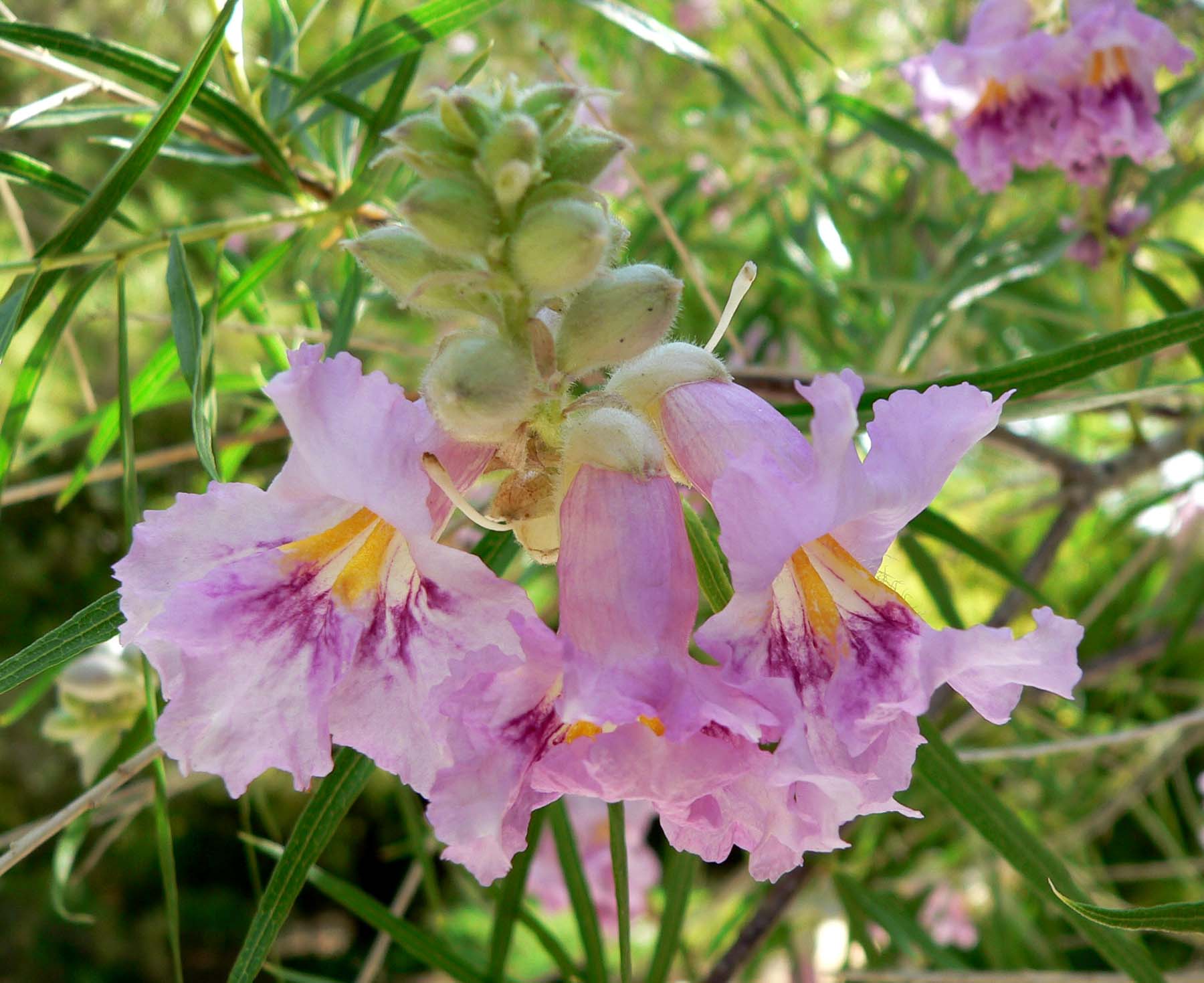
Chilopsis is a monotypic genus of flowering plants in the trumpet vine family, Bignoniaceae (order Lamiales), containing the single species Chilopsis linearis — commonly known as desert willow or desert-willow. Despite its willow-like foliage, it is not a true willow (Salix) but rather a relative of catalpa trees.
Growing as a shrub or small tree reaching up to 9 metres (30 ft) in height, Chilopsis linearis is a phreatophyte well adapted to ephemeral desert washes and sandy streams of the southwestern United States and northern Mexico, typically below 1,500 metres (5,000 ft) elevation. Its deciduous leaves are linear and curved, up to 30 cm (12 in) long but only a few millimetres wide — hence the common name. Blooming from April through September, the showy flowers appear in terminal panicles or racemes, with two to four open at a time. Each blossom features a lavender to light pink corolla 2–5 cm long, a slightly inflated purple-tinged calyx, and a distinctively patterned throat with yellow ridges and purple lines set against crinkled petal margins. The fruit is a slender linear pod up to 30 cm long, packed with numerous winged seeds.
The genus name derives from Greek words meaning "lip-resembling," a reference to the bilabiate flowers. Two subspecies are recognised — subsp. linearis (Utah, Arizona, New Mexico, western Texas, Mexico) and subsp. arcuata (Nevada, California, Baja California). The species is pollinated by large native bees and hummingbirds, and has a history of traditional use: its wood was crafted into bows and baskets, while plant parts were employed medicinally for fungal infections, wounds, and coughs. Chilopsis is closely related to Catalpa, and the intergeneric hybrid ×Chitalpa tashkentensis — originating from a botanical garden in Tashkent, Uzbekistan — is a cross between C. linearis and Catalpa bignonioides.
Etymology
The generic name Chilopsis is derived from the Greek χεῖλος (cheilos, “lip”) and ὄψις (opsis, “resembling”), referring to the shape of the bilabiate (two-lipped) flowers characteristic of the genus.
Distribution
Chilopsis linearis is native to the southwestern United States and northern Mexico, occurring from California and Nevada eastward to Utah, Arizona, New Mexico, and western Texas, and south through Baja California and mainland northern Mexico. As a phreatophyte, it is most commonly found in ephemeral desert washes, sandy stream beds, and along riverbanks, usually at elevations below 1,500 m (5,000 ft).
Ecology
Chilopsis linearis flowers are pollinated primarily by large native bees in the family Apidae — including carpenter bees, bumblebees, Anthophora, and Centris species. The nectar-rich, tubular blossoms are also popular with hummingbirds. As a phreatophyte, the plant’s deep roots tap groundwater in otherwise dry desert washes, making it a characteristic component of riparian zones in arid landscapes.
Cultivation
Chilopsis linearis is widely cultivated as an ornamental in hot, dry climates for its abundant, showy flowers and exceptional drought tolerance. Though its natural growth habit is irregular, the plant responds well to pruning and can be shaped into a conventional single-trunk tree. Numerous cultivars have been selected, including ‘Rio Salado’ which bears dark purple or magenta blooms. The plant is cold-hardy to approximately 10°F (−12°C). A notable horticultural development is the intergeneric hybrid ×Chitalpa tashkentensis, a cross between Chilopsis linearis and Catalpa bignonioides that first arose in a botanical garden in Tashkent, Uzbekistan, combining the desert adaptability of Chilopsis with the showier flower clusters of Catalpa.
Cultural Uses
Parts of Chilopsis linearis have been used in traditional medicine by Indigenous peoples of the southwestern United States and northern Mexico, particularly as an antifungal treatment for conditions such as candidiasis and athlete’s foot, as well as for wounds and coughs. The wood of the plant was traditionally used to craft bows and baskets.
Taxonomy
Chilopsis is a monotypic genus in the family Bignoniaceae, order Lamiales. It contains the single species Chilopsis linearis, which is divided into two subspecies: subsp. linearis (Utah, Arizona, New Mexico, western Texas, Mexico) and subsp. arcuata (Nevada, California, Baja California). The genus is closely related to Catalpa, and hybrids between the two genera are viable — the most notable being the nothogeneric hybrid ×Chitalpa tashkentensis (C. linearis × Catalpa bignonioides).










