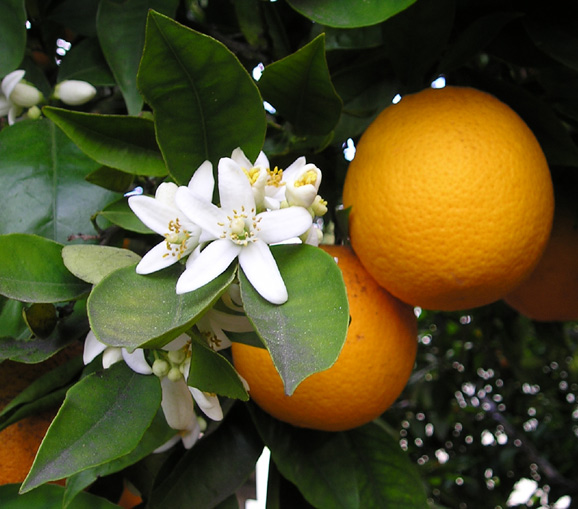
Citrus L. is a genus of flowering trees and shrubs in the family Rutaceae, order Sapindales, comprising some of the world's most economically important fruit crops. The genus as currently circumscribed — following modern phylogenetic revisions that absorbed formerly separate genera including Poncirus, Eremocitrus, Microcitrus, Oxanthera, and Clymenia — encompasses at least 179 taxa according to GBIF, with species ranging from the familiar sweet orange and lemon to the kumquat and pomelo.
Plants typically grow 5–15 metres tall with evergreen, aromatic foliage. The fragrant white flowers contain essential oils that have long been prized in perfumery and medicine. Most commercially grown varieties are ancient hybrids ultimately derived from three ancestral species: the mandarin orange (Citrus reticulata), the pomelo (Citrus grandis), and the citron (Citrus medica) — the remainder of cultivated citrus diversity traces back to crosses and backcrosses among these three progenitors over millennia.
The genus is native to South Asia, East Asia, Southeast Asia, Melanesia, and Australia, with its likely center of origin in the southeastern foothills of the Himalayas, spanning eastern Assam, northern Myanmar, and western Yunnan. From that heartland, citrus spread outward through human agency: Austronesian seafarers dispersed species across Micronesia and Polynesia from roughly 3000–1500 BCE, while Arab traders carried citrus westward to the Mediterranean, and European explorers subsequently introduced it to the Americas.
Citrus thrive in sunny, humid climates with fertile, well-drained soil and consistent moisture, and they are intolerant of sustained frost. Commercial orchards worldwide rely on grafting onto disease-resistant rootstocks to ensure uniformity and health. Global production reached 124 million tonnes in 2016 and 144 million metric tons by 2020, making citrus the highest-value fruit crop in international trade by revenue.
Etymology
The genus name Citrus is Latin in origin, used in antiquity to denote either the citron fruit or certain aromatic conifer trees (notably the Thuja or North African cedar). Scholars have proposed a connection to the ancient Greek word kedros (κέδρος), meaning cedar of Lebanon, arising from similarities between the aromatic resins and scents of citrus leaves and those of cedar wood. The same Latin root gave rise to the modern English word "citrus" and its derivatives in most European languages.
Distribution
Citrus is native to a broad arc of Asia extending from South Asia and East Asia through Southeast Asia into Melanesia and Australia. Genetic and archaeobotanical evidence points to the southeastern slopes of the Himalayas — covering eastern Assam (India), northern Myanmar, and western Yunnan (China) — as the primary center of origin and diversification. From this heartland, citrus dispersed in two main waves: Austronesian maritime peoples carried species into island Southeast Asia, Micronesia, and Polynesia beginning around 3000–1500 BCE; later, Arab merchants and physicians introduced citrus to the Middle East and Mediterranean basin during the early centuries CE, and European colonists brought citrus to the Americas from the 15th century onward.
Today roughly 79% of global citrus production occurs in the Northern Hemisphere, with the Mediterranean Basin as the dominant traditional growing region. Brazil is the world's largest single producer, followed by China, India, the European Union, the United States, Mexico, and Egypt.
Ecology
Citrus species are woody perennials adapted to warm, frost-free climates with high sunlight and reliable moisture. They perform best in humid subtropical and tropical conditions, tolerating brief cool spells but sustaining damage at sustained temperatures below freezing. The flowers are rich in essential oils and nectar, attracting pollinators including bees. Natural stands occur in forest margins and disturbed habitats across southern and southeastern Asia and northern Australia, but the vast majority of the genus's current global footprint reflects millennia of cultivation and deliberate introduction rather than natural dispersal.
Cultivation
Commercial citrus production relies almost universally on vegetative propagation through grafting: scion wood of the desired fruiting variety is budded or grafted onto a rootstock selected for disease resistance, soil adaptation, and vigour. This approach bypasses the genetic variability of seedlings and brings trees into bearing more quickly. In the United States, Florida's warm, humid conditions favour processing-grade oranges destined for juice, while California, Arizona, and Texas focus on fresh-market fruit. Orchards require well-drained, fertile soils, full sun, and irrigation in drier climates. Nutrient management — particularly nitrogen, magnesium, and micronutrients — is central to maintaining yield and fruit quality.
Propagation
Citrus is propagated almost exclusively by vegetative means for commercial production. Budding (T-budding or chip budding) onto seedling rootstocks is the industry standard, ensuring true-to-type fruit and early bearing. Rootstock selection is critical: common choices include trifoliate orange (formerly Poncirus trifoliata, now within Citrus), rough lemon, and sour orange, chosen for traits such as cold tolerance, Phytophthora resistance, and soil adaptability. Seed propagation is used in rootstock production and breeding programmes; many citrus seeds are polyembryonic, producing multiple nucellar (clonal) seedlings per seed alongside the zygotic embryo.
Conservation
Citrus production faces severe biological threats globally. Citrus greening disease — caused by the bacterium Candidatus Liberibacter asiaticus and spread by the Asian citrus psyllid (Diaphorina citri) — is considered the most destructive citrus disease ever recorded. In Florida alone it reduced commercially productive acreage from 665,529 acres in 2000 to 473,086 acres by 2011, and the decline has continued since. Infected trees produce small, misshapen, bitter fruit with green bottoms and eventually die; no cure exists. Other major threats include citrus canker, Phytophthora root rot, and various scale insects and psyllids. The disease-driven contraction of production in Florida and parts of Brazil has prompted intensive research into resistant rootstocks, bactericide treatments, and breeding of resistant scion varieties.
Cultural uses
Citrus fruits rank among humanity's most widely consumed foods and beverages. Oranges and their juice dominate global consumption, with orange juice alone accounting for over 80% of all processed citrus. Lemons and limes are indispensable in cuisines worldwide for their acid and aromatic zest; citron peel is candied for confectionery; mandarins and tangerines are popular fresh-eating fruits. Beyond the table, citrus peel oils — principally d-limonene — are extracted for use in perfumery, cleaning products, and as flavour compounds in the food and beverage industry. Essential oils from citrus flowers (neroli, from bitter orange blossoms) and leaves (petitgrain) are fixtures of fine perfumery. Medicinally, vitamin C from citrus juice was historically used to prevent scurvy among sailors.
In cultural and historical terms, citrus fruits carried strong prestige associations in the ancient Mediterranean — paintings of citrus in Roman villas at Pompeii and Livia's Garden fresco attest to their status as luxury imports. They remain symbolically significant in Chinese New Year customs (kumquats and mandarins as emblems of prosperity), in wedding traditions across the Mediterranean, and in religious observance (the citron or etrog in the Jewish festival of Sukkot).
History
The cultivation of citrus is one of the oldest documented forms of fruit horticulture. Citrons (Citrus medica) appear in ancient Mesopotamian and Persian records from at least the 4th century BCE, and the pomelo and mandarin were cultivated in China for thousands of years before written records began. Arab agronomists of the medieval Islamic golden age played a decisive role in diffusing sour oranges, lemons, and limes across North Africa and into Iberia between the 9th and 12th centuries CE. The sweet orange — a hybrid of the mandarin and pomelo, or possibly the mandarin and a pummelo-like progenitor — was likely developed in southern China and reached Europe through Portuguese trade routes in the 15th century, triggering rapid adoption across Mediterranean horticulture. European colonisation of the Americas, Caribbean, and Pacific subsequently spread citrus to every frost-free region on earth.
Taxonomy notes
The limits of Citrus have been substantially revised in the 21st century. Traditional narrow circumscriptions recognized a small number of "true" species alongside many related satellite genera (Poncirus, Microcitrus, Eremocitrus, Clymenia, Oxanthera). Molecular phylogenetic studies — notably those published by Swingle-Reece and later by Curk et al. and the Kew-led revisions — demonstrated that these genera are nested within Citrus, necessitating their merger. Under the current broad circumscription, kumquats (formerly Fortunella) are treated as Citrus japonica and related species, while the trifoliate orange (formerly Poncirus trifoliata) is now Citrus trifoliata. GBIF recognizes 179 taxa under the genus. Reticulate evolution — extensive hybridization among a small number of ancestral wild species, then further crosses with hybrids — underlies much of the observed morphological diversity and has historically complicated species-level delimitation. Citrus was formally described and published by Carl Linnaeus in Species Plantarum 1: 401 (1753).










