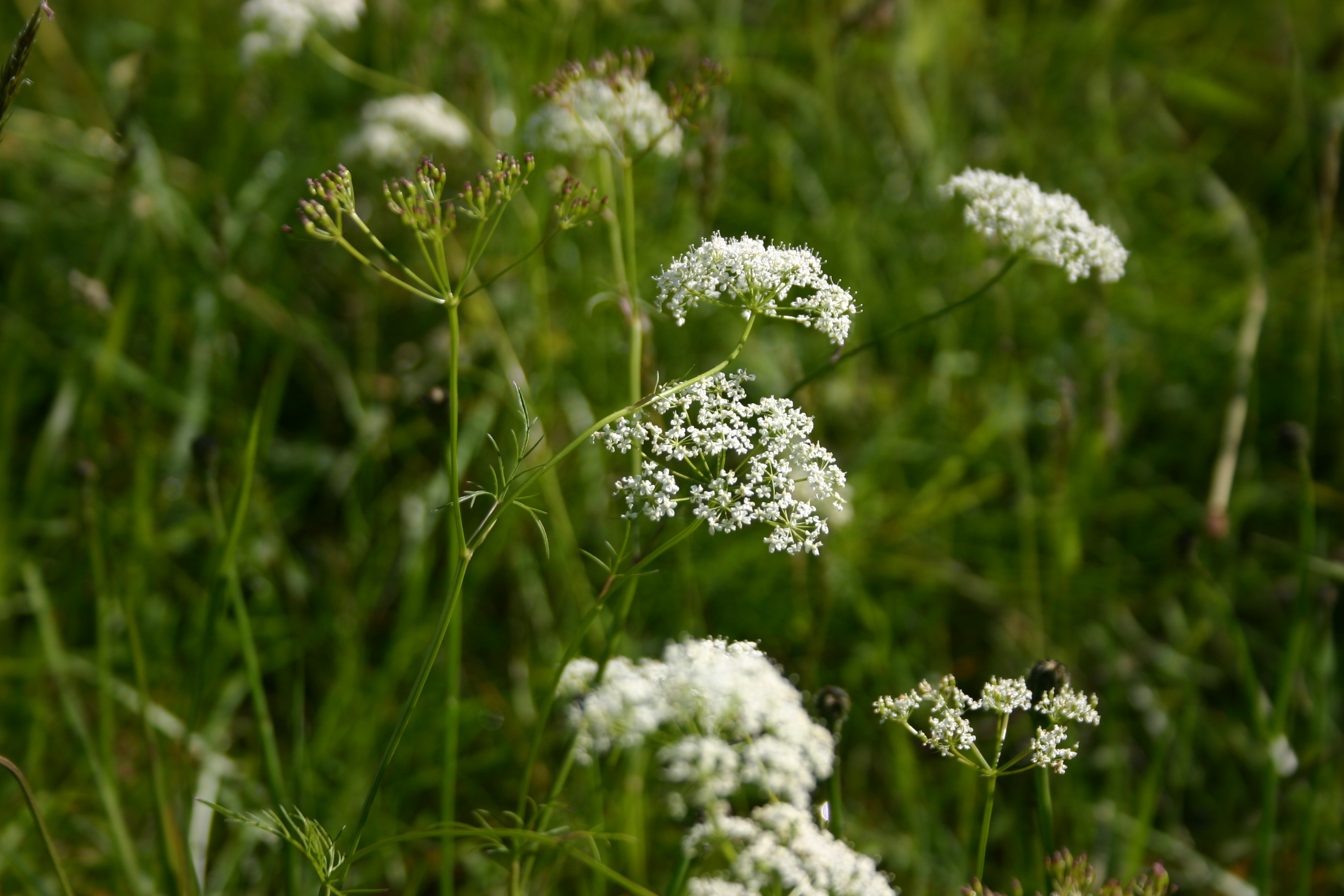
Conopodium is a small genus of flowering plants in the carrot family, Apiaceae (order Apiales), described by W.D.J. Koch. GBIF's Backbone Taxonomy recognises around eight accepted species (plus synonyms), and Wikipedia lists them as C. arvense, C. bunioides, C. glaberrimum, C. majus, C. marianum, C. pyrenaeum, C. subcarneum and C. thalictrifolium. The genus is native to north-western Europe and the Mediterranean basin, with recorded distribution spanning Great Britain, Ireland, Norway, Belgium, Germany, France (including Corsica), Italy (including Sicily), Spain, Portugal, and North Africa (Algeria, Morocco, Tunisia); it has also been recorded in Newfoundland.
Across several languages the genus's common names all point to the same feature: an underground tuber. English speakers call it "pignut" or "earthnut"; German "Erdkastanie" translates literally as "earth chestnut"; French uses "Conopode." This tuberous habit is best documented in the genus's most familiar member, Conopodium majus, a low, slender perennial umbellifer reaching around 30 cm, flowering from May to June with seed set in July and August. It is hermaphrodite, insect-pollinated and self-fertile, and typically grows in woods, hedgerows and open fields on moist, mildly acid to neutral soils — notably, it is never found on alkaline ground.
Each plant produces just a single, small, rounded tuber buried at some depth, which has made pignut-digging a traditional (if fiddly) foraging activity in the British Isles; the tuber is eaten raw or cooked and is often likened in flavour to a cross between sweet potato and hazelnut, sometimes with a mildly hot, radish-like finish. Under cultivation the tuber reportedly grows larger, and selective breeding has been suggested as a way to improve yield, though Conopodium has not become a mainstream food crop. Beyond C. majus, the other species in the genus are far less documented in the general literature, appearing mainly in regional European and North African floras as slender, tuberous umbellifers of grassland, scrub and open woodland habitats similar to those favoured by their better-known relative.
Distribution
Conopodium is native to north-western Europe and the Mediterranean basin. Recorded occurrences span Great Britain, Ireland, Norway, Belgium, Germany, France (including Corsica), Italy (including Sicily), Spain and Portugal, as well as North Africa (Algeria, Morocco, Tunisia), with a further record from Newfoundland.
Ecology
The best-documented species, Conopodium majus, grows in woods, hedgerows and fields on moist, mildly acid to neutral soils, and is never found on alkaline ground. It flowers from May to June, is insect-pollinated, and is self-fertile.
Cultivation
Conopodium majus responds to cultivation by producing larger tubers than it does in the wild, and selective breeding has been suggested as a route to a more productive plant, though each plant still produces only a single tuber. It has a clumping growth habit with limited spread.
Cultural Uses
The tuber of Conopodium majus — known as "pignut" or "earthnut" in English, and "Erdkastanie" ("earth chestnut") in German — has long been foraged and eaten raw or cooked, with a flavour likened to a cross between sweet potato and hazelnut. Each plant yields only one small tuber, which is notoriously fiddly to dig up, making pignut-hunting a traditional pastime in parts of the British Isles.
Taxonomy Notes
Conopodium W.D.J.Koch sits in family Apiaceae, order Apiales. GBIF's Backbone Taxonomy lists 27 names (accepted species and synonyms) under the genus; Wikipedia enumerates eight currently recognised species. Recorded synonyms for C. majus include C. denudatum and Bunium flexuosum.










