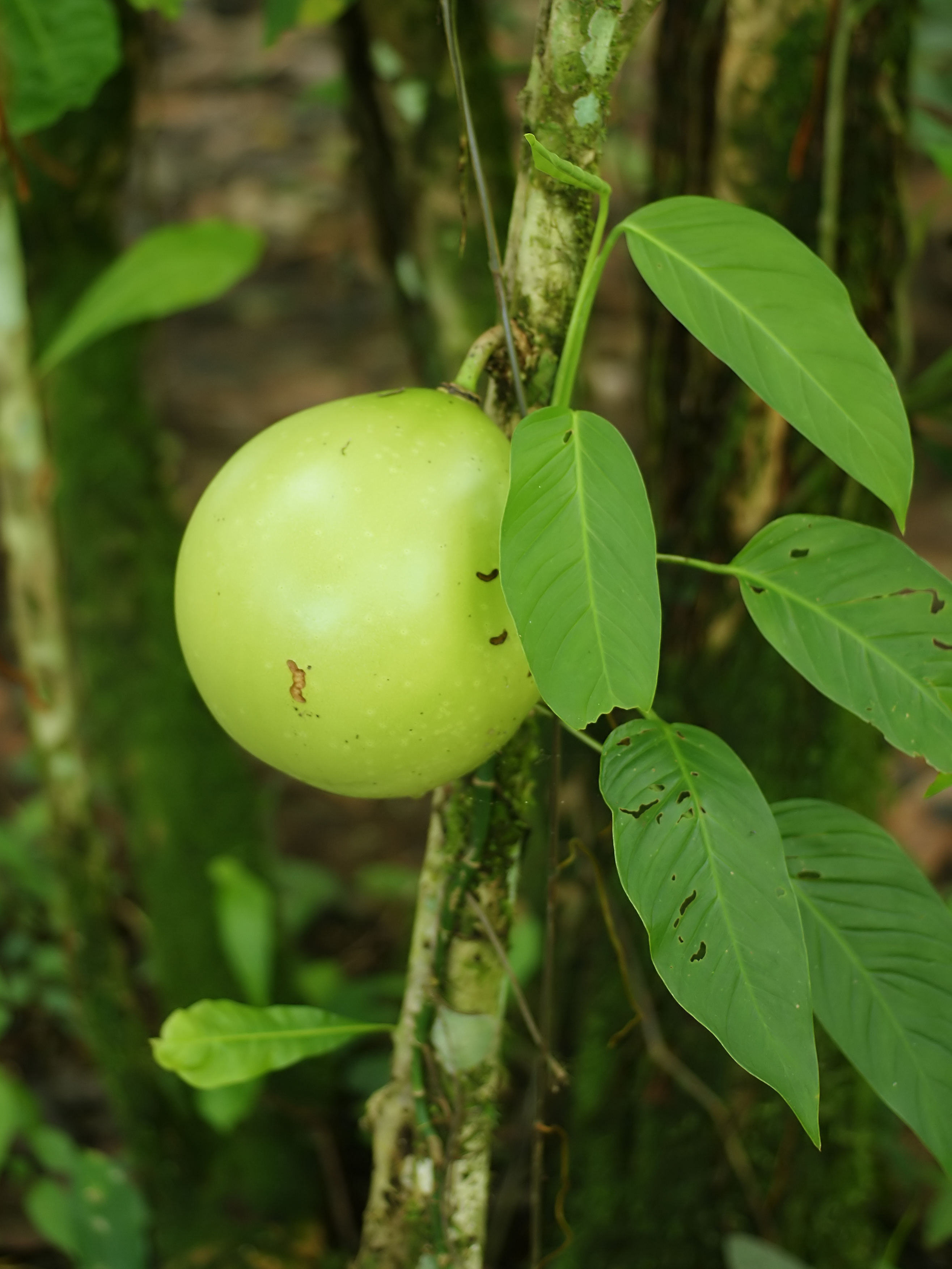
Crescentia is a small genus of six species of flowering trees in the family Bignoniaceae (order Lamiales), native to the tropical and subtropical regions of Mexico, the Caribbean, Central America, and northern South America. The trees are moderate in size, typically reaching 10 metres (35 feet) in height, with thick boles, dense rounded crowns, and simple alternate leaves. Their most distinctive feature is the large, hard-shelled fruit — spherical to oblong, up to 25 centimetres (10 inches) in diameter — whose smooth woody shell has made the genus culturally significant across its range for millennia.
The best-known member is Crescentia cujete L., the calabash tree, which is widely distributed across the Neotropics and is the national tree of St. Lucia. Its bell-shaped flowers are pollinated by bats and can appear directly on the trunk or major branches (a habit called cauliflory). The fruits have nectaries thought to attract ants that deter browsing herbivores, and the tree is a favoured host for epiphytic orchids and bromeliads. Crescentia alata, the Mexican calabash or jicaro, is another widely encountered species found from Mexico through Central America. The remaining species — C. amazonica, C. linearifolia, C. mirabilis, and C. portoricensis — have more restricted ranges within South America and the Caribbean.
The hard shells of the fruit have been fashioned into containers, cups, bowls, spoons, and rattles throughout the Americas; such vessels, known as jícaras in Mesoamerica, were in use long before European contact. The raw pulp and seeds of C. cujete are toxic, though the seeds can be rendered edible by cooking and are used to prepare beverages and a confection called carabobo. The wood, which is light brown, fine-grained, and exceptionally tough when seasoned, has historically been used for ox yokes, tool handles, saddle trees, and stirrups.
Etymology
The genus name Crescentia honours Pietro de' Crescenzi (1233–1320), an Italian jurist and agronomist from Bologna whose influential work Ruralia commoda (c. 1304) was one of the earliest printed books on agriculture in Europe. The common name "calabash" derives from Spanish calabaza (gourd), itself of uncertain origin — possibly from Arabic qar'a yabisa (dry gourd) or Persian kharbuz.
Distribution
Crescentia is native to lowland tropical regions of Mexico, the Caribbean, Central America, and northern South America, including the Amazon basin (C. amazonica) and Puerto Rico (C. portoricensis). The widely cultivated C. cujete has been introduced throughout the tropics and is naturalised in parts of Africa, Asia, and the Pacific. Species occupy moist lowland habitats but are drought-tolerant once established.
Ecology
Crescentia species are plants of the lowland tropics, growing in moist, sunny habitats including forest edges and open woodlands. Flowers are bat-pollinated and often cauliflorous (borne on trunks or large branches). Fruits produce nectaries that attract ants, which in turn protect the tree from herbivores such as goats. The rough-barked trunks and branches are a favoured substrate for epiphytic orchids, bromeliads, and other plants; blocks of calabash wood are even sold commercially for mounting epiphytes.
Cultural Uses
Throughout the Americas, the hard shells of Crescentia fruits have been fashioned into jícaras (drinking cups), bowls, spoons, containers, and rattles for thousands of years. The shells are polished, painted, and incised with decorative designs; in some parts of Africa, where the species was introduced, they are finely carved for ceremonial use. In Mesoamerica, the jícara was a prestige vessel associated with cacao consumption. The wood has been used since colonial times to make stirrups, saddle trees, ox yokes, and tool handles, with some carved examples reportedly still in use after hundreds of years. Medicinally, C. cujete is used across its range for treating colds, respiratory ailments, diarrhoea, intestinal disorders, and as a topical agent for wounds and toothache; the raw pulp and seeds are toxic.










