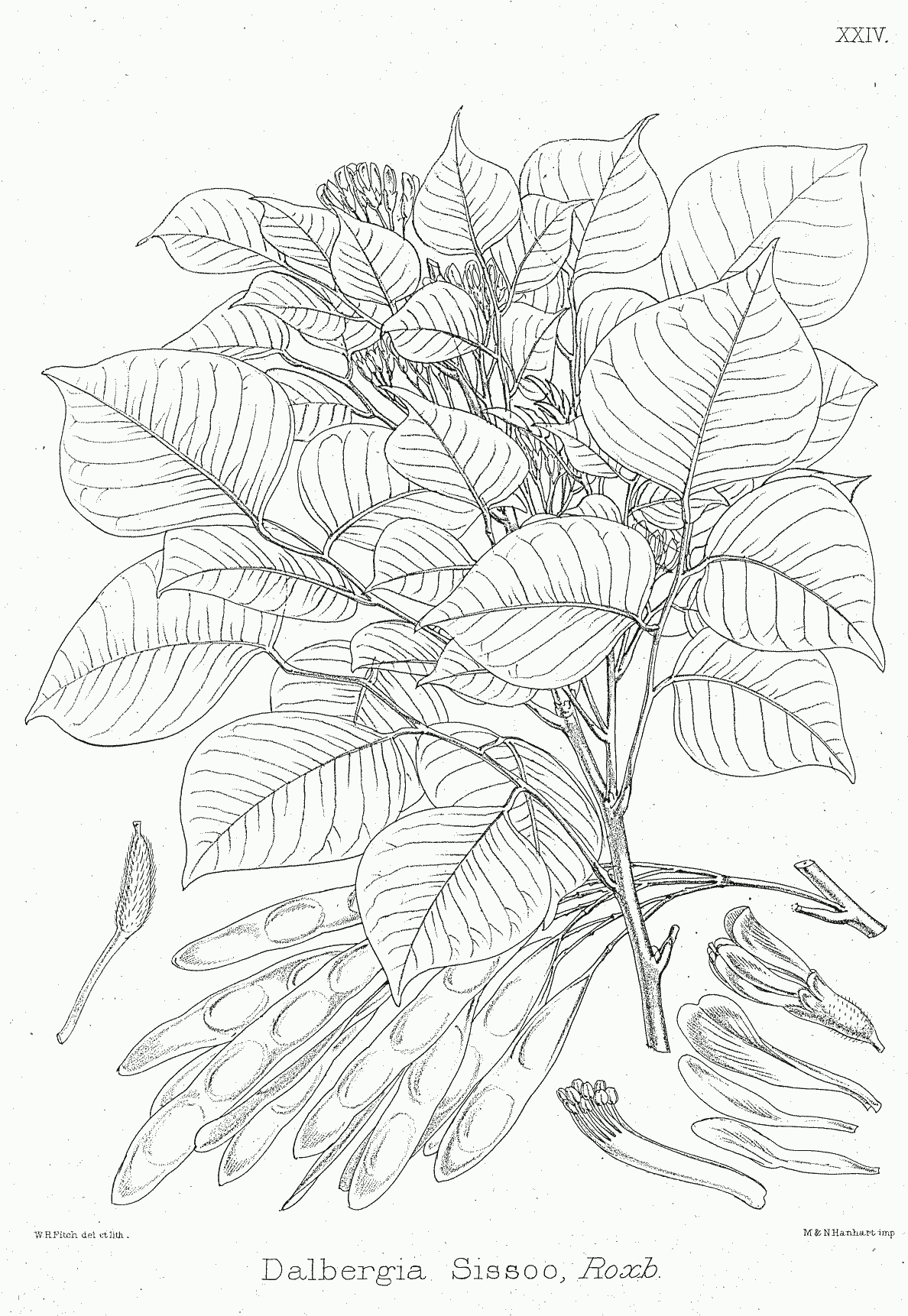
Dalbergia is a large genus of trees, shrubs, and lianas in the legume family Fabaceae (subfamily Faboideae, tribe Dalbergieae), comprising around 284 accepted species according to Kew's Plants of the World Online. The genus was formally described by Carl Linnaeus the Younger (L.f.) and published in Supplementum Plantarum in 1782.
Members of the genus are distributed across the tropical and subtropical regions of Africa, Madagascar, Asia, and the Americas, with a handful of species introduced into the Middle East. They occupy a wide range of habitats, from humid lowland rainforests and gallery forests to drier woodlands and scrub. The wood of many species is notably aromatic, oil-rich, and dense, producing the prized timbers collectively known as rosewoods and palisanders. Well-known commercial timbers include Brazilian rosewood (D. nigra), Indian rosewood (D. latifolia), cocobolo (D. retusa), kingwood, tulipwood, and African blackwood — the last long favored for woodwind instruments. In English the genus is broadly called "rosewood" or "Indian rosewood," while German and Russian speakers use "Palisander/Палисандр," reflecting the same association with luxury timber.
Because of intense commercial demand, virtually all Dalbergia species are now listed under CITES: most fall under Appendix II (regulated trade), while D. nigra holds the stricter Appendix I designation, prohibiting commercial international trade. Many individual species are also assessed as Vulnerable or Endangered on the IUCN Red List.
Etymology
The genus name Dalbergia honors two Swedish naturalists: Nils Dalberg (1736–1820), a physician and botanist, and his cousin Carl Gustaf Dalberg. The German vernacular name "Palisander" and its cognates in Russian ("Палисандр") and other European languages derive from a Dutch/German rendering of the timber trade name for these prized rosewoods, widely used in 18th- and 19th-century cabinetry and instrument-making. The genus was formally established by Carl Linnaeus the Younger, published in Supplementum Plantarum (1782).
Distribution
Dalbergia has a pantropical distribution spanning four continents. Its native range extends across sub-Saharan Africa and Madagascar, through South and Southeast Asia (including the Andaman Islands and Afghanistan's margins), and through Central America, the Caribbean, and tropical South America as far as northeastern Argentina. Kew/POWO records the genus as introduced into Iraq, Oman, and Palestine. Within this range species occupy diverse lowland tropical habitats: humid rainforests, gallery forests and riverine fringes, seasonally dry woodlands, and coastal margins including swamp forests and areas near mangroves.
Ecology
Dalbergia species are typical legumes in their capacity to fix atmospheric nitrogen through symbiotic root bacteria, enabling colonization of nutrient-poor or disturbed soils. Individual species occupy contrasting niches: some (e.g., D. baronii in Madagascar) grow in humid lowland forests at sea level to around 600 m, often near watercourses; others favor drier open woodland. The wood is characteristically dense, aromatic, and rich in oils and sensitizing quinones — the latter responsible for allergic dermatitis reported in woodworkers. The genus has a fossil record extending back to the Chattian and Miocene epochs in Europe and Miocene-era China, indicating a once-broader distribution.
Cultivation
Within the genus, species cultivated in horticulture or forestry generally require tropical to subtropical conditions (USDA hardiness zones 10–12). They perform best in fertile loam soils with full sun and reliably moist conditions, though some species tolerate seasonally dry periods. As legumes, dalbergias are capable of nitrogen fixation and can improve soil fertility — a trait exploited in agroforestry systems. Dalbergia sissoo is among the most widely planted species, used in shelterbelts, urban street plantings, and plantation forestry across South Asia and the Middle East.
Propagation
Seed propagation is the standard method. Dalbergia seeds, like most Fabaceae, have hard seed coats that benefit from scarification to break dormancy: pouring near-boiling water over the seeds and soaking for 12–24 hours in warm water is effective; if seeds still do not swell, carefully nicking the seedcoat and soaking a further 12 hours before sowing is recommended. Germination rates improve significantly after scarification. Vegetative propagation via cuttings is practiced for some species in nursery and plantation contexts.
Conservation
All members of Dalbergia are subject to international trade controls under CITES. The majority of species are listed in CITES Appendix II, meaning commercial trade requires export permits to prevent unsustainable exploitation. Dalbergia nigra (Brazilian rosewood) carries the stricter Appendix I listing, effectively prohibiting commercial international trade. At the species level, D. baronii (Madagascar rosewood) is assessed as Vulnerable by the IUCN, with natural stands described as largely depleted due to severe overexploitation for the guitar and furniture trades; future sustainable use is considered dependent on plantation establishment. The genus-wide CITES listing, which came into force in 2017, was a direct response to large-scale illegal logging and laundering of rosewood timber.
Cultural uses
Dalbergia timbers rank among the most commercially and culturally significant hardwoods in the world. Rosewoods (D. nigra, D. latifolia) and allied species have been the premier material for fine furniture, cabinetry, veneer, and marquetry since at least the 17th century in Europe. African blackwood (D. melanoxylon) is the traditional material for professional-grade woodwind instruments — oboes, clarinets, and bagpipe chanters — valued for its extreme hardness and acoustic resonance. Cocobolo (D. retusa) and kingwood are prized by luthiers for guitar backs and sides. In South Asia, D. sissoo (Indian rosewood / sheesham) is an important timber for furniture and agricultural implements and is widely planted as a street tree and agroforestry species. Traditional carvings and boat building are also documented uses.
Taxonomy notes
Dalbergia L.f. was described in Supplementum Plantarum page 52, published in 1782 by Carl Linnaeus the Younger. POWO recognizes 284 accepted species; GBIF records 526 descendant taxa (including infraspecific taxa and synonyms). The genus carries 16 heterotypic synonyms, including the historically used names Securidaca L. and Pterocarpus P.J.Bergius, both now rejected or superseded. Dalbergia belongs to tribe Dalbergieae within subfamily Faboideae (Fabaceae), order Fabales. Fossil evidence shows the genus or close relatives were present in Europe during the Chattian, Miocene, and Sarmatian stages and in Miocene-era China, suggesting a once-Holarctic distribution that contracted to the tropics.










