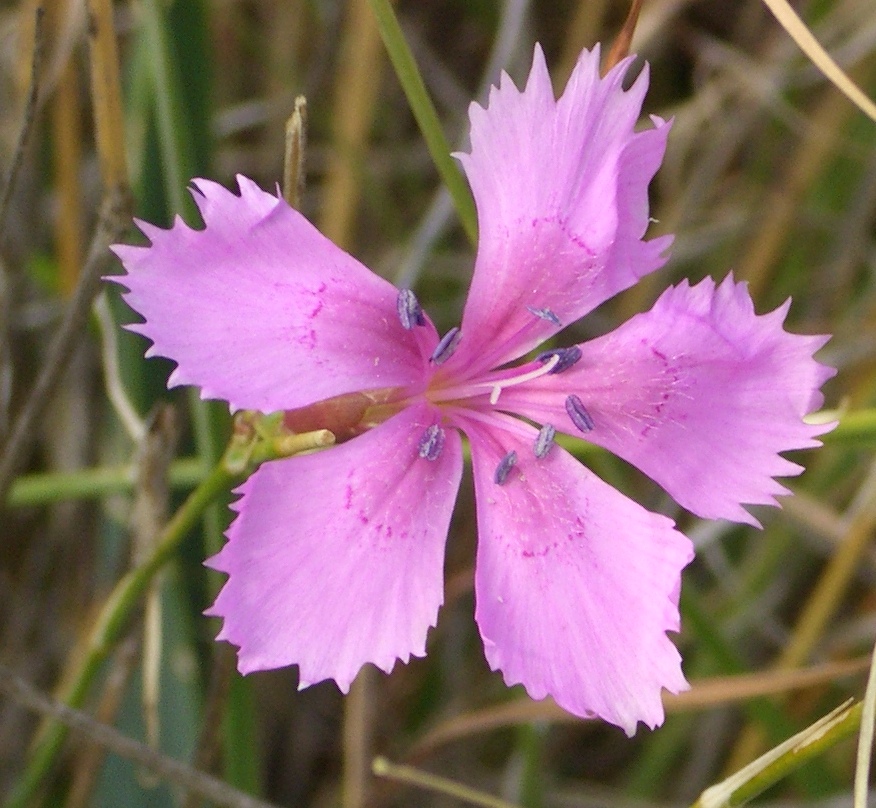
Dianthus is a genus of roughly 340 flowering plant species in the family Caryophyllaceae, order Caryophyllales, comprising mostly herbaceous perennials alongside annuals, biennials, and low subshrubs. Described by Linnaeus in 1753 in his Species Plantarum (p. 409), the genus is native mainly to Europe and Asia, with a smaller representation in northern and southern Africa and a single arctic North American species, Dianthus repens.
Plants are characterized by opposite, simple, mostly linear leaves with a glaucous gray-green to blue-green coloration. The flowers bear five petals with distinctively frilled or "pinked" margins, typically in shades of pale to dark pink, though cultivated selections span white, lilac, purple, and red. One species, D. knappii, is unusual within the genus for producing yellow flowers with purple centers. Many perennial pinks are renowned for a strong, spicy-sweet clove-like fragrance.
The genus is extraordinarily diverse in cultivation, with over 27,000 registered cultivars recorded and six recognized horticultural groups: border carnations (to 60 cm), perpetual-flowering carnations (to 150 cm), Malmaison carnations (to 70 cm), old-fashioned pinks (to 45 cm), modern pinks (to 45 cm), and alpine pinks (to 10 cm). Hybridization has been practiced since at least 1717. More than 100 varieties hold Royal Horticultural Society Awards of Garden Merit. Common names include carnation (D. caryophyllus), pink (D. plumarius), and sweet william (D. barbatus).
Etymology
The genus name Dianthus derives from the Greek compound diósanthos — a fusion of Dios (genitive of Zeus) and anthos (flower), giving the meaning "flower of Zeus" or "divine flower." The epithet was used by the ancient Greek botanist Theophrastus and formalized by Linnaeus in 1753.
The common name "pinks" does not refer to the color. It derives from the verb to pink (attested in English from the 14th century), meaning to decorate with a perforated or punched pattern — precisely describing the frilled, serrated petal margins characteristic of the genus, resembling a cut made by pinking shears. An alternative derivation proposed for the color name traces it to the Dutch word pinksteren, alluding to Pentecost, when many species flower.
Distribution
Dianthus is native primarily to Europe and Asia, with a few species occurring in northern and southern Africa. One species, D. repens, extends into arctic North America, making it the sole representative of the genus on that continent. Natural habitats include high elevations of 2,400–3,000 m in the Himalayas, with range extending through Turkey, Tibet, and Mediterranean regions including Greece.
In Switzerland alone, approximately 25 species and subspecies are documented, including both native and naturalized taxa. Notable Swiss representatives include D. armeria (Deptford pink), D. carthusianorum (Carthusian pink), D. caryophyllus (clove pink), D. deltoides (maiden pink), D. glacialis, D. superbus (superb pink), and D. sylvestris (wild pink).
Ecology
Dianthus species serve as important foodplants for Lepidoptera larvae. Among the most notably dependent are the cabbage moth and the double-striped pug moth. Three species of Coleophora case-bearer moths feed exclusively on Dianthus; Coleophora musculella specializes entirely on D. superbus. The flowers attract bees and butterflies as pollinators. In the Himalayas, several species occupy high-elevation habitats between 2,400 and 3,000 m, indicating adaptation to harsh, well-drained alpine substrates.
Cultivation
Dianthus thrives in full sun with a minimum of six hours of direct light daily; most species cannot grow in shade. Well-drained soil is essential — waterlogged conditions cause root rot and fungal disease. The genus tolerates a range of soil textures from light sandy to heavy clay, and prefers a neutral to slightly alkaline pH, though it can adapt to mildly acidic conditions (down to pH 6). Good air circulation is important.
Plants are hardy across USDA zones 4a–9b (UK hardiness zone 6), making them suitable for a wide range of temperate climates. Habit ranges from compact alpine cushions (as low as 10 cm) to tall perpetual-flowering carnations reaching 150 cm. Garden applications include rock gardens, borders, cutting gardens, containers, cottage gardens, and mass plantings. The plants are deer-resistant and attract bees and butterflies. Petals of organically grown, pesticide-free plants are edible and used as culinary decoration. Leaves may cause mild gastrointestinal distress or dermatitis in sensitive individuals.
Hybridization has been practiced since 1717 and has yielded over 27,000 registered cultivars. More than 100 varieties hold RHS Awards of Garden Merit.
Propagation
Dianthus can be propagated by multiple methods: division of established clumps, layering of stems, sowing from seed, or taking stem cuttings. The genus is self-fertile and flowers from July to August in temperate climates.
Cultural Uses
Dianthus has a long history of symbolic and cultural significance across multiple traditions. In the language of flowers, pink Dianthus symbolizes boldness. In the United Kingdom, D. gratianopolitanus (Cheddar pink) was named Somerset's county flower in 2002. In Japan, D. japonicus serves as the official flower of Hiratsuka city, and D. superbus is associated with the cultural concept of Yamato nadeshiko, an expression used to describe the traditional ideal of Japanese womanhood — graceful, modest, and resilient.
Medicinally, the genus has historically been used as an antiperiodic in the treatment of intermittent fevers, though medicinal use is limited.
Conservation
Conservation status varies considerably across the genus and its range. National flora databases such as InfoFlora (Switzerland) maintain detailed red list designations and habitat classifications (under the TypoCH and Phytosuisse systems) for the roughly 25 Dianthus species and subspecies recorded in the Swiss flora. Some species have restricted distributions and are considered locally vulnerable; consult regional red lists for accurate status of any given taxon.
Taxonomy
Dianthus L. was described by Carl Linnaeus in 1753 in Species Plantarum (p. 409). It belongs to the family Caryophyllaceae within the order Caryophyllales. GBIF records 937 total taxonomic entities (species, synonyms, and infraspecific taxa) under the genus key 3085411, with Dianthus L. treated as the accepted name. The genus encompasses a wide morphological range from annual herbs to low evergreen subshrubs.
Major common names anchored to the genus include: carnation (D. caryophyllus), pinks (D. plumarius and allies), and sweet william (D. barbatus).










