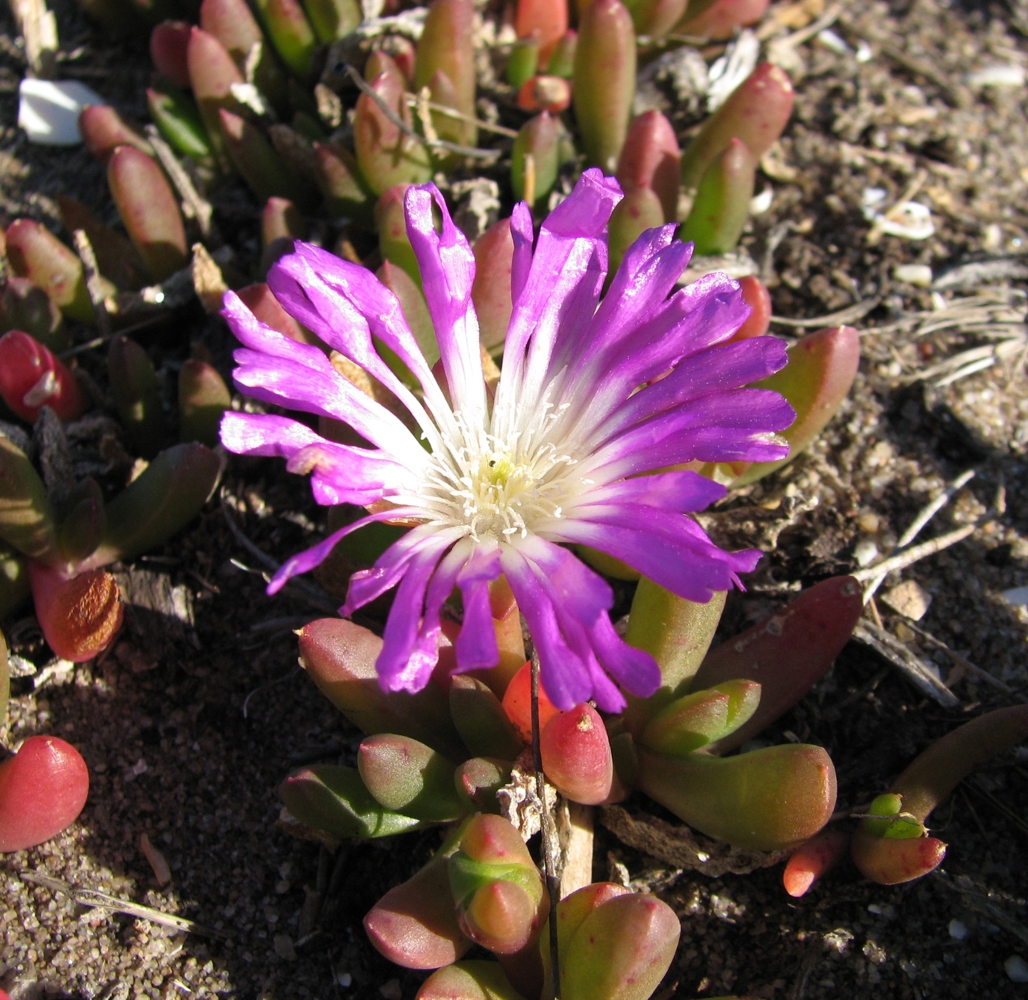
Disphyma is a small genus of succulent flowering plants in the family Aizoaceae (ice plants / fig-marigolds), belonging to the order Caryophyllales. The genus was first formally described in 1925 by N. E. Brown in The Gardeners' Chronicle and currently comprises four accepted species distributed across New Zealand, Australia, and the Cape Provinces of South Africa.
Plants are prostrate, annual or short-lived perennial shrubs whose branches root at nodes, spreading across the ground to form dense mats. The leaves are succulent, arranged alternately, fused at the base, and round to roughly triangular in cross-section — an adaptation for water storage in coastal and semi-arid habitats. Flowers are typically borne singly (occasionally in pairs or threes) at the ends of branches or on short side shoots, each on a pedicel up to 100 mm long. The perianth is tube-shaped with five sepals — two larger and leaf-like, three smaller and slightly succulent. Conspicuous petal-like purplish staminodes are arranged in two rows, many stamens in four or five rows, and the inferior ovary bears usually five styles. The fruit is a capsule.
Notable species include Disphyma crassifolium, the most widespread member, native to Australia and southern Africa; Disphyma australe, endemic to New Zealand; and Disphyma papillatum, restricted to the Chatham Islands. Disphyma crassifolium subsp. clavellatum, endemic to Australia, has also been introduced to the South Island of New Zealand.
Etymology
The genus name Disphyma is derived from Greek, though the specific derivation is not detailed in the sources consulted. The genus was erected by N. E. Brown in 1925.
Distribution
Disphyma species are native to New Zealand, Australia, and the Cape Provinces of South Africa. Disphyma australe is endemic to New Zealand (with a subspecies restricted to Kermadec Island), Disphyma papillatum is restricted to the Chatham Islands, and Disphyma dunsdonii is endemic to the Cape Province. Disphyma crassifolium ranges across Australia and southern Africa and has been introduced to the South Island of New Zealand.
Ecology
Species in the genus typically grow in coastal and low-lying habitats, consistent with their succulent, mat-forming habit and tolerance for saline or exposed conditions — characteristic of many Aizoaceae.
Taxonomy Notes
The genus Disphyma was first formally described by N. E. Brown in 1925 in The Gardeners Chronicle. It belongs to the family Aizoaceae in the order Caryophyllales. As accepted by Plants of the World Online (October 2020), the genus comprises four species and two subspecies. GBIF records six descendant taxa. Disphyma sits within the "ice plant" clade of Aizoaceae alongside genera such as Carpobrotus and Lampranthus.










