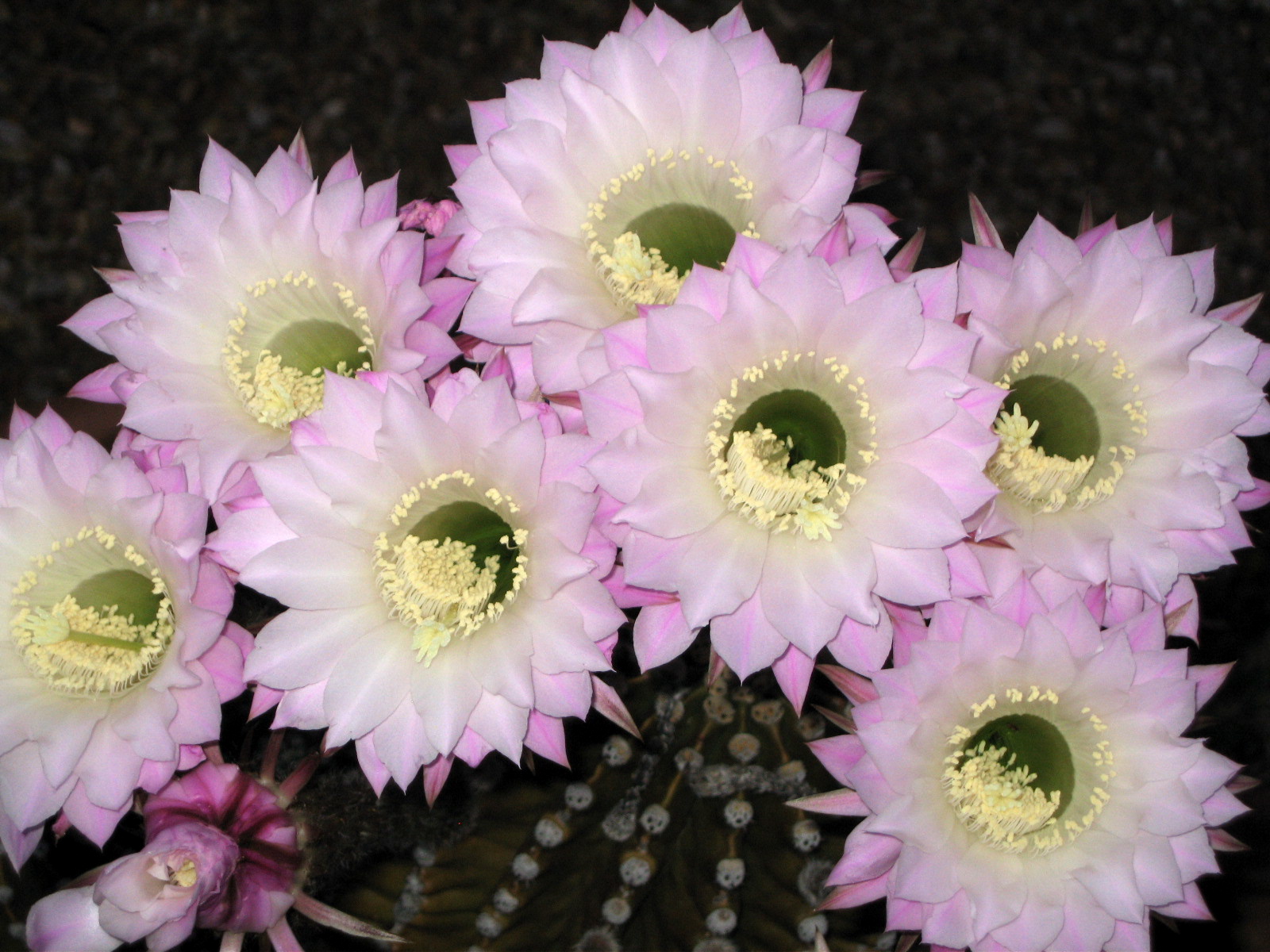
Echinopsis is a genus of South American cacti in the family Cactaceae, established by the German botanist Joseph Gerhard Zuccarini in 1837. The name combines the Greek roots echinos ("hedgehog" or "sea urchin") and opsis ("appearance"), a nod to the dense, often formidable spine cover that wraps many of its species. In English-language horticulture the group has acquired a handful of common names — Easter lily cactus, hedgehog cactus, and sea urchin cactus — none of which captures the full diversity of forms the genus contains.
Habit within Echinopsis is unusually varied for a single cactus genus, ranging from small globose plants barely the size of a fist to large, treelike columnar species several metres tall. Stems are typically ribbed and well armed with areoles bearing radial and central spines. What unites the group, more than any single growth form, is the flowers: large, funnel-shaped, often nocturnal blooms borne on remarkably long floral tubes. Classic descriptions of the genus highlight "the great size, length of tube, and beauty of their flowers, borne upon generally small and dumpy stems," and many species are heavily fragrant on warm evenings, attracting bees, butterflies, and night-flying moths.
Taxonomically Echinopsis sits in subfamily Cactoideae, tribe Cereeae, subtribe Trichocereinae. Its circumscription has shifted substantially: molecular studies in 2012 and 2019 demonstrated that earlier morphology-based generic splits — including Trichocereus, Lobivia, Chamaecereus, and Soehrensia — actually reflected convergent evolution of growth form and pollinator syndrome rather than separate evolutionary lineages, and these names have largely been absorbed back into Echinopsis. Recent treatments recognise roughly 80 accepted species, though the figure fluctuates as revisions continue; the GBIF backbone currently tracks 92 descendant taxa under the genus.
In the wild, Echinopsis species are concentrated in Argentina, Bolivia, Peru, Brazil, Paraguay, and Uruguay, with the greatest diversity in the Andes and adjacent foothills. They favour desert grasslands and shrublands, typically rooted in sandy or gravelly substrates and frequently colonising rocky hillsides and rock-crevice microhabitats where competition is limited and drainage is sharp.
Etymology
The genus name Echinopsis was coined by Joseph Gerhard Zuccarini in 1837, combining the Greek echinos — hedgehog or sea urchin — with opsis, meaning appearance or likeness. The compound captures the prickly, rounded silhouette of the smaller globose species that early European botanists encountered first. The same imagery survives in several English vernacular names still in use today, including hedgehog cactus and sea urchin cactus.
Distribution
Echinopsis is exclusively South American in its native range. Species occur across Argentina, Bolivia, Peru, Brazil, Paraguay, and Uruguay, with greatest concentration in the Andean cordillera and its eastern foothills. NCSU summarises the core range as "Peru, West Central and Southern Brazil and Northern Argentina." Some well-known members, such as E. pachanoi, are native specifically to high-Andean valleys of Ecuador and Peru at 2,000–3,000 m elevation, while others extend to lower-elevation grassland and rocky habitats further south. The genus has spread far beyond its native range in cultivation, and several species are now grown ornamentally around the world.
Ecology
Echinopsis species are characteristic plants of arid and semi-arid South American landscapes. They occupy desert grasslands and shrublands, and are particularly associated with sandy or gravelly substrates and rocky hillsides where they often anchor themselves in rock crevices. These conditions provide the sharp drainage and lean soils the genus tolerates well. The large, funnel-shaped flowers — many of which open at night and release a strong fragrance — attract bees, butterflies, and moths, and several species have evolved features consistent with hawkmoth pollination.
Cultivation
Echinopsis is among the easier cactus genera to grow and has long been a horticultural favourite. NCSU rates the group as hardy in USDA zones 8b–11b, with most species preferring full sun (six or more hours daily) but tolerating partial shade. The recurring theme across cultivation guidance is drainage: well-drained sandy or rocky soils are essential, and the classic recommendation is "light loam, with a little leaf mould and a few nodules of limestone." The thick, water-storing stems make Echinopsis notably drought tolerant; the most common cultivation failure is overwatering, which leads quickly to root rot. Mealybugs and scale are the typical pests to watch for. The genus is widely used as container plants, houseplants, and accents in rock gardens and drought-tolerant landscapes.
Propagation
Echinopsis is propagated either from seed or by stem cuttings. Cuttings are widely used because many species offset readily, producing pups around the base or along the stem that can be detached, calloused, and rooted. Seed propagation is straightforward but slower and is more commonly used by collectors interested in genetic variation or in raising species that offset less freely.
Cultural uses
Several Echinopsis species occupy a remarkable place in South American ethnobotany. The best-known is Echinopsis pachanoi, the San Pedro cactus or huachuma, which carries archaeological evidence of ceremonial use spanning more than two thousand years among the Moche, Nazca, and Chavín cultures. It is the central plant in the mesa norteña shamanic tradition of northern Peru, where it is prepared as a bitter brew known as cimora, sometimes combined with tobacco, and used for healing, divination, and contact with ancestral spirits. The Spanish renaming as "San Pedro" — after Saint Peter, holder of the keys to heaven — reflects the colonial syncretism through which the practice survived missionary suppression. In 2022 Peru's Ministry of Culture formally recognised traditional San Pedro use as cultural heritage.
The related Echinopsis peruviana, the Peruvian torch, has a similarly deep history of ceremonial use among indigenous Andean peoples — pollen evidence from Guitarrero Cave pushes documented use back to roughly 8600 BCE, with explicit depictions on pre-Columbian ceramics by ~1300 BCE. Both species owe their psychoactive reputation to mescaline, recorded at levels ranging from undetectable in some wild plants up to roughly 4.7% of dry weight in selected shamanic cultivars, alongside other alkaloids including hordenine and tyramine. The variability across populations suggests centuries of selective cultivation for ceremonial potency.
History
The genus was formally established in 1837 by the German botanist Joseph Gerhard Zuccarini, published in Abhandlungen der Bayerischen Akademie der Wissenschaften, München 2: 675. For much of the twentieth century, cactus systematists split the group on morphological grounds into several segregate genera — most prominently Trichocereus (for the tall columnar species), Lobivia (for many globose Andean species), Chamaecereus, and Soehrensia. Molecular phylogenetic work published in 2012 and 2019 demonstrated that these segregates were not natural groups: similar growth forms and shared pollinators had evolved repeatedly in unrelated lineages, producing classic convergent evolution. As a result, modern treatments have re-absorbed most of these names back into Echinopsis, restoring Zuccarini's broader concept of the genus.
Taxonomy notes
Echinopsis Zucc. is an accepted genus in the Cactaceae (subfamily Cactoideae, tribe Cereeae, subtribe Trichocereinae). Current estimates put accepted species at around 80, though the GBIF backbone tracks 92 descendant taxa as figures continue to shift with ongoing revisions. The genus has long been taxonomically unstable: Trichocereus, Lobivia, Chamaecereus, and Soehrensia are among the segregate genera that have been variously split off and merged back in. Molecular phylogenies have consistently supported a broad Echinopsis concept, and many famous "Trichocereus" species — including the San Pedro cactus and the Peruvian torch — are now treated under Echinopsis combinations.










