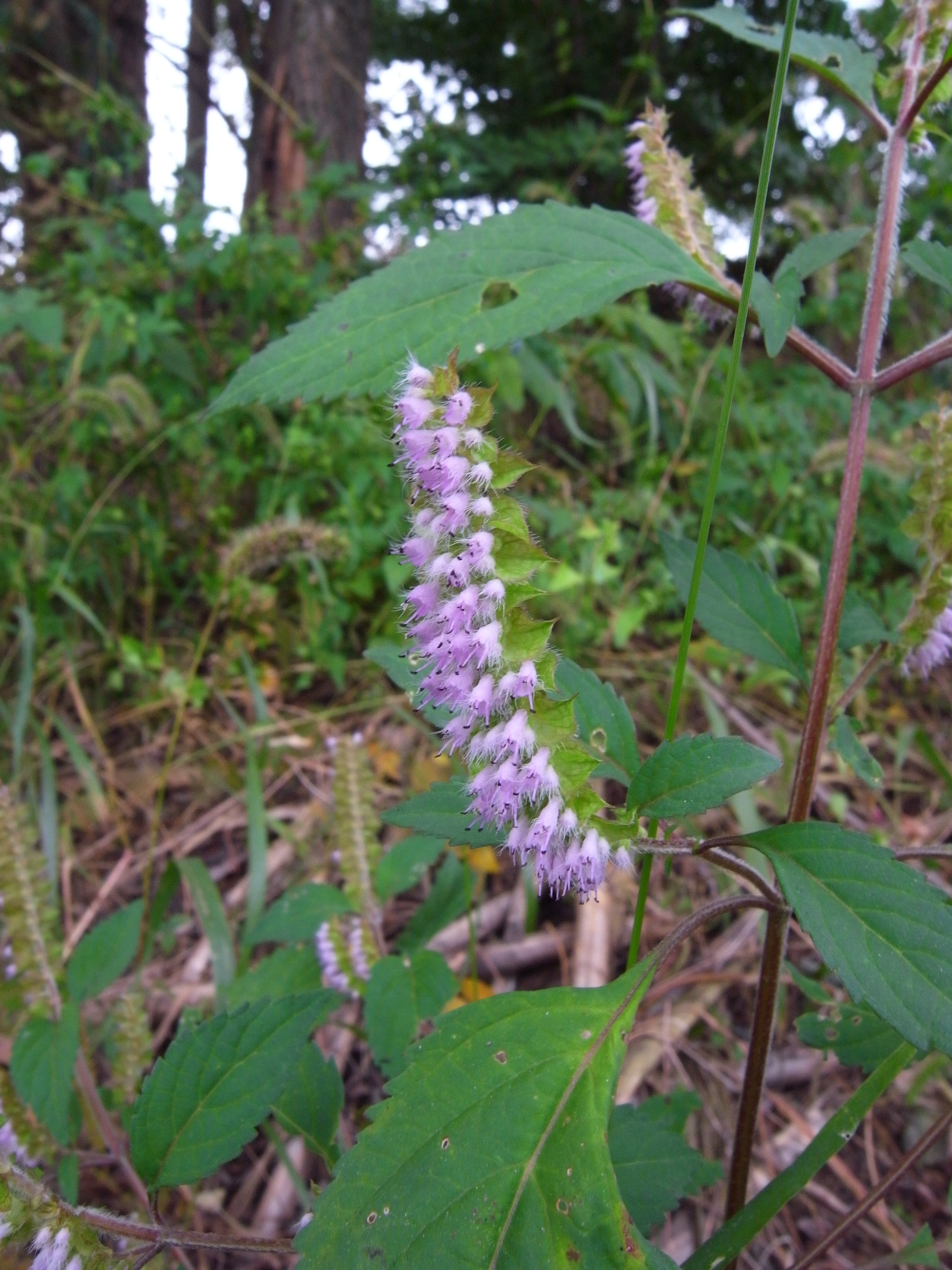
Elsholtzia is a genus of roughly 40–50 species of annual and perennial herbs and subshrubs in the mint family (Lamiaceae), order Lamiales. The genus was described by the German botanist Carl Ludwig Willdenow in 1790, who named it in honour of the Prussian physician and naturalist Johann Sigismund Elsholtz (1623–1688).
Plants in the genus are typically aromatic, with opposite, toothed or entire leaves and dense terminal or axillary spikes of small, two-lipped flowers in shades of purple, pink, or white — characteristic of the broader mint-family form. Several species have been noted for their copper-tolerant properties, making them of interest in phytoremediation research, particularly Elsholtzia splendens and E. argyi, which are studied for their ability to accumulate heavy metals in contaminated soils.
The genus is distributed across much of temperate and tropical Asia, ranging from Siberia and the Russian Far East south through China, Japan, Korea, the Himalayan region, northeastern India, and Indochina, with some species extending into the Indonesian archipelago and others reaching Central Asian ranges in Afghanistan, Kyrgyzstan, and Tajikistan. China is the principal centre of diversity, with the majority of species occurring there. Elsholtzia stauntonii, native to northern China, is grown as an ornamental shrub in temperate gardens for its late-summer spikes of lilac-purple flowers. Elsholtzia ciliata, the most widespread species in the genus, has been used in traditional medicine and as a culinary herb across its range in East and South Asia.
Etymology
The genus name Elsholtzia honours Johann Sigismund Elsholtz (1623–1688), a Prussian physician and naturalist. The name was given by Carl Ludwig Willdenow when he formally described the genus in 1790, published in Botanisches Magazin (Römer & Usteri).
Distribution
Elsholtzia is widespread across temperate and tropical Asia, spanning from Siberia and the Russian Far East south through China, Japan, Korea, the Himalayas, northeastern India, and Indochina to Indonesia. Several species also extend into Central Asia (Afghanistan, Kyrgyzstan, Tajikistan, Mongolia). China hosts the greatest diversity of species within the genus.










