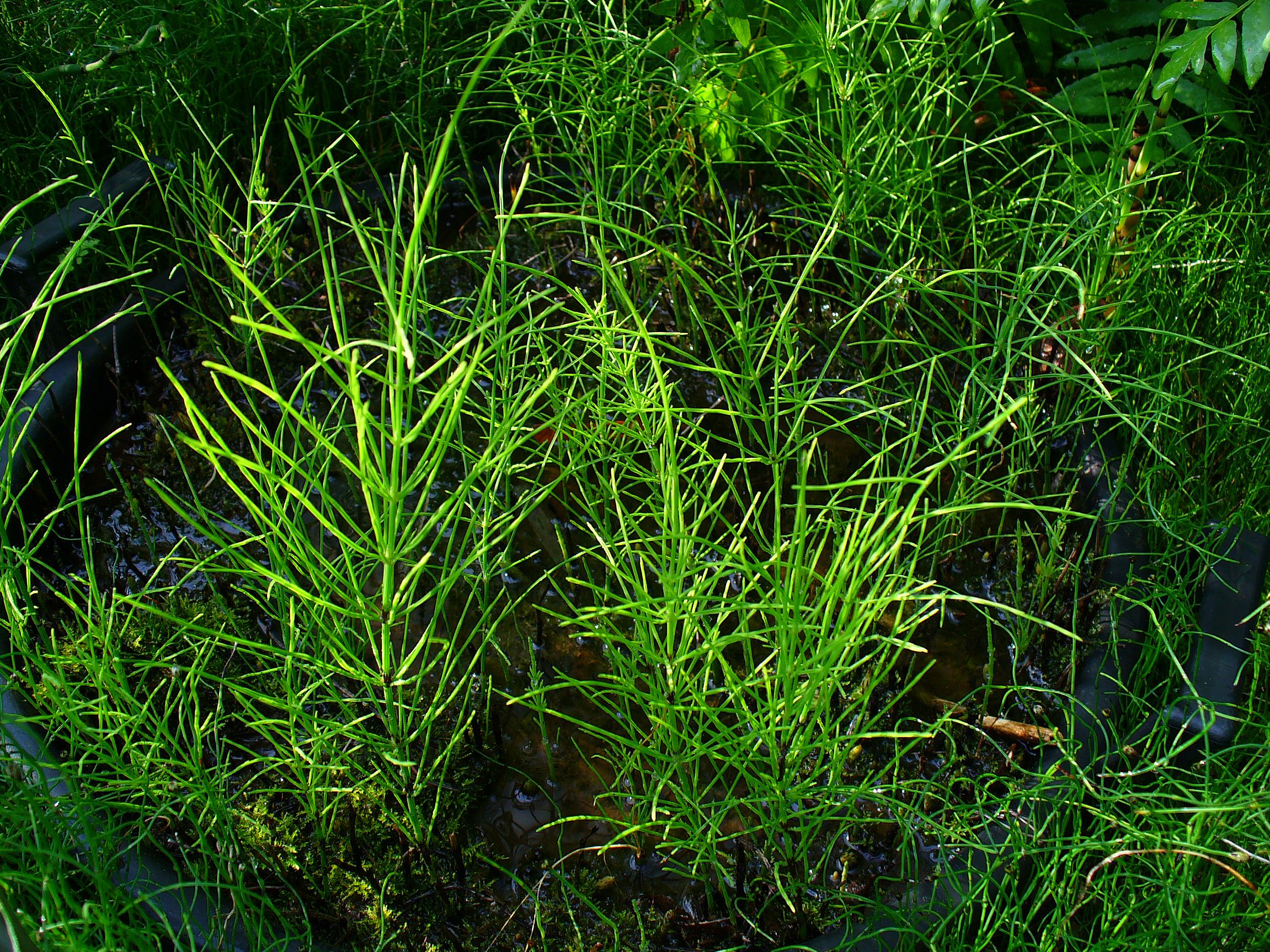
Equisetum — commonly known as horsetails or scouring rushes — is the sole living genus of the ancient plant family Equisetaceae, and the last surviving member of a lineage (subclass Equisetidae) that dominated forests on Earth for over 100 million years. These plants are true "living fossils": their massive tree-like relatives, the Calamites, formed vast coal-forest understories during the Carboniferous period roughly 300 million years ago and grew to 30 metres tall, while modern horsetails are modest herbaceous perennials, typically 20 cm to 1.5 m in height — though tropical giants such as Equisetum giganteum still reach up to 8 metres in South American subtropical forests.
The genus is instantly recognisable by its hollow, jointed, ribbed stems that are encrusted with silica, and by the whorls of tiny fused scale-like leaves that ring each node. Photosynthesis occurs almost entirely in the green stems rather than the leaves. Most species produce two distinct stem types across the season: pale, cone-bearing fertile shoots that appear first in spring, and later green, branched vegetative shoots that carry out photosynthesis. Spores are produced in strobili — tight cone-like structures at the shoot tips.
Approximately 18 to 25 species are recognised worldwide (18 by Plants of the World Online; researchers differ on boundaries). The genus is near-cosmopolitan in distribution, found across every major continent except Antarctica and is naturally absent from Australia, New Zealand, and most Pacific islands. Northern Europe supports the greatest diversity, with ten species, while the Neotropics and temperate Asia also have significant representation. Horsetails are typically plants of moist, disturbed, or waterlogged habitats — stream banks, marshes, wet meadows, roadsides — and spread not only by spores but also aggressively through deep underground rhizomes. The name Equisetum derives from the Latin equus (horse) and seta (bristle), a reference to the bushy branched appearance of the sterile stems resembling a horse's tail.
Etymology
The genus name Equisetum is classical Latin, compounded from equus (horse) and seta (bristle), an allusion to the wiry, brush-like appearance of the branched vegetative stems, which were thought to resemble a horse's tail. The common name "horsetail" carries the same imagery. The alternative common name "scouring rush" reflects a practical historical use: the silica-impregnated stems were widely used to scour and polish metal cookware and wooden surfaces before modern abrasives were available. Other vernacular names include "candock" and "puzzlegrass." Linnaeus formally established the genus in his Species Plantarum of 1753.
Distribution
Equisetum has a near-cosmopolitan range, occurring on every continent except Antarctica and absent naturally from Australia, New Zealand, and most oceanic Pacific islands. The greatest species diversity is found in northern Europe (ten species) and in temperate to subtropical parts of North America and Asia. In Switzerland alone, InfoFlora documents ten species plus two hybrids. The genus is primarily a plant of moist, low-lying, and often disturbed environments: riparian margins, marshes, wet meadows, open fields, arable land, waste places, hedgerows, and roadsides. Most species require consistently moist or waterlogged soils. A few species tolerate drier or more exposed conditions; Equisetum hyemale (rough horsetail) grows in sandy, well-drained as well as moist soils. The subtropical Equisetum giganteum and E. myriochaetum extend the genus's range into South and Central America, where they occupy stream margins in warm, humid climates.
Ecology
Horsetails are spore-bearing vascular plants that reproduce without seeds. Spores are produced in strobili — compact, cone-like structures at the apex of fertile shoots. The spores are equipped with hygroscopic elaters (coiled ribbon-like appendages) that aid in dispersal. In addition to spore reproduction, the genus spreads extensively and persistently via deep, branching underground rhizomes. This rhizome network makes Equisetum highly competitive in disturbed habitats and notoriously difficult to eradicate once established in agricultural fields or gardens.
The silica-encrusted stem surfaces deter herbivory and give the plants exceptional physical durability. The plants accumulate silica (up to approximately 10% of dry weight in some species) from soil water. Equisetum is frequently a pioneer on bare, moist, or waterlogged mineral soils — colonising stream banks after flooding, road cuttings, and disturbed wetland margins. Several species, notably E. arvense and E. palustre, are considered persistent weeds of arable and pasture land across the temperate Northern Hemisphere. The genus is also toxic to livestock (especially horses) when consumed in quantity, due to the enzyme thiaminase which destroys vitamin B1; cooking destroys this enzyme and renders the plants safe for human consumption.
Cultivation
In gardens, horsetails are grown primarily as architectural accent plants, valued for their strongly vertical, jointed stems and striking geometric form. Equisetum hyemale (rough horsetail / scouring rush) is the most commonly cultivated species, prized for its evergreen, bamboo-like dark green stems reaching 1–1.5 m. Equisetum arvense is rarely cultivated deliberately as it spreads aggressively and is usually regarded as a weed.
All species require moist to wet soil and perform well beside water features, in bog gardens, or in containers placed in shallow water. They are extremely cold-hardy, tolerating temperatures down to approximately -30°C. Full sun to part shade is tolerated. The primary challenge in cultivation is containment: rhizomes spread vigorously and indefinitely unless physically restricted. Growing horsetails in submerged or above-ground containers, or lining beds with root barriers, is strongly recommended to prevent them from colonising surrounding areas. Once established, they require minimal care and are largely resistant to pests and disease.
Propagation
Horsetails are propagated almost exclusively by division of the rhizome, typically in spring. Rhizome sections with at least one node readily regenerate when replanted in moist soil or placed in shallow water. Spore propagation is possible but rarely practised in horticulture: spore viability is very short (often only a few days under ambient conditions), germination is slow and erratic, and prothalli (the small gametophyte generation) require specific wet conditions. Division is therefore the standard and reliable method. The aggressive rhizome growth that makes Equisetum a problematic weed also makes vegetative propagation straightforward when intentional.
Cultural uses
Horsetails have a long and varied history of human use. The young, emerging fertile shoots of Equisetum arvense are eaten in Japan — known as tsukushi — typically boiled, drained, and prepared with seasoning; they are considered a spring delicacy. Young vegetative shoots were also gathered as food by various indigenous peoples in North America and Asia, though their collection is labour-intensive.
Medicinally, E. arvense has been used across European and Asian traditional medicine as a diuretic, astringent, haemostatic, and antiseptic, with applications for kidney and bladder disorders, urinary tract infections, wound healing, and connective tissue support (attributed to the high silica content). However, the European Food Safety Authority found insufficient evidence to substantiate the purported health benefits. Caution is warranted: the plants contain thiaminase (which destroys vitamin B1) and, in large amounts, equisetic acid — a potent nerve and heart sedative. Internal use should be short-term only.
The silica-rich stems have been used practically across cultures as natural scouring pads for cleaning metal cookware and wooden utensils, as fine-grade sandpaper for woodworking, and as a fungicidal spray (diluted horsetail tea is used by some organic gardeners to suppress mildew and black spot). The plant also yields a pale pink dye and can be fermented into a liquid plant fertiliser.
History
The fossil record of Equisetaceae spans roughly 350 million years. During the Carboniferous period (approximately 300 Mya), arborescent relatives such as Calamites — which could grow to 30 metres tall and up to 1 metre in diameter — formed major components of the coal swamp forests that gave rise to much of the world's coal. The herbaceous lineage leading to modern Equisetum first appears clearly in the Jurassic fossil record, surviving the Permian-Triassic and Cretaceous-Paleogene extinctions that eliminated all other Equisetidae. The result is a genus of extraordinary antiquity, essentially unchanged in gross morphology for tens of millions of years — earning its reputation as a "living fossil." Linnaeus formally described the genus in 1753 in Species Plantarum, bringing together the then-known European species under one name that has remained stable ever since.
Taxonomy notes
Equisetum L. (1753) is the only accepted genus in the family Equisetaceae and the sole living representative of the order Equisetales. In modern classification it sits within class Polypodiopsida (the ferns and fern allies), phylum Tracheophyta. GBIF (taxon 2687913) records the genus as accepted, authored by Linnaeus and published in Sp. Pl. 2: 1061 (1753).
Three subgenera are currently recognised: subg. Equisetum (branched horsetails), subg. Hippochaete (scouring rushes, with harder rougher stems and persistent cones), and subg. Paramochaete. Plants of the World Online accepts approximately 18 species; some monographers recognise up to 25, the difference largely stemming from treatment of local variants and recent segregates. GBIF records 122 total taxon entries under the genus, including accepted species, hybrids, subspecies, and synonyms. Hybrid species are frequently documented — examples include Equisetum ×moorei and Equisetum ×trachyodon recorded in Switzerland by InfoFlora. The modern genus dates to the Jurassic, though its fossil relatives (Calamites and kin) extend the lineage deep into the Devonian.










