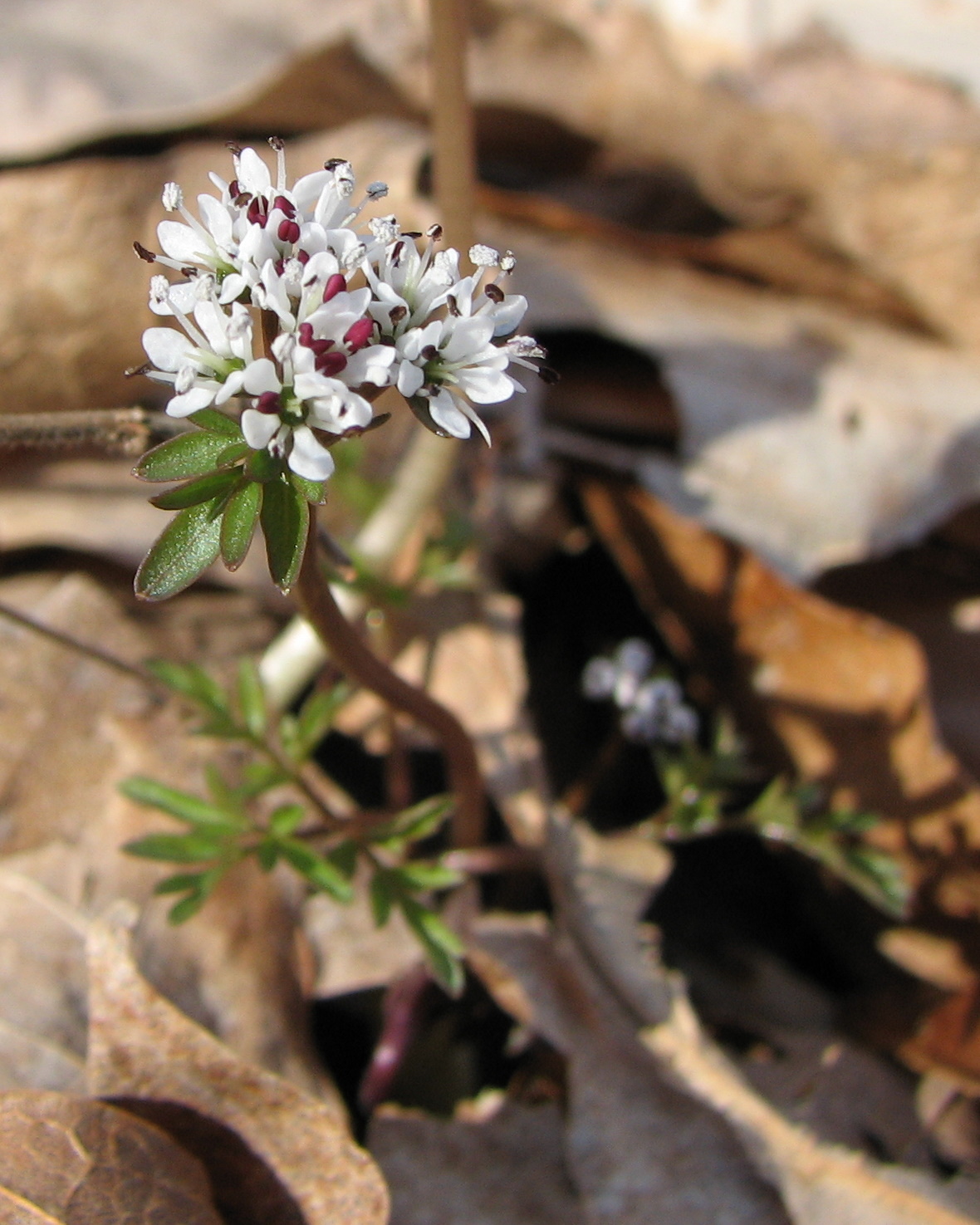
Erigenia is a monotypic genus of flowering plant in the carrot family, Apiaceae, containing the single species Erigenia bulbosa — commonly known as harbinger of spring, or pepper and salt. It is the sole member not only of its genus but of tribe Erigenieae within Apiaceae, and was described by American botanist Thomas Nuttall in his Genera of North American Plants (1818).
The plant is a small spring ephemeral of eastern North American forests, reaching only 5–15 cm in height while flowering. A spherical underground bulb sends up a single purplish stem that terminates in an umbel of small flowers with white, widely spaced, teardrop-shaped petals (3–4 mm long) and conspicuous dark-reddish anthers, giving the inflorescence a "pepper and salt" speckled look. The leaves are sheathed at the base and finely pinnately divided, in keeping with the family's typical foliage.
True to its common name, Erigenia bulbosa is among the earliest-blooming native wildflowers in the rich hardwood forests it inhabits, flowering from late February through early April alongside other early spring ephemerals such as spring beauty (Claytonia virginica) and cut-leaf toothwort (Cardamine laciniata). Its flowers are pollinated chiefly by solitary bees, with flies and honey bees playing a lesser role; the nectar, produced in small daily amounts per flower, consists solely of fructose. Unusually for a plant, it does not form vesicular-arbuscular mycorrhizal associations with fungi.
The genus's range spans rich hardwood forests of eastern North America, from central New York and southern Wisconsin south to central Alabama and west to the western Ozarks, with an outlying occurrence in extreme southern Ontario. Within parts of this range it is uncommon enough to be listed as state-endangered, and its edible bulb has a history of use, including as a toothache remedy chewed by the Cherokee.
Distribution
Erigenia occurs in rich hardwood forests of eastern North America, ranging north to central New York and southern Wisconsin, west to the western Ozarks, south to central Alabama, and into extreme southern Ontario.
Ecology
As a spring ephemeral, its sole species flowers from late February through early April alongside associates like spring beauty and cut-leaf toothwort, and is pollinated mainly by solitary bees (also flies and honey bees). Its fructose-only nectar and lack of vesicular-arbuscular mycorrhizal associations are notable ecological traits.
Conservation
The genus's only species is listed as a state-endangered plant in New York and Wisconsin.
Cultural Uses
The bulb is edible raw or cooked; the Cherokee reportedly chewed the plant as a toothache remedy. It is occasionally grown in native wildflower gardens within its natural range.
Taxonomy Notes
Erigenia is monotypic, containing only Erigenia bulbosa, and is likewise the sole genus of tribe Erigenieae within family Apiaceae (order Apiales). The genus was published by Thomas Nuttall in 1818 (Gen. N. Am. Pl. 1: 187).










