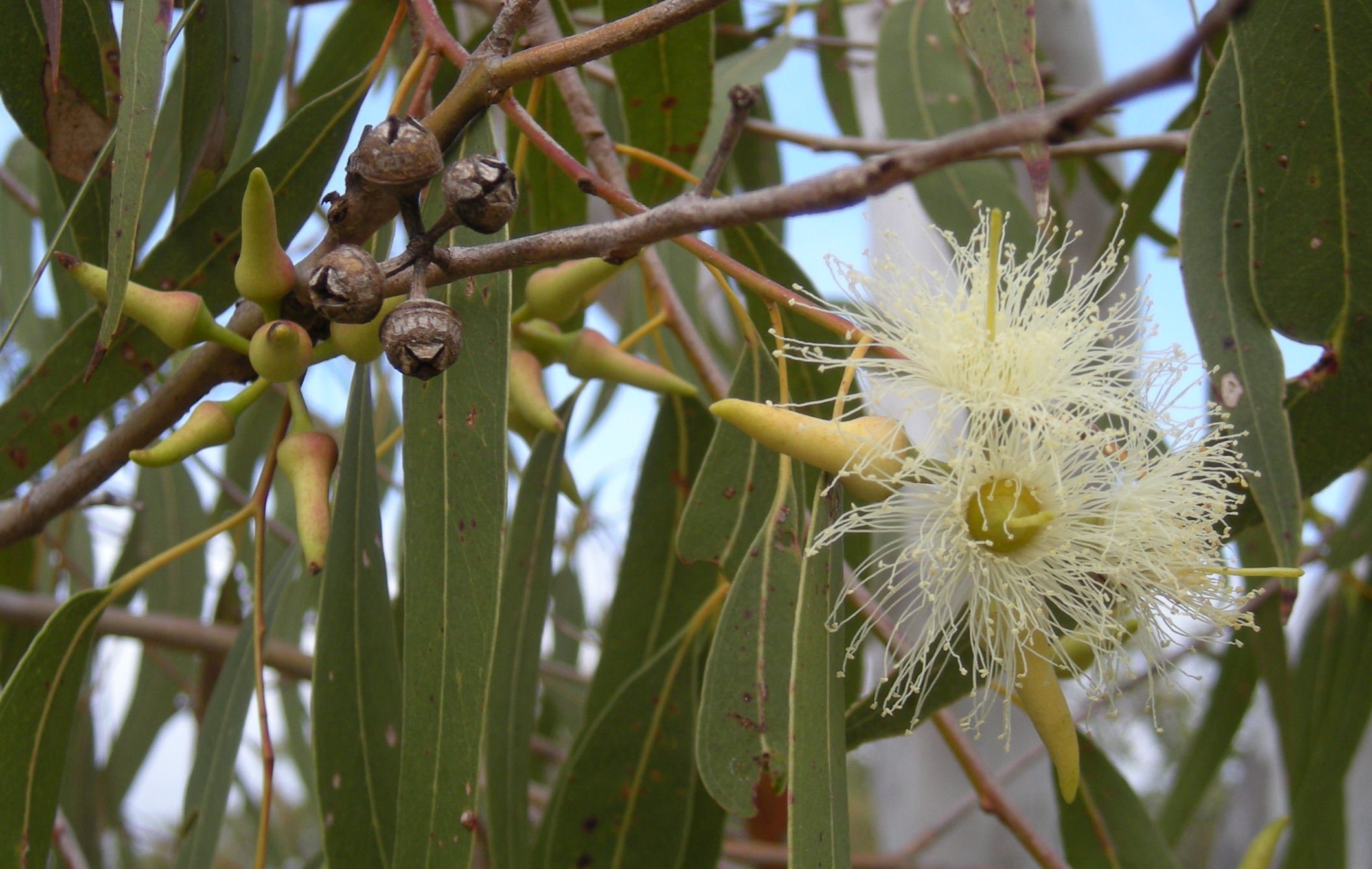
Eucalyptus L'Hér. is a large genus of flowering trees and shrubs in the family Myrtaceae, comprising over 700 accepted species. The vast majority are native to Australia, where eucalypts dominate approximately 92 million hectares of the continent's forests, making them the most ecologically prevalent trees on the continent. A small number of species extend into adjacent New Guinea and Indonesia, and a single species, E. deglupta, reaches as far north as the Philippines.
The genus was formally described in 1789 by the French botanist Charles Louis L'Héritier de Brutelle, with Eucalyptus obliqua — collected from Bruny Island, Tasmania in 1777 — serving as the type specimen. Its name derives from the Greek eû ('well') and kaluptós ('covered'), a reference to the distinctive operculum, or cap-like bud cover, that encloses and protects the developing stamens and floral parts before flowering.
Eucalypts are ecologically and economically among the most significant plant genera in the world. They are the most widely planted trees in commercial forestry plantations globally, valued for pulpwood, timber, charcoal, and bioenergy. Their leaves are rich in aromatic essential oils — most notably eucalyptol — which are commercially extracted for use as antiseptics, industrial solvents, and flavouring agents. The trees are deeply integrated into Australian Indigenous cultures, with uses ranging from the didgeridoo (crafted from hollowed trunks) to medicinal preparations and as a source of dyes in colours spanning yellow, green, and deep rust red.
Ecologically, eucalypts are adapted to fire-prone landscapes. Many species regenerate rapidly from epicormic buds beneath the bark or from lignotubers at the base following fire. Their highly flammable, oil-rich leaves and accumulation of phenolic litter make them significant contributors to fire intensity. Most species are sensitive to hard frost, though the hardiest, such as E. pauciflora (snow gum), can tolerate temperatures as low as -20°C.
Since the late 18th century, eucalypts have been introduced worldwide. Brazil alone has planted approximately 7 million hectares, achieving some of the fastest recorded plantation growth rates globally. They are widely established across California, Argentina, Uruguay, Ethiopia, Portugal, and South Africa, among other regions — valued for their rapid growth and versatility, but also raising ecological concerns about invasiveness, water use, soil acidification, and displacement of native flora and fauna.
Etymology
The genus name Eucalyptus was coined in 1789 by French botanist Charles Louis L'Héritier de Brutelle. It is formed from the Greek eû ('well') and kaluptós ('covered'), describing the operculum — the distinctive cap or lid that encloses and protects the flower's stamens and petals within the bud until flowering. When the operculum falls away, the characteristic fluffy mass of stamens is revealed.
Distribution
Eucalyptus is overwhelmingly an Australian genus: more than 715 of its species are native to the continent, where eucalypt-dominated vegetation covers approximately 92 million hectares. A small number of species extend into the adjacent islands of New Guinea and Indonesia, and E. deglupta — the rainbow gum — has a natural range reaching as far north as the Philippines, making it the only eucalypt native to the Northern Hemisphere.
Outside its native range, Eucalyptus has been planted extensively since the 19th century. California received its first introductions in the 1850s during the Gold Rush, with approximately 250 species now cultivated there. Argentina introduced eucalypts around 1870; Uruguay followed around 1896 and now supports around 800,000 hectares of eucalyptus monoculture. Brazil has planted approximately 7 million hectares since 1910. Ethiopia received introductions in 1894–1895, initially around Addis Ababa. The genus is now established across tropical and temperate regions of the Americas, Europe, Africa, the Mediterranean Basin, the Middle East, China, and the Indian subcontinent.
Taxonomy
Eucalyptus L'Hér. belongs to the family Myrtaceae, order Myrtales, within the kingdom Plantae. The genus was first formally published in Sertum Anglicum (1789), with the type specimen E. obliqua collected from Bruny Island, Tasmania in 1777 by David Nelson during Cook's third voyage.
The genus has a complex taxonomic history. George Bentham's 1867 revision divided it into five series based on stamen characteristics. Subsequent workers — including Joseph Maiden and William Blakely — further refined the classification, and modern treatments emphasize a combined assessment of buds, fruits, leaves, and bark. GBIF recognises 1,574 descendant taxa across the genus, reflecting accepted species, natural hybrids, and infraspecific taxa. The closely related genera Corymbia and Angophora are frequently grouped with Eucalyptus as "eucalypts" or "gum trees" in ecological and horticultural contexts, though they are distinct genera.
The oldest definitive fossil evidence for the genus dates to the early Eocene (approximately 51.9 million years ago) in Patagonia, and a 21-million-year-old macrofossil has been recovered from New South Wales, suggesting a long Gondwanan lineage.
Ecology
Eucalypts are predominantly evergreen, though some tropical species shed leaves seasonally. Their leaves contain oil glands producing volatile terpenoids, most notably eucalyptol (1,8-cineole), which contribute to the characteristic aroma and the genus's extreme flammability. Trees range in stature from multi-stemmed mallees less than 3 m tall to forest giants exceeding 60 m — E. regnans (mountain ash) is the tallest flowering plant on Earth, with the Centurion individual measuring 100.5 m.
Eucalypts are strongly adapted to fire. Many species regenerate from epicormic buds held dormant under thick bark, or from swollen lignotubers at the base of the stem, allowing rapid regrowth after fire. The accumulation of phenol-rich leaf litter and the high oil content of leaves create significant fuel loads. The same oils contribute to allelopathic effects, suppressing the germination and growth of competing plants beneath the canopy.
Bark morphology varies widely across the genus and is often used as a key identifying characteristic: smooth and ribboning in some species, fibrous or stringy in others, and hard, furrowed ironbark in yet others. Cold tolerance also varies considerably: most species sustain damage below about -5°C, but the hardiest species such as E. pauciflora can withstand temperatures of -20°C. Eucalypts are a major food source for koalas and many bird species, and their flowers are important nectar sources for bees.
Cultivation
Eucalyptus species are the most widely planted trees in commercial forestry plantations worldwide, valued primarily for pulpwood, timber, charcoal, and bioenergy. In temperate plantations E. globulus is the dominant pulpwood species. Brazil achieves world-record plantation growth rates typically exceeding 40 m³ per hectare per year under intensive management.
In horticulture, eucalypts require full sun (at least 6 hours per day) and well-drained soil. They are drought tolerant once established and are suitable for USDA hardiness zones 7b–10b, though plants in zone 7a and below may suffer dieback from frost. Growth is typically rapid. They are used as accent trees, windbreaks, screens, street trees, and container specimens, and are noted for attracting pollinators. No significant pest or disease issues are commonly reported, but their extreme flammability is a documented landscape risk, particularly in fire-prone regions.
Cultural Uses
Eucalypts have been central to Australian Indigenous life for tens of thousands of years and have accumulated global economic and cultural significance since European contact. The most commercially important product is eucalyptus essential oil — primarily eucalyptol (1,8-cineole) — distilled from leaves and used as an antiseptic, industrial cleaning agent, deodorant, flavouring, food supplement, and insect repellent.
The wood is valued for heavy construction, furniture, flooring, and as building poles; species with suitable hollow branches are the primary material for the didgeridoo, the iconic Australian Aboriginal wind instrument. Eucalyptus timber is also used as a tonewood in acoustic guitar construction. Bark and leaves yield dyes producing a wide spectrum from yellow and orange through green, tan, chocolate, and deep rust red.
Historically, eucalyptus plantations were promoted in Mediterranean Europe, Algeria, California, and elsewhere in the 19th century specifically to drain swamps and reduce malaria transmission — a use largely superseded by modern mosquito control, but responsible for much of the genus's global spread. More recently, geochemical surveys have used the trees' ability to draw trace minerals from depth, including microscopic gold particles detectable in leaf tissue, as a prospecting tool.
Conservation
Within Australia, the conservation status of Eucalyptus species is highly variable. While the genus as a whole is ecologically dominant, a number of individual species are listed as Endangered in Victoria and as Priority 1 (Poorly-known species) in Western Australia, reflecting the impact of land clearing, altered fire regimes, and climate change on rarer members of the genus.
Outside Australia, many eucalyptus introductions are classified as invasive. In California, non-native eucalypts are criticised for competing with native flora, reducing habitat suitability for native fauna, and generating fuel loads nearly three times that of native oak woodland. Concerns in plantation-heavy regions of South America and southern Africa include high water consumption, soil and stream acidification, and nutrient depletion. Removal programs have been implemented in some conservation areas, while elsewhere planted groves are protected for their amenity and carbon value.
History
The first European botanical specimens of Eucalyptus were collected in 1770 at Botany Bay by Joseph Banks and Daniel Solander during James Cook's first Pacific voyage. The genus was formally described nineteen years later by French botanist Charles Louis L'Héritier de Brutelle in Sertum Anglicum (1789), drawing on material that included E. obliqua. Accelerated collection and description followed the establishment of the British colony at Port Jackson in 1788. The first Western Australian species to be formally described was the yate (E. cornuta) in 1792. By the mid-19th century, hundreds of species had been named, and George Bentham's 1867 monograph brought the first systematic order to the genus.
The global spread of eucalypts as planted trees began in earnest during the second half of the 19th century. California received introductions from the 1850s. Argentina introduced them around 1870, Ethiopia in 1894–1895 to address deforestation around Addis Ababa, and Uruguay around 1896. Brazil's large-scale industrial planting began around 1910 to supply timber and charcoal. By the 21st century Eucalyptus had become one of the most economically significant tree genera on Earth.










