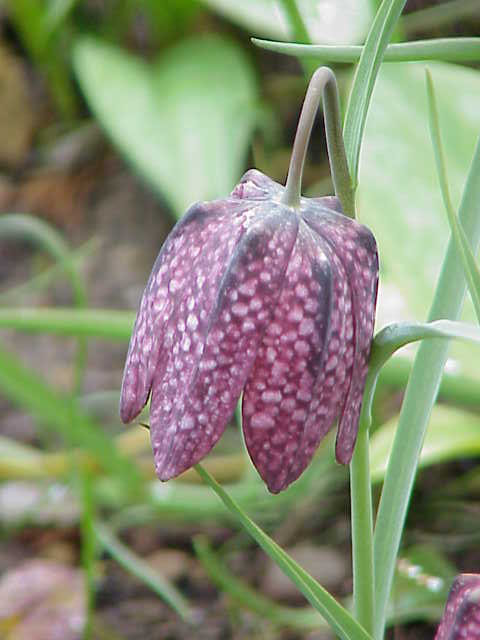
Fritillaria (Tourn. ex L., 1753) is a genus of spring-flowering bulbous perennials in the family Liliaceae, commonly known as fritillaries. The genus comprises several hundred species distributed across the temperate Northern Hemisphere, from western North America through Europe and the Mediterranean, across the Middle East and Central Asia, to China and Japan. The greatest species diversity occurs in Turkey, which hosts approximately 39 species, and in the Zagros Mountains of Iran.
Fritillaries are recognised by their characteristically nodding, bell-shaped (campanulate) flowers, which are often tessellated — marked with a checkered or mosaic pattern of contrasting colours including white, yellow, green, purple, and red. Flowers are typically solitary, though some species form umbels or multi-flowered racemes. The bulbs consist of fleshy scales, and the plants emerge and flower in spring before dying back to dormancy in summer.
The genus takes its name from the Latin word fritillus, the box in which dice were shaken, a reference to the checkered patterning of the flowers — an etymology clarified by the Flemish botanist Carolus Clusius, who corrected an earlier suggestion by the French apothecary Noël Capperon that the name referred to a gaming board rather than the dice-box itself.
Fritillaria occupies an unusual position in plant biology due to its exceptionally large genome: reported 1Cx values range from 30 to over 85 gigabases, and F. assyriaca was historically recognised as possessing one of the largest plant genomes known. Ecologically, pollination strategy varies with nectary size and nectar chemistry — species with larger nectaries and fructose-rich nectar tend to attract wasps, while those with smaller nectaries and more balanced nectar composition are primarily pollinated by bumblebees. The scarlet lily beetle (Lilioceris lilii) is a significant herbivore of cultivated fritillaries.
Many species are widely grown as ornamental bulbs. They are planted in autumn from dormant bulbs and suit a range of conditions from open meadow to light woodland. A smaller number of species, including F. affinis and F. camschatcensis, produce edible bulbs that were historically consumed as food by indigenous peoples of the Pacific Northwest coast of North America. In China, several species — particularly F. cirrhosa — have been used in traditional medicine for more than 2,000 years, with active steroidal alkaloid compounds valued as antitussives and expectorants; the annual market is estimated at around US$400 million. However, this demand has placed intense pressure on wild populations, with F. cirrhosa and several other species now threatened by over-collection. Note that most fritillaries contain toxic steroidal alkaloids and can be harmful if ingested in quantity without proper preparation.
Etymology
The genus name Fritillaria derives from the Latin word fritillus, meaning the cup or box used to shake dice. The French apothecary Noël Capperon of Orléans first applied the name in reference to the tessellated (checkered) patterning of the flowers, drawing a comparison with a gaming board. The Flemish botanist Carolus Clusius later corrected this, noting that fritillus specifically referred to the dice-box rather than the board. The common English name "fritillary," shared with a group of butterflies bearing similarly patterned wings, derives from the same Latin root. The genus was formally established by Linnaeus in Species Plantarum (1753), based on the earlier work of Tournefort, with Fritillaria meleagris as the type species.
Distribution
Fritillaria is distributed across the temperate Northern Hemisphere, with a range extending from western North America eastward through Europe, the Mediterranean basin, the Middle East, Central Asia, and onward to China and Japan. The genus is most diverse in the mountains and steppes of the Middle East and Central Asia: Turkey alone hosts approximately 39 species, and the Zagros Mountains of Iran support 14–15 species. North American species (including F. affinis, F. camschatcensis, and F. agrestis) occur primarily in the Pacific coastal ranges and interior valleys, with habitats spanning prairies, grass bluffs, open woodland, and coniferous forest from sea level to around 1,500 metres.
Ecology
Fritillaries are spring ephemerals, emerging and flowering before dying back to summer dormancy. Their campanulate, nodding flowers employ two distinct pollination syndromes depending on nectary morphology and nectar chemistry: species with larger nectaries (4–12 × 1–4 mm) and fructose-dominant nectar are preferentially visited by wasps, while those with smaller nectaries and a more balanced glucose-fructose ratio attract bumblebees. The genus exhibits extraordinary genome size variation — reported 1Cx values from approximately 30 to over 85 gigabases — and Fritillaria assyriaca has been cited as bearing one of the largest plant genomes on record. The scarlet lily beetle (Lilioceris lilii) is a principal invertebrate herbivore of both wild and cultivated plants. Notably, F. delavayi populations subject to intensive human harvesting in China have been observed to develop darker, more camouflaged flower and leaf coloration, interpreted as an evolutionary response to predation pressure by collectors.
Cultivation
Fritillaries are grown from dormant bulbs planted in autumn. Most cultivated species prefer well-drained soil — a sandy loam is ideal — with moisture available during the growing season but reduced in summer when the plants are dormant. Light requirements range from semi-shade to full sun depending on species; woodland species generally prefer dappled shade and lighter soils. Hardiness varies by species: many are suitable for USDA zones 4–8 (UK zone 5). The genus has become increasingly popular as ornamental garden plants, with a wide range of species and cultivars commercially available. Larger species such as F. imperialis suit borders and gravel gardens; smaller species such as F. meleagris naturalise well in damp meadow and grass.
Propagation
Fritillaria can be propagated by seed or vegetatively. Fresh seed sown into a cold frame germinates in spring; stored seed may require a full year before germination occurs. Vegetative propagation is most reliable: bulb offsets (bulblets) can be separated and replanted in August when the plant is dormant. Bulb scaling — removing individual fleshy scales and growing them on — is an alternative method. Seedlings typically take several years to reach flowering size.
Conservation
Multiple Fritillaria species face significant conservation pressure. In China, wild collection of F. cirrhosa bulbs for use in traditional medicine has driven the species toward extinction in some localities; F. delavayi has been documented evolving cryptic coloration as a direct response to human harvesting. Japan considers five of its eight endemic fritillary species to be endangered. More broadly, habitat loss — particularly the drainage and ploughing of traditional meadows and mountain grasslands — combined with over-collection from the wild threatens numerous species across the genus's range in Europe, the Middle East, and Asia.
Cultural Uses
Fritillaries have been used by humans across several cultures. In China, dried and processed bulbs of species including F. cirrhosa, F. thunbergii, and relatives have been employed in traditional medicine for over 2,000 years; the active compounds are steroidal alkaloids used as antitussives (cough suppressants), expectorants, and antihypertensives, with the annual market in these medicinal materials estimated at approximately US$400 million. Indigenous peoples of the Pacific Northwest coast of North America historically harvested and ate the bulbs of F. affinis, F. camschatcensis, and related species, which are starchy and nutritious when properly prepared; immature seedpods were also consumed despite a bitter taste. Caution is warranted, as most fritillaries contain toxic steroidal alkaloids (including imperialin) and can cause serious harm if consumed in quantity without preparation. In Britain, F. meleagris is the county flower of Oxfordshire and naturalised populations in traditional hay meadows are considered part of the cultural landscape. In Sweden, it is the provincial flower of Uppland. F. camschatcensis is the floral emblem of Ishikawa Prefecture and Obihiro City in Japan. The checkered pattern of fritillary flowers has featured in Dutch Golden Age paintings and was referenced by Shakespeare, Matthew Arnold, and George Herbert.
History
Fritillaria meleagris was first recorded growing wild in meadows along the Loire River in France in 1570, and was introduced to British cultivation by 1578. Fritillaria imperialis, now one of the most widely grown ornamental species, was introduced to European horticulture around the 1570s from its native range in the Middle East and Central Asia; the first documented flowering in London occurred in April 1605 in the garden of James Nasmyth. The genus was formally named and described by Linnaeus in Species Plantarum (1753), though the name Fritillaria had been used informally since the sixteenth century. Tournefort's earlier pre-Linnaean description is acknowledged in the authority "Tourn. ex L."
Taxonomy Notes
Fritillaria Tourn. ex L. (1753) belongs to the family Liliaceae, order Liliales, subfamily Lilioideae, tribe Lilieae. The genus is divided into eight subgenera: Fritillaria, Liliorhiza, Davidii, Petilium, Korolkowia, Theresia, Rhinopetalum, and Japonica. The type species is Fritillaria meleagris L. GBIF records 316 descendants across all ranks under the genus and returns at least 92 accepted species names. The published species count varies by authority; treatments range from roughly 130 to 140 accepted species. Most fritillaries contain steroidal alkaloids (e.g. imperialin), which has both taxonomic and pharmacological significance.










