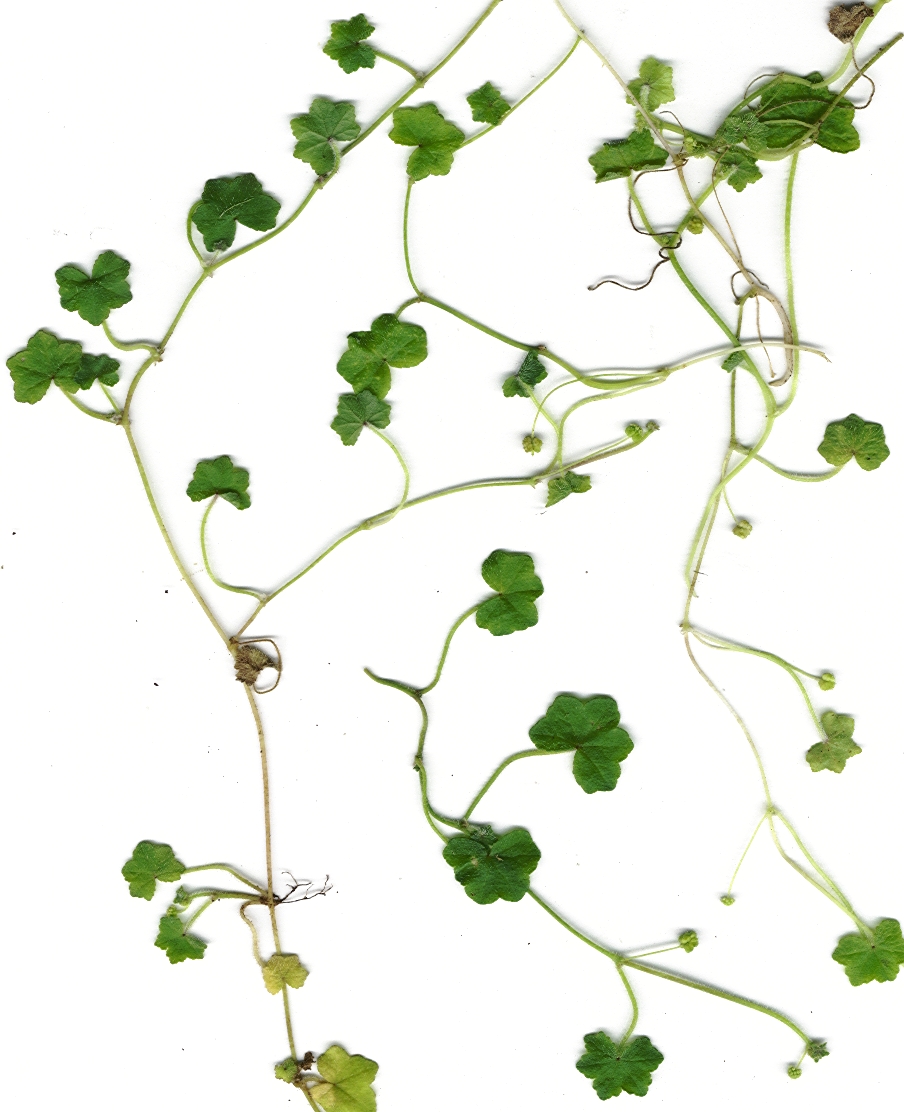
Hydrocotyle L. — commonly called water pennywort, marsh pennywort, or floating pennywort — is a genus of roughly 75–280 small perennial herbs in the family Araliaceae (order Apiales). Carl Linnaeus established the genus in his Species Plantarum of 1753. The name derives from Greek roots for "water" and "cup-shaped," alluding to the concave or peltate leaves; the familiar English name "pennywort" likewise reflects the round, coin-sized leaf blades.
Plants are prostrate or creeping perennials with slender stems that readily root at nodes, often forming dense floating or emergent mats in shallow water and on wet ground. Leaves are simple, long-petiolate, and range from broadly ovate to orbicular or reniform; some species are distinctly peltate. Flowers are small, white, and arranged in simple umbels or proliferous interrupted spikes on axillary peduncles. Fruits are orbicular to ellipsoid, strongly laterally flattened, with evident ribs and a sclerenchyma layer surrounding each seed cavity; no carpophore is present.
The genus has a near-cosmopolitan distribution, concentrated in the tropics and warm temperate zones. Species inhabit wet and damp habitats — ponds, lake margins, rivers, marshes, paddy fields, and coastal wetlands — across North America, South America, Europe, Asia, Africa, and the Pacific. With over 250 documented taxa in GBIF and around 75 accepted species listed in regional treatments, the delimitation of the genus has varied between authorities; it was historically placed in Apiaceae before being transferred to Araliaceae on the basis of molecular phylogenetic evidence.
Several species are cultivated as ornamental aquatic or terrarium plants, and certain warm-climate members (notably H. asiatica, now often treated as Centella asiatica) have long histories of food and medicinal use across Asia.
Etymology
The genus name Hydrocotyle is Latin formed from two Greek elements: hydro- (ὕδωρ, "water") and kotylē (κοτύλη, "cup" or "hollow vessel"). The compound name alludes both to the plants' wetland habitat and to their characteristic cup-shaped or peltate leaves. The English common name "pennywort" has the same leaf-shape logic from a different direction: the round blades were compared to a penny coin. Vernacular names across European languages follow similar patterns — German Wassernabel ("water navel"), Danish Vandnavle ("water navel") — emphasising the rounded, centrally attached or navel-like leaf form.
Distribution
Hydrocotyle has a near-cosmopolitan distribution centred on the tropics and warm temperate zones. GBIF distribution data (sourced from the World Checklist of Vascular Plants) documents occurrences across every major continent: North America (from the US Southeast through the Southwest), South America (Colombia, Argentina), Europe (widely, including Switzerland where three species — H. ranunculoides, H. sibthorpioides, and H. vulgaris — are recorded), Asia (South and Southeast Asia including the Andaman Islands and Bangladesh), Africa (Angola; one record lists the genus as extirpated from Algeria), and island groups including the Azores and Antipodean Islands. The native range of individual species spans East Asia, South Asia, Australia, Africa, South America, and the Pacific; some species have also naturalised or become invasive outside their native ranges.
Taxonomy
Hydrocotyle was formally described by Linnaeus in Species Plantarum (1753) and has long been recognised as the type genus of its family. Historically, it was placed in Apiaceae (umbellifers), but molecular phylogenetic work demonstrated that the pennyworts are more closely related to Araliaceae, and the genus is now accepted in that family under the order Apiales. GBIF records 259 descendant taxa under the accepted name Hydrocotyle L.; SEINet's treatment lists approximately 75 accepted species; Wikipedia cites over 280. This variation reflects ongoing taxonomic revision: some authorities segregate additional genera from within Hydrocotyle sensu lato. ITIS carries the genus with TSN 29512 and marks it as accepted. The family Araliaceae affiliation is consistent across GBIF, SEINet, and Info Flora.
Ecology
Plants of Hydrocotyle are primarily wetland herbs adapted to shady, damp, or inundated conditions. They grow in and around ponds, lake margins, slow-moving rivers, marshes, paddy fields, coastal wetlands, and seasonally flooded grasslands. The prostrate stems root freely at nodes, enabling rapid vegetative spread across wet substrates or as floating mats on open water. Reproduction is both sexual (seed) and clonal (nodal rooting), which facilitates colonisation of disturbed or fluctuating wetland edges. Certain species function as important oviposition sites for butterflies. The genus tolerates a range of light levels from full sun to partial shade, and some species withstand temperatures as low as −10°C, expanding the genus's reach into cooler temperate climates.
Cultivation
A number of Hydrocotyle species are cultivated as ornamental aquatic plants, particularly for garden ponds and aquarium use, where their spreading mats and rounded foliage provide surface cover and textural contrast. Plants prefer moist to wet soil in sun or partial shade and are hardy across a broad range — USDA zones 7–10 (UK zone 8) for the more commonly grown warm-climate species, tolerating temperatures between −5 and −10°C. They are generally low-maintenance once established and can spread vigorously in suitable conditions, so container planting or pond-edge restriction may be advisable in cultivation.
Propagation
Two primary propagation methods are used for Hydrocotyle. Seeds can be sown in spring under glass and transplanted outdoors after the risk of frost has passed. Division is usually simpler and more reliable: stems with rooted nodes can be separated during the growing season (spring is preferred) and potted individually until they establish, then planted out. Because the genus roots readily at nodes, even small stem cuttings placed in moist substrate will typically root without difficulty.
Uses
Several Hydrocotyle species have documented food and medicinal uses, particularly in Asia. The leaves of some species (notably those historically grouped under or confused with H. asiatica, now Centella asiatica) are eaten raw in salads or cooked in curries; the flavour is aromatic but potent, so small quantities are preferred. In Indian traditional medicine the plant is called Brahmi and is valued as an alterative, mild cardio-depressant, hypotensive, sedative, and tonic. Attributed benefits include improved circulation, wound healing, memory enhancement, and nervous system support, though excessive doses are reported to cause headaches and temporary loss of consciousness. The genus is similarly valued in East Asian traditional medicine. Note: much of the specific medicinal literature refers to Centella asiatica (previously H. asiatica), which is now generally treated as a separate genus.










