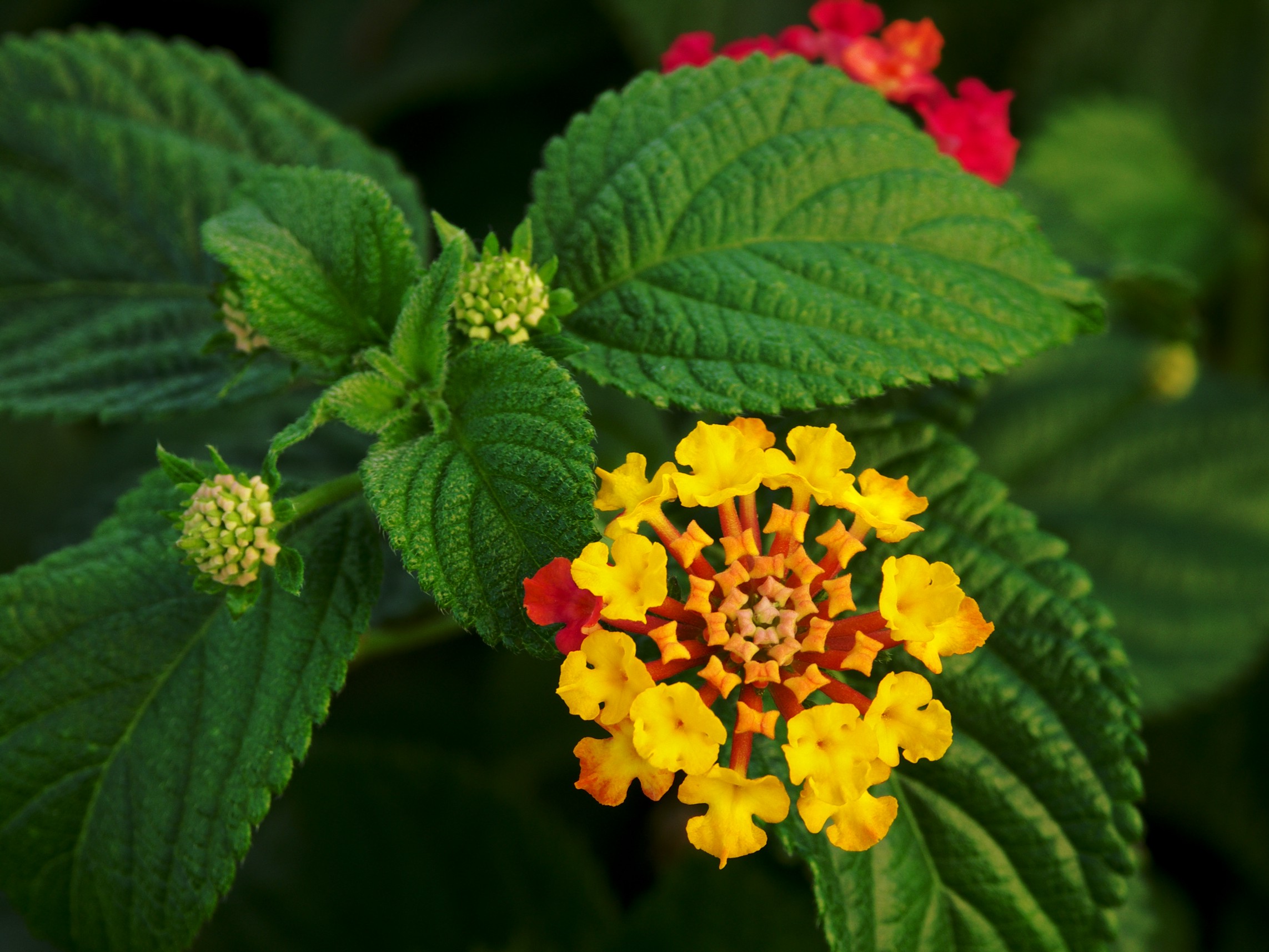
Lantana L. is a genus of approximately 150 species of flowering shrubs and herbaceous perennials in the verbena family (Verbenaceae), order Lamiales. Plants typically grow 0.5–2 m (1.6–6.6 ft) tall with opposite, broadly ovate leaves that emit a pungent odor when crushed. The genus is best known for its compact, rounded flower clusters (umbels) that display striking color changes as individual florets mature — a single inflorescence can carry two or three colors simultaneously, cycling through shades of red, orange, yellow, pink, white, or violet.
Native to the tropical Americas — from Venezuela and Colombia through Central America, Mexico, and the Caribbean — Lantana species have spread across most tropical and subtropical regions of the world. Lantana camara, the type species, is among the most widely planted ornamentals in warm climates while simultaneously being listed as one of the world's worst invasive plants. It is designated a noxious weed across South Asia, Southern Africa, Australia, Hawaii, and coastal areas of the southeastern United States, where it forms dense, allelopathic thickets capable of suppressing native forest regeneration.
Despite its invasive reputation, the genus is valued in horticulture for its heat, drought, and salt tolerance, its long flowering season, and its exceptional value for pollinators. Lantana flowers attract swallowtails, skippers, sulphurs, and many other butterfly families, and several species including L. camara, L. lilacina, and L. trifolia serve as important honey plants. The genus was described by Linnaeus in Species Plantarum in 1753 (Sp. Pl.: 627) and is classified in the kingdom Plantae, phylum Tracheophyta, class Magnoliopsida.
Etymology
The generic name Lantana was borrowed into botanical Latin from an older vernacular name that referred to the unrelated shrub Viburnum lantana (wayfaring tree). Linnaeus applied the name to this American genus in 1753, adopting an existing Late Latin term rather than coining a new one — making the etymology a case of transferred nomenclature rather than a description of any morphological character of the plants themselves.
Distribution
The center of diversity for Lantana is the tropical Americas, with the native range spanning Venezuela and Colombia north through Central America, Mexico, and the Caribbean islands. From this core, the genus — particularly Lantana camara — has established naturalized or invasive populations across virtually every tropical and subtropical region of the world. Documented invasive ranges include the Indian subcontinent (especially southern and northeastern India), Southern Africa, Australia and its Pacific neighbors, Hawaii, and the coastal southeastern United States from the Carolinas through Georgia, Florida, and the Gulf Coast. In Florida, the native species Lantana involucrata and Lantana depressa occur but are considered rare within their native range. The genus tolerates a wide elevation band, from sea level to approximately 1,700 m, and is rarely able to persist where temperatures consistently fall below 5°C.
Ecology
Lantana thrives in open, disturbed habitats — roadsides, forest margins, and cleared land — and spreads aggressively via bird-dispersed seeds. A single plant can produce up to 12,000 seeds per year. The leaves are unpalatable and toxic to most mammalian herbivores due to pentacyclic triterpenoids that cause hepatotoxicity and photosensitization, but the ripe drupes are eagerly consumed by a wide range of frugivorous birds including yellow-fronted white-eyes, superb fairy-wrens, scaly-breasted munias, and Mauritius bulbuls, making avian dispersal highly effective. The swamp wallaby is one of the few mammals that can consume the leaves without apparent ill effects.
Where Lantana invades, it produces allelopathic compounds that inhibit the germination and growth of neighboring plants, enabling the formation of dense monoculture thickets that suppress native forest regeneration. Livestock losses have been documented in the United States, South Africa, India, Mexico, and Australia as a result of grazing on toxic foliage. Biological control has seen limited success: roughly 30 insects were released in Australia, but the lantana bug (Aconophora compressa, introduced 1995) became a pest of ornamental plants rather than an effective control agent, and introduced moth species and the lantana scrub-hairstreak butterfly failed to suppress populations. Paradoxically, Australian research has found that removing Lantana from urban greenspaces can reduce local bird diversity where native plant cover has not yet recovered to fill the structural niche.
Fungal associations include parasitism by Ceratobasidium cornigerum, and greenhouse populations are commonly attacked by the sweet potato whitefly (Bemisia tabaci). Native moth species documented feeding on lantana include Aenetus ligniveren, A. scotti, Endoclita malabaricus, and Hypercompe orsa.
Cultivation
Lantana is widely grown as an ornamental in tropical and subtropical gardens and as a warm-season annual in temperate climates. It demands full sun and is exceptionally tolerant of heat, drought, and coastal salt exposure, making it a reliable performer in difficult sites. Plants flower most prolifically with regular irrigation despite their drought tolerance. Well-drained soil is preferred; the genus adapts readily to sandy loam and container growing.
Fertilization requirements are modest — light applications of slow-release or controlled-release fertilizer are sufficient. Most varieties have few significant pests or diseases in cultivation. The majority of commercially available lantanas are hybrids of Lantana camara or the trailing species Lantana montevidensis, which produces blue or white flowers year-round and is widely used as a groundcover. Named cultivars include the tall-growing 'Irene', 'Christine', and 'Dallas Red'. In regions where Lantana is invasive, gardeners are advised to select sterile cultivars — such as 'Bloomify™ Red', 'Bloomify™ Rose', and 'Luscious® Royale Red Zone™' — that cannot set viable seed.
Conservation
Several Lantana species, especially Lantana camara, rank among the world's most problematic invasive plants. The species is listed as a noxious weed or invasive in South Asia, Southern Africa, Australia, Hawaii, and the southeastern United States. Its combination of high seed output, bird-mediated dispersal, allelopathic soil chemistry, and near-total resistance to mammalian herbivory makes eradication extremely difficult once established.
Biological control programs, most extensively conducted in Australia, have not achieved reliable population suppression. The inadvertent creation of a new horticultural pest from an introduced biocontrol agent (Aconophora compressa) illustrates the complexity of managing the genus. In areas where Lantana is invasive, conservation recommendations include using certified sterile cultivars for ornamental planting and avoiding introduction into wildland-adjacent areas.
Paradoxically, where Lantana has become a structural feature of urban or degraded habitats, its sudden removal without native plant replacement can reduce refuge availability for small birds, creating a secondary conservation challenge.
Cultural Uses
Lantana has a long history of human use spanning food, medicine, craft, and agriculture. Ripe black fruits have traditionally been eaten fresh, particularly by children in tropical regions, though the edibility of even ripe berries is disputed and unripe fruits are clearly toxic. Aromatic leaves are used in some cultures to prepare an herbal tea. Traditional medicine across tropical regions has employed lantana preparations to treat fever, malaria, cough, wounds, leprosy, and scabies, and decoctions are used for respiratory ailments; laboratory analyses confirm antimicrobial, fungicidal, insecticidal, and nematicidal activity in plant extracts.
In Karnataka, India, tribal communities around MM Hills have developed a cottage industry producing approximately 50 varieties of furniture from invasive Lantana stems, which are considered a near-substitute for cane and bamboo due to their resistance to sun, rain, and termites. In agriculture, extracts of Lantana camara have shown activity against the mustard aphid Lipaphis erysimi on cabbage. The genus is also important to beekeeping — L. camara, L. lilacina, and L. trifolia are recognized honey plants — and is widely planted for butterfly gardening, attracting swallowtails, skippers, sulphurs, and brush-footed butterflies. Beyond flowers, established plants contribute to erosion control and live fencing, and dried stems are used as firewood and biogas feedstock in some rural areas.
Taxonomy
Lantana L. was formally described by Carl Linnaeus in Species Plantarum: 627 (1753), placing it in what is now the family Verbenaceae. The genus holds accepted taxonomic status (GBIF ID 2925302) within the order Lamiales, class Magnoliopsida, phylum Tracheophyta. The type species is Lantana camara L. GBIF records 261 descendant taxa under the genus, though the working estimate of accepted species is approximately 150, reflecting the large number of synonyms that have accumulated across the group's complex taxonomic history. The genus name has no descriptive relationship to the plants themselves, being transferred from the unrelated Viburnum lantana.
Propagation
Lantana propagates readily from both seed and stem cuttings. It shows rapid growth and has a strong capacity to resprout from the base after severe cutting or fire damage. In cultivation, plants can be cut back almost to the ground at the end of the season and will regenerate vigorously, often with improved flowering. This resilience to hard pruning is one reason the genus persists and spreads so effectively in the wild.










