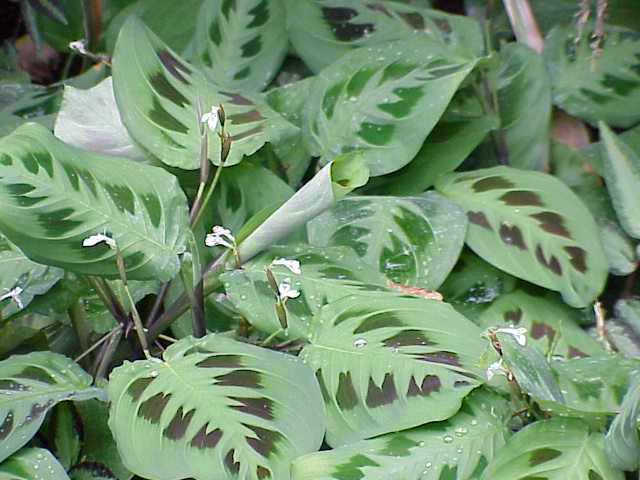
Maranta is a genus of approximately 40–50 species of flowering plants in the family Marantaceae (order Zingiberales), native to tropical Central and South America and the West Indies. The genus was described by Carl Linnaeus and named in honour of Bartolomeo Maranta, a sixteenth-century Italian physician and botanist.
Plants in the genus grow from rhizomes and naturally form dense perennial clumps. Their most distinctive feature is their crowded, oval, undivided evergreen leaves borne on sheathing stalks. The leaves lie flat during the day but fold upward along the midrib as evening approaches — a nyctinastic movement that has earned the genus and its most familiar member, Maranta leuconeura, the popular common name "prayer plant." Flowers are small and borne in pairs, with three petals and two larger petal-like staminodes.
The genus includes both economically important and ornamental species. Maranta arundinacea (arrowroot) has been cultivated across the tropics for centuries as a source of high-quality edible starch. Maranta leuconeura, prized for its dramatically patterned foliage, is one of the most widely grown tropical houseplants worldwide.
Etymology
The genus Maranta was named by Carl Linnaeus in honour of Bartolomeo Maranta (c. 1500–1571), an Italian physician and botanist who practised and wrote in Naples during the sixteenth century.
Distribution
Maranta species are native to the humid tropical regions of Central America, South America, and the West Indies, where they grow in forest understorey habitats.
Cultivation
Maranta arundinacea is cultivated across the tropics as a food crop; its rhizomes yield arrowroot starch, a fine, easily digestible carbohydrate. Maranta leuconeura and related ornamental species are grown as houseplants, requiring a warm, humid environment. Plants can be propagated readily by stem cuttings of two to three leaves or by division of the rhizomatous root clumps.










