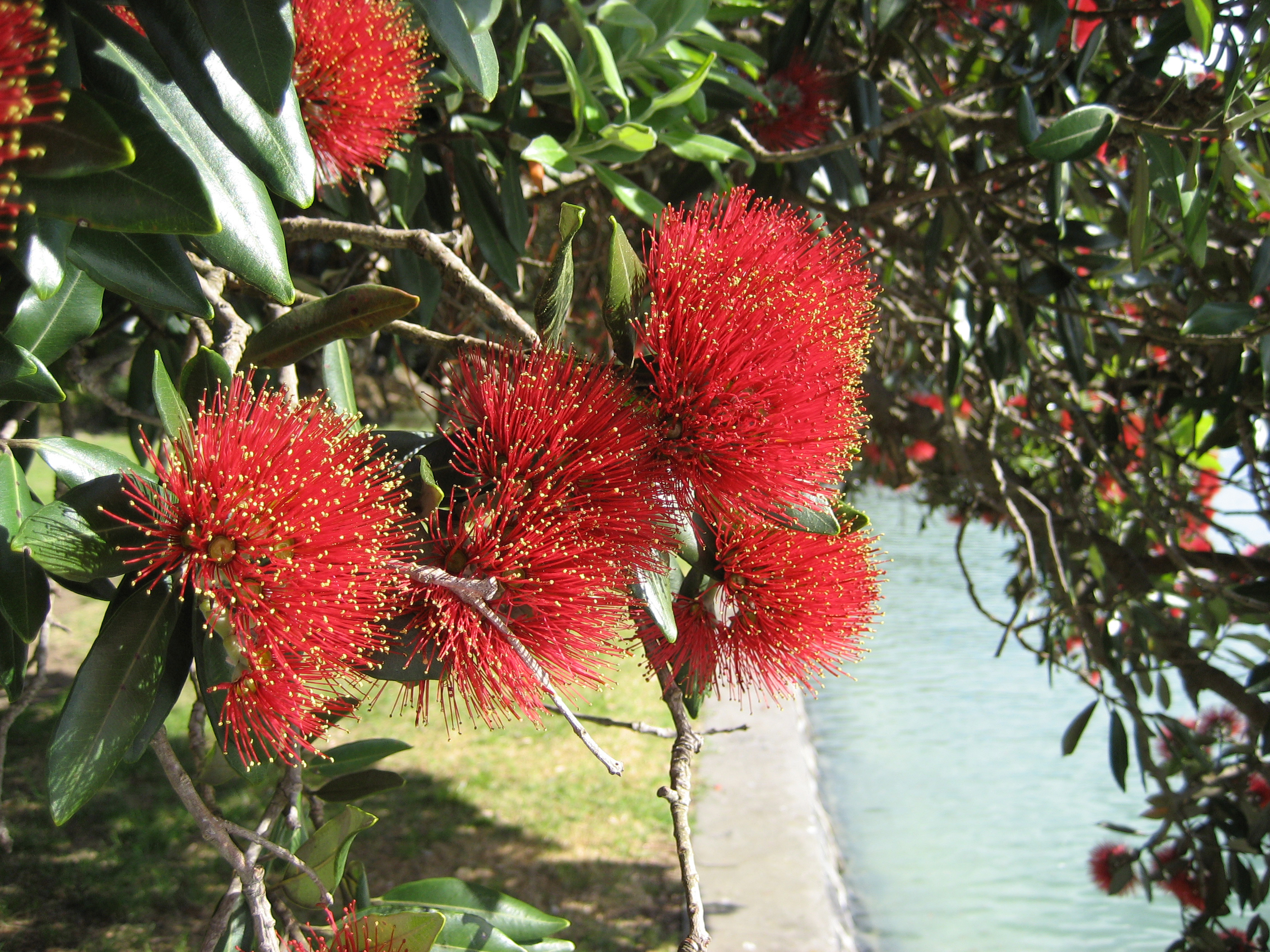
Metrosideros (Banks ex Gaertn., 1788) is a genus of roughly 60 trees, shrubs, and climbing vines in the family Myrtaceae (order Myrtales), placed within the subfamily Myrtoideae and tribe Metrosidereae. The genus name comes from the Ancient Greek words metron ("heartwood" or "measure") and sideron ("iron"), a reference to the exceptionally hard, dense timber these plants produce.
The genus is one of the most widely distributed flowering plant genera across the Pacific basin. Its native range stretches from South Africa and the island of Tristan da Cunha in the south Atlantic, through tropical and subtropical Pacific archipelagos — New Caledonia (21 species), New Zealand (12 species), New Guinea (7 species), Hawaii (5 species), and further through Fiji, Vanuatu, Solomon Islands, Samoa, the Cook Islands, French Polynesia, and the Bonin Islands — to Chile and Argentina at the southern tip of South America, and north to the Philippines. Despite this broad Pacific distribution, Metrosideros is notably absent from mainland Australia, though fossil evidence records its former presence there.
Much of the genus's dispersal success comes from its seeds, which are exceptionally lightweight and wind-borne. They can survive freezing temperatures and remain viable after up to 30 days submerged in saltwater, allowing long-distance oceanic dispersal. Many species function as pioneer colonizers, establishing themselves on bare lava flows, volcanic ridges, and exposed coastal headlands before other plants can gain a foothold.
GBIF records 139 total taxa within the genus. The genus carries several synonyms in older literature, including Agalmanthus, Ballardia, Carpolepis, Mearnsia, and Microsideros. The genus was introduced to cultivation in temperate gardens primarily through its showiest members, which produce brilliant red, crimson, or yellow bottlebrush-like flowers formed by dense clusters of long stamens.
Etymology
The genus name Metrosideros is compounded from two Ancient Greek roots: metron, meaning "heartwood" (sometimes glossed as "measure" or "middle"), and sideron, "iron." The combined sense refers to the hard, iron-like quality of the heartwood, which is notably dense and durable. The genus was formally established by Banks ex Gaertn. in 1788, published in Fructus. In Hawaiian tradition the genus is also known as lehua.
Distribution
The native range of Metrosideros is centred on the Pacific basin and extends to disjunct areas of the southern hemisphere. According to the World Checklist of Vascular Plants (WCVP), native occurrences are confirmed across New Zealand's North and South Islands, New Caledonia, New Guinea, Hawaii, the Kermadec Islands, Norfolk Island, the Antipodean Islands, the Cook Islands, Fiji, Samoa, Vanuatu, the Solomon Islands, the Society Islands, the Marquesas, Tuamotu and Tubuai archipelagos, the Pitcairn Islands, the Ogasawara-shoto (Bonin Islands) of Japan, the Philippines, the Cape Provinces of South Africa, and southern South America (central and southern Chile, southern Argentina).
Introduced populations occur in the Azores, Madeira, the Chatham Islands, Tonga, and Tristan da Cunha. The genus is conspicuously absent from mainland Australia, despite fossil evidence indicating past presence. New Caledonia is the most species-rich region with 21 species; New Zealand follows with 12, New Guinea with 7, and Hawaii with 5.
Ecology
Metrosideros species are notable pioneer colonizers, commonly establishing on raw lava flows, volcanic ridges, and coastal bluffs where few other plants can survive. The seeds are tiny, lightweight, and wind-dispersed; they possess remarkable environmental tolerance — surviving freezing temperatures and immersion in saltwater for up to 30 days while retaining germination viability. This combination of traits underlies the genus's extraordinary dispersal across oceanic islands separated by thousands of kilometres.
The wood is extremely durable, remaining sound even in persistently damp or wet conditions. Several species form dominant forest canopy in montane and lowland forests of New Zealand, Hawaii, and the Pacific. In Hawaii, M. polymorpha (ʻōhiʻa lehua) is among the first plants to colonize new lava flows and is ecologically critical to native forest structure.
Cultivation
Metrosideros species are cultivated as ornamental trees and shrubs in warm temperate to subtropical gardens, valued for their brilliant staminate flowers and dense evergreen foliage. They require fertile, well-drained, moisture-retentive, lime-free soil and a position in full sun — they do not tolerate shade. Hardiness is limited: most species tolerate occasional frosts to around −5 °C, placing them in USDA zones 8–11. In cooler climates they require wall protection or greenhouse cultivation. In suitable frost-free climates some species can serve as informal hedging.
Propagation
Two reliable methods are used. For seed, sow on the surface of permanently moist, lime-free compost in a warm greenhouse, keeping the pot base standing in approximately 5 cm of water; sowing can be done in spring or autumn. For vegetative propagation, take half-ripe lateral shoot cuttings with a heel in July or August and root them in a cold frame.
Cultural Uses
Several Metrosideros species carry deep cultural significance for indigenous Pacific peoples. In New Zealand, the pōhutukawa (M. excelsa) is an iconic coastal tree, its crimson flowers blooming around Christmas and earning it the informal name "New Zealand Christmas tree"; the rātā (M. robusta, M. umbellata) are similarly revered in Māori tradition. In Hawaii, the ʻōhiʻa lehua (M. polymorpha) is woven into mythology, ceremonial garlands (lei), and is considered sacred to the volcano deity Pele. The leaves and twigs of some species yield an essential oil with a nutmeg-like scent that has been used medicinally as an antibacterial, antiseptic, diaphoretic, and expectorant, applied to wounds, skin infections, and respiratory complaints.
Taxonomy Notes
Metrosideros Banks ex Gaertn. (1788) is the accepted name. It is placed in family Myrtaceae, order Myrtales, class Magnoliopsida; within Myrtaceae it sits in subfamily Myrtoideae, tribe Metrosidereae. GBIF recognises 139 total descendant taxa under the genus. Synonyms reduced into Metrosideros include Agalmanthus (Endl.) Hombr. & Jacquinot, Ballardia Montrouz., Carpolepis (J.W.Dawson) J.W.Dawson, Mearnsia Merr., and Microsideros Baum.-Bod. The genus is not recorded in the IUCN Global Invasive Species Database at genus level.










