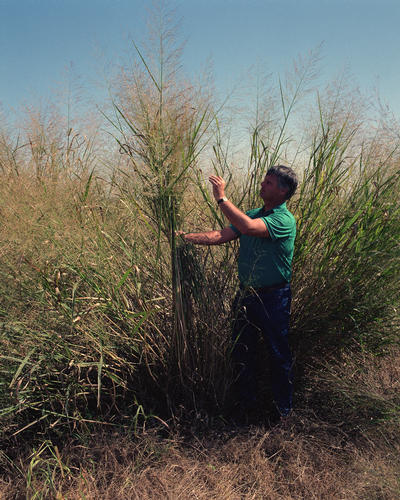
Panicum is a large, cosmopolitan genus of grasses commonly called panicgrasses, named for their characteristic panicle inflorescence. It sits in the family Poaceae, subfamily Panicoideae, tribe Paniceae, and was formally described by Linnaeus in 1753. Wikipedia recognises roughly 250 species, while the GBIF taxonomic backbone lists 744 descendant taxa under the genus when synonyms and infraspecies are included.
Members are often large annual or perennial grasses, frequently reaching 1–3 m (3–10 ft) tall, though many smaller species exist. PFAF notes the genus encompasses both annuals and perennials across a wide range of soils, generally favouring full sun and moist conditions. The inflorescence is typically a panicle (sometimes a spike-like raceme), bearing small spikelets that usually contain a single perfect terminal floret. SEINet describes the spikelets as lanceolate or fusiform to ovoid, obovoid or globose, with a characteristic white or pale, smooth or shining fertile lemma; in most species the ligule is reduced to a band of hairs or is essentially absent.
The genus is centred in the tropics but extends well into northern temperate zones. Australia alone hosts 29 native and 9 introduced species, and regional floras catalogue Panicum across the Americas, Africa, Asia, and Europe (with several North American species naturalised in Europe). Most well-studied species use the C4 photosynthetic pathway, an adaptation that gives them an advantage in hot, dry, high-light environments — switchgrass (P. virgatum) and proso millet (P. miliaceum) are textbook C4 grasses, with proso millet using the NAD-ME variant of the C4 shuttle.
Economically, Panicum is one of the most important genera of grasses. Panicum miliaceum (proso millet) is an ancient grain crop first domesticated around 10,000 BP in northern China and still cultivated across Eurasia and the US Great Plains. Panicum virgatum (switchgrass) is a North American prairie grass widely used as livestock forage, hay, and a cellulosic-ethanol/biofuel feedstock, and is also grown as a drought-tolerant ornamental. Other species provide fibre, edible seed (P. sonorum, P. decompositum), and tropical pasture (P. maximum, P. antidotale).
Taxonomically the genus has been under heavy revision. Recent phylogenetic studies have shown Panicum as historically circumscribed to be polyphyletic; species from section Stolonifera have been moved to the genus Ocellochloa, and P. venezuelae has been transferred to a newly erected genus, Drakkaria. The subgenus Dichanthelium is often treated as a separate genus in modern floras, though SEINet still includes it within Panicum while noting its intergrading and taxonomically difficult species complexes.
Etymology
The genus name Panicum is the classical Latin word for millet or panic grass, and the common English name "panicgrass" reflects the genus's defining feature: a branched panicle inflorescence. The same root underlies the names of several economically important members of the group, including proso "millet" (Panicum miliaceum).
Distribution
Panicum is essentially pantropical, with strong representation across the Americas, Africa, southern Asia, and Australasia, and a number of species extending into northern temperate zones. Australia hosts 29 native and 9 introduced species. In the southwestern United States, SEINet documents species such as P. antidotale and P. aztecanum. In Europe, much of the contemporary diversity is introduced: the Swiss flora (Info Flora) catalogues seven Panicum entries, with several — including P. barbipulvinatum, P. capillare, P. dichotomiflorum, and P. hillmanii — of North American origin. The cultivated species P. miliaceum is grown across Eurasia (China, India, Nepal, Russia, Ukraine, Belarus, Turkey, Romania) and the US Great Plains.
Ecology
Most well-characterised Panicum species use the C4 photosynthetic pathway, which improves water-use efficiency and gives them a competitive edge in hot, dry, high-light environments. Switchgrass (P. virgatum) uses standard C4 carbon fixation and is noted for its drought and heat tolerance, while proso millet (P. miliaceum) uses the less common NAD-ME variant of the C4 shuttle (in contrast to foxtail millet and sorghum, which use NADP-ME). Habitats range from open grasslands and prairies to disturbed ground, ruderal sites, agricultural margins, and seasonally wet areas, reflecting the genus's adaptability across tropical and warm-temperate climates.
Cultivation
Panicum species generally prefer full sun and moist but well-drained soils, and tolerate a wide range of soil types. Several are grown ornamentally — switchgrass cultivars such as 'Heavy Metal' and 'Dallas Blues' have received Royal Horticultural Society recognition for their drought tolerance and architectural form, and are widely used in landscape and prairie-style plantings. Agricultural species (proso millet, switchgrass, Guinea grass, blue panicgrass) are grown from seed in warm soils after the last frost.
Cultural & Economic Uses
Panicum is one of the most economically important grass genera. Panicum miliaceum (proso millet) is a domesticated cereal cultivated since around 10,000 BP, valued for its very short growing season (45–60 days), exceptional water-use efficiency, and naturally gluten-free grain — increasingly marketed as a specialty organic crop. Panicum virgatum (switchgrass) is grown for livestock forage and hay and is a leading candidate cellulosic-bioenergy feedstock, used for ethanol, biogas, pellets, and direct combustion; it is also planted widely for soil conservation, erosion control, and habitat restoration. Other species provide tropical pasture and animal feed, edible seed, and fibre for papermaking. PFAF notes folk-medicinal uses of some species, including decoctions used historically for gonorrhea and as remedies for cataracts and general debility.
History
The history of Panicum is bound up with that of its most famous crop, proso millet. Archaeological evidence from the Cishan site in northern China dates the domestication of P. miliaceum to around 10,000 BP (ca. 8,000 BCE), making it one of the oldest cultivated grains. Its rapid maturation enabled seminomadic peoples to shift toward settled agriculture, and the crop subsequently spread westward through Eurasia. Switchgrass (P. virgatum), a dominant native of North American tallgrass prairie, gained renewed scientific and commercial attention in the late 20th and early 21st centuries as a candidate biofuel feedstock.
Taxonomy
Panicum L. was published by Linnaeus in Species Plantarum (1753, p. 55) and is the type genus of tribe Paniceae within subfamily Panicoideae of the grass family Poaceae. GBIF lists the genus as accepted with 744 descendant taxa under it (including synonyms and infraspecific names), while traditional treatments recognise around 250 species. Molecular phylogenetic work has shown Panicum as historically circumscribed to be polyphyletic, and a number of segregates have been erected: species of section Stolonifera have been transferred to Ocellochloa, and P. venezuelae has been moved to the new genus Drakkaria. The subgenus Dichanthelium is increasingly treated at generic rank in modern floras, though some regional treatments (e.g. SEINet) still retain it within Panicum, noting that its species form an intergrading complex with poorly defined taxonomic limits.










