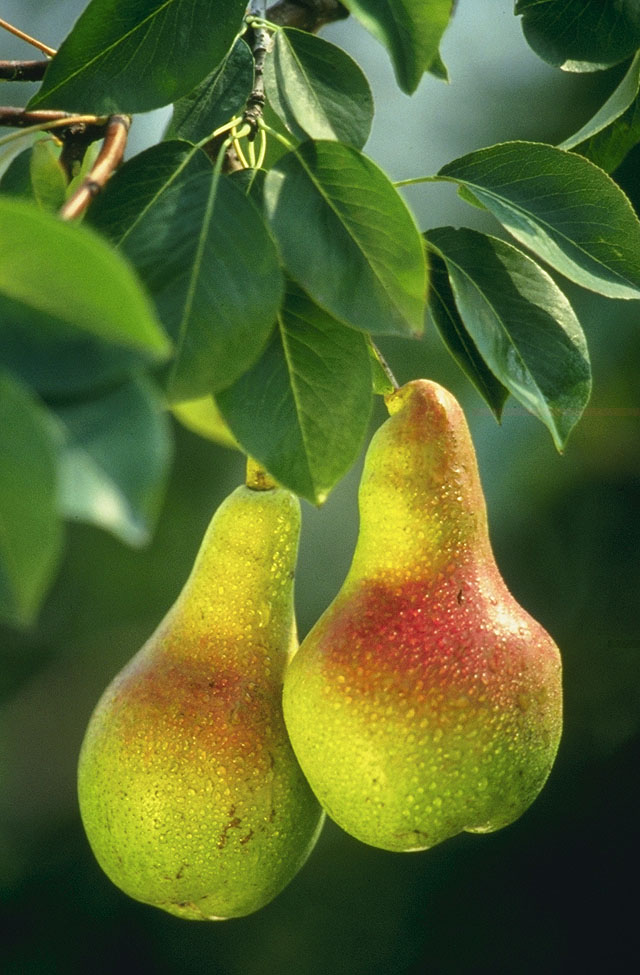
Pyrus is a genus of small to medium-sized deciduous trees in the rose family (Rosaceae) that produces the fruits known as pears. The genus was formally described by Linnaeus in Species Plantarum in 1753, and Plants of the World Online currently recognises about 75 accepted species, while Wikipedia cites roughly 74 as of late 2024. Modern treatments split the genus into two subgenera: subgenus Pyrus, an Occidental clade centred on Europe, the Mediterranean basin, southwest Asia and North Africa, and subgenus Pashia, an Oriental clade radiating across China, the Himalayas and East Asia.
The native range tracks that division almost exactly. POWO records Pyrus as indigenous across a broad arc from Morocco, Algeria and Iberia through central and southern Europe, the Caucasus, Iran and Central Asia, into the Himalayas, China, Korea, Japan and parts of Southeast Asia. The genus is widely introduced outside this range — across the United States, southern Canada, the Canary Islands, southern Africa, parts of South America and beyond — almost always as a consequence of orchard cultivation and ornamental plantings.
Pears are among the oldest fruits in human use. Wikipedia notes archaeological evidence of pear consumption in prehistoric times, with cultivation documented in China by about 2000 BC, and Roman growers later carrying selected forms into western Europe and Britain. In 2024 global pear production reached approximately 27.6 million tonnes, of which China alone accounted for roughly 76 per cent. The economically dominant species are the European pear (Pyrus communis), the Asian or nashi pear (Pyrus pyrifolia), and the Chinese white pear (Pyrus bretschneideri). Ornamental cultivation has centred on Pyrus calleryana, the Callery pear, prized for spring blossom and autumn colour but now flagged as a problematic invader in eastern North America.
As a group Pyrus species are forgiving woody plants: Plants For A Future reports a preference for rich, loamy, well-drained soils, tolerance of heavy clay and seasonal drought, and intolerance only of true waterlogging. In the wild they tend to occupy open woodland edges, rocky slopes and riverbanks on neutral to slightly calcareous substrates. In the southwestern United States, SEINet records the genus as non-native, with cultivated trees regularly escaping into old fields, pastures and disturbed rights-of-way.
Etymology
The Latin genus name Pyrus is the classical word for the pear tree, descended from pirum, the Latin name for the fruit. English "pear" reaches the same root through Old English pere or peru and Vulgar Latin pera. The deeper origin of pirum is uncertain; Wikipedia notes that it most likely entered Latin from an ancient Mediterranean language, possibly a Semitic one, reflecting the genus's long association with cultures around the eastern Mediterranean and the Near East.
Distribution
Pyrus is naturally distributed across a wide Eurasian and North African range. Plants of the World Online lists native occurrence from Morocco and Algeria through Iberia, France, Italy and central Europe, eastward through the Balkans, Türkiye, the Caucasus, Iran, Central Asia and the Himalayas, and on into China, Korea, Japan, Taiwan and parts of Southeast Asia including Vietnam, Laos, Myanmar and Thailand. The genus has been widely introduced through cultivation: POWO records naturalised populations across much of the United States and southern Canada, in the Canary Islands, the Cape provinces of South Africa, Denmark, Great Britain, Ecuador and elsewhere.
Regional records reflect this pattern. Info Flora documents four Pyrus taxa in Switzerland — Pyrus communis, P. nivalis, and the wild pear P. pyraster (including an aggregate concept) — covering both cultivated and indigenous forms. In the southwestern United States, SEINet treats Pyrus as a non-native genus whose escaped trees turn up in old fields, pastures, waste ground and along railroad rights-of-way, while listing a small number of native North American species (P. americana, P. angustifolia, P. coronaria, P. fusca) elsewhere on the continent.
Ecology
Wild Pyrus typically grows in open woodlands, on rocky slopes and along riverbanks, favouring neutral to slightly calcareous soils. Outside their native range, escapes establish in disturbed open habitat: SEINet documents naturalised pears in old fields, pastures, waste ground and railroad rights-of-way across the U.S. Southwest.
Cultivation
Pears are tolerant trees in cultivation. Plants For A Future reports that the genus prefers a rich, loamy soil and grows well in almost any site that is not waterlogged, including heavy clay and seasonally dry ground. The main horticultural complaint is biological rather than agronomic: birds strip the fruit before it ripens unless trees are netted or harvested early.
Propagation
Pyrus is most reliably raised from seed, but the seed has demanding requirements. Plants For A Future recommends harvesting seed green and sowing it immediately; stored seed needs around four weeks of warm stratification followed by winter cold, and germination can still take 18 months or more. Spring layering also works but takes roughly 18 months to root, and suckers can be divided in late winter once the parent has been established for two years.
History
Pears are among the oldest fruits in human use. Wikipedia notes that the genus likely originated in the foothills of the Tian Shan in Central Asia, that pear use is recorded in prehistoric contexts, and that pears were already being cultivated in China by about 2000 BC. The Romans selected and propagated pear cultivars and carried them westward, eventually introducing the European pear into Britain.
Taxonomy notes
Pyrus L. was formally established by Linnaeus in Species Plantarum (1753, page 479) and is placed in the family Rosaceae, order Rosales. Plants of the World Online accepts 75 species in the genus and Wikipedia cites roughly 74 as of December 2024. The genus is divided into two subgenera, subgenus Pyrus (Occidental clade, mostly Eurasian and North African) and subgenus Pashia (Oriental clade, mostly East Asian), reflecting a deep east-west split visible in both morphology and molecular data. GBIF treats the genus as ACCEPTED in its backbone taxonomy and indexes 477 descendant records under it.
Cultural uses
Pears are an economically major fruit crop. Wikipedia reports global production of about 27.6 million tonnes in 2024, with China contributing roughly 76 per cent of the world total. Across the genus the fruits are edible raw or cooked, with quality varying from dry, gritty and uninteresting in some wild species to sweet and juicy in selected dessert cultivars. Many ornamental Pyrus, especially Pyrus calleryana, are also planted as flowering street and amenity trees.










