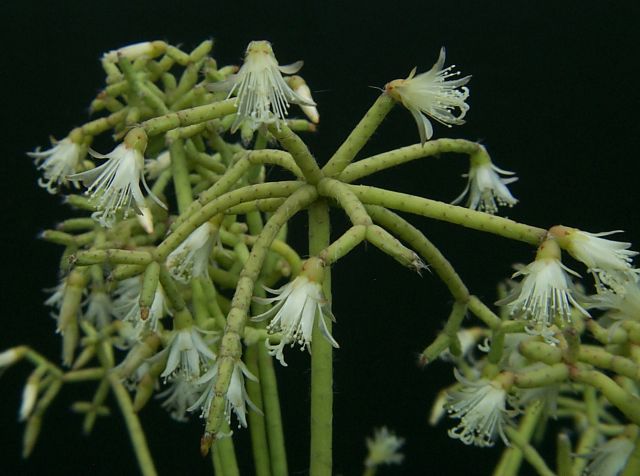
Rhipsalis Gaertn. (1788) is a genus of approximately 35–57 epiphytic cacti in the family Cactaceae (subfamily Cactoideae, tribe Rhipsalideae). The name comes from the Ancient Greek word for "wickerwork," an apt reference to the dense, interlacing stems that characterise the genus. Unlike the popular image of spiny desert cacti, Rhipsalis plants are adapted to life in humid tropical rainforests, where they grow perched on tree branches or rocky surfaces without parasitising their hosts.
The stems are highly variable across species, taking one of three main forms: terete (cylindrical), angular, or flattened and leaf-like. Adult plants rarely carry true spines. The flowers are small — typically around 1 cm in diameter — and usually white, though some species produce yellow or red blooms. Fruits are small, fleshy berries in shades of white, pink, red, or yellow, and are dispersed by fruit-eating birds and other animals.
The genus is centred in the Mata Atlântica (Atlantic Forest) of Brazil, where the greatest diversity of species occurs, but the range extends throughout Central America, the Caribbean, and much of South America, including Mexico, Florida (USA), and parts of the Andean countries. Rhipsalis baccifera stands apart as the only cactus species naturally occurring in the Old World, with a native or long-naturalised presence across tropical Africa, Madagascar, and Sri Lanka — a distribution that has long intrigued biogeographers.
Three monophyletic subgenera are currently recognised: Rhipsalis, Calamorhipsalis, and Erythrorhipsalis. Depending on the authority consulted, the genus contains between 35 (The New Cactus Lexicon) and 57 (GBIF, based on WCVP) accepted species, with additional taxa of uncertain status.
Etymology
The genus name Rhipsalis is derived from the Ancient Greek rhips (ῥίψ), meaning "wickerwork" or "wicker." The name was chosen to evoke the plants' characteristic tangle of slender, interlacing stems, which bear a visual resemblance to woven basketry. The genus was formally described by the German botanist Joseph Gaertner in 1788.
Distribution
Rhipsalis has a remarkable distribution spanning the Americas and — uniquely among cacti — the Old World. In the Americas, the genus ranges from the southern United States (Florida, with occasional occurrences in Vermont) through Mexico, Central America (Belize, Costa Rica, Guatemala, Honduras, Nicaragua, Panama), the Caribbean islands (Cuba, Dominican Republic, Jamaica, Puerto Rico, Trinidad and Tobago, and various Lesser Antilles), and throughout South America (Bolivia, Brazil, Colombia, Ecuador, French Guiana, Guyana, Paraguay, Peru, Suriname, Uruguay, Venezuela, and Argentina). The centre of diversity is Brazil's Mata Atlântica rainforest biome.
The most extraordinary distributional feature of the genus is the occurrence of Rhipsalis baccifera — the Mistletoe Cactus — across tropical Africa (from West Africa to East and South Africa, including countries such as Nigeria, Kenya, Tanzania, Mozambique, and South Africa), Indian Ocean islands (Madagascar, Réunion, Mauritius, Seychelles), and Sri Lanka. Whether this Old World presence is truly native or the result of prehistoric long-distance dispersal by birds remains debated, though the isolated island populations and lack of human cultivation history point to natural dispersal.
Distribution data derive from the World Checklist of Vascular Plants (WCVP) as aggregated by GBIF.
Ecology
Rhipsalis species are predominantly epiphytic, anchoring themselves to the bark of host trees in humid tropical and subtropical rainforests without extracting nutrients from the host. Some species are epilithic (growing on rock surfaces) and a few can be terrestrial. The genus thrives in the dappled light of forest canopies, where high humidity and warm temperatures prevail year-round.
Stem morphology is diverse: species may bear terete (round in cross-section), angular, or flattened stems, often with branching that creates the characteristic interlaced, "wickerwork" appearance that gave the genus its name. Adult plants are largely spineless or bear only hair-like bristles, a derived feature compared to the spiny ancestors of the Cactaceae. Flowers are typically small (~1 cm) and often white, pollinated by insects attracted to their nectar. The fleshy berries — white, pink, red, or yellow depending on species — are consumed and dispersed by birds and other frugivores, a mechanism thought to account for the remarkable long-distance dispersal that may explain the Old World presence of R. baccifera.
Taxonomy
Rhipsalis belongs to family Cactaceae, subfamily Cactoideae, tribe Rhipsalideae, and was established by Gaertn. in 1788 (GBIF nubKey 3084035). The genus is currently divided into three monophyletic subgenera: Rhipsalis, Calamorhipsalis, and Erythrorhipsalis. Species counts differ between authorities: The New Cactus Lexicon accepts 35 species, while GBIF (following the World Checklist of Vascular Plants) recognises 57 accepted species plus 8 of doubtful status, for a total of 94 descendant taxa.
Cultivation
Rhipsalis species are increasingly popular as houseplants and in tropical or subtropical gardens. Because they are forest-dwelling epiphytes rather than desert cacti, their cultural requirements differ markedly from most cacti: they prefer bright, indirect light rather than full sun, and benefit from the higher humidity of a sheltered indoor environment or shaded patio.
A fast-draining, epiphytic or cactus-specific potting mix with good aeration suits the genus well. Unlike desert cacti, Rhipsalis should be watered with moderate regularity during the growing season, allowing the substrate to partially dry between waterings but never desiccating completely. Overwatering and cold draughts are the most common sources of stress. Most species prefer temperatures above 10 °C and are not frost-tolerant. Hanging baskets are a popular display method that allows the pendulous or cascading stems to trail freely.
Propagation
Rhipsalis is straightforward to propagate from stem cuttings. A healthy stem segment is allowed to callous for one to two days, then placed in a lightly moistened, well-draining epiphyte or cactus mix. Rooting typically occurs within several weeks in warm, humid conditions. Seed propagation is possible but slower and less commonly practised by hobbyists. Because the plants are epiphytes, root systems are relatively shallow and division is feasible for established clumps.










