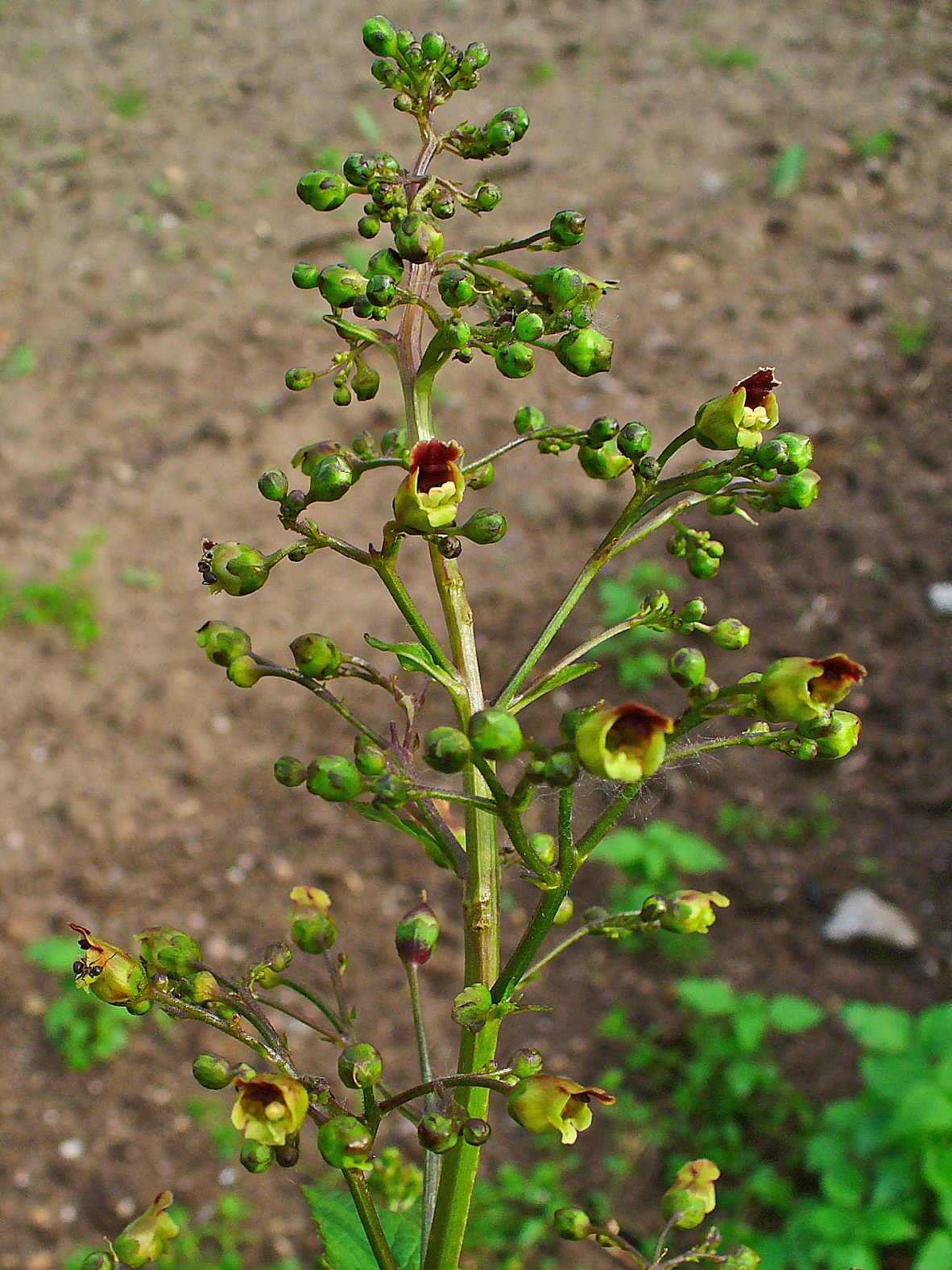
Scrophularia, commonly called figworts, is a genus of approximately 200 herbaceous flowering plants (with estimates ranging from about 150 to over 480 total taxa) in the family Scrophulariaceae, order Lamiales. The genus was formally described by Carl Linnaeus in 1753 in Species Plantarum (Sp. Pl. 2: 619).
Members of the genus are perennial herbs recognizable by their square stems, opposite petiolate leaves with serrate or incised margins, and small two-lipped (bilabiate) flowers borne in large terminal paniculate inflorescences. The corolla has a wide tube with a forward-directed two-lobed upper lip and a deflexed median lobe on the lower lip. A characteristic feature is the presence of four stamens and a dilated sterile fifth filament (staminode) lying beneath the upper corolla-lip. Flowers are typically dull reddish-brown to greenish. The fruit is a septicidal capsule containing angular, rugose seeds. Plants are pollinated mainly by bees and wasps.
Scrophularia is distributed throughout the Northern Hemisphere, with its greatest diversity in temperate Eurasia. Multiple species also occur in the southwestern United States and adjacent regions. In Switzerland alone, six species are recorded: S. auriculata, S. canina, S. juratensis, S. nodosa, S. umbrosa, and S. vernalis.
The genus name alludes to scrofula, a form of tuberculosis affecting the lymph nodes — a reference to the traditional herbal use of several species in treating this condition. Several species, including the widely used Ningpo figwort (S. ningpoensis), remain important in herbal medicine today. Scrophularia species also have ecological significance as larval host plants for certain Lepidoptera.
Etymology
The genus name Scrophularia derives from the Latin scrofula, referring to a form of tuberculosis that causes swelling of the lymph nodes in the neck. The name reflects the long-standing use of several species in European herbal medicine as remedies for this condition. The connection follows the Doctrine of Signatures — the knotted rhizomes of the most familiar species, S. nodosa (knotted figwort), were thought to resemble swollen lymph nodes, suggesting the plant as a treatment. The genus was formally named by Carl Linnaeus in his 1753 Species Plantarum.
Distribution
Scrophularia is distributed primarily throughout the Northern Hemisphere, with its center of diversity in temperate Eurasia. The genus is well-represented in Europe, the Middle East, and central to eastern Asia. Multiple species occur in the southwestern United States and western North America, including the native S. californica. Within Switzerland, six species are recorded across the national flora, spanning a range of habitat types. Favored habitats for individual species include damp woodland edges, hedgebanks, streambanks, and similar moist, partly shaded environments.
Ecology
Scrophularia species colonize damp, disturbed, and semi-shaded habitats including woodland margins, hedgerows, stream banks, and roadsides. The bilabiate, nectariferous flowers are primarily pollinated by bees and wasps. Certain species also serve as larval food plants for Lepidoptera; S. nodosa is documented as a host for Phymatopus hectoides. The genus occupies a range of soils — from light to heavy — tolerating mildly acidic to mildly alkaline conditions, provided moisture is adequate.
Cultivation
Scrophularia species are undemanding plants suited to moist, partially shaded garden positions. S. nodosa, the most commonly cultivated species, tolerates a wide range of soil textures (light to heavy clay) and a moderately acidic to slightly alkaline pH. It prefers consistently moist conditions and grows in semi-shade or full sun. Plants are cold-hardy to at least -15°C (USDA zones 6–9, UK hardiness zone 7). They are generally grown as ornamentals for their architectural foliage and attract pollinators, particularly bees and wasps, throughout a long flowering season from June to September.
Cultural Uses
Scrophularia has a long history of use in European and Asian herbal medicine, with the genus name itself reflecting traditional treatment of scrofula (lymph node tuberculosis). The whole plant, particularly in S. nodosa, functions as an alterative, anti-inflammatory, diuretic, mild purgative, and stimulant. It has been applied internally for chronic skin diseases such as eczema and psoriasis, poor circulation, and lymph node swellings, and externally as decoctions or ointments for sprains, burns, and inflammatory skin conditions. Use is contraindicated in patients with ventricular tachycardia or heart conditions and during pregnancy.
S. ningpoensis (Ningpo figwort) is the most widely used species in contemporary herbal practice globally, featuring prominently in Traditional Chinese Medicine. Several species contain iridoid glycosides, which are considered responsible for at least some of their biological activity.
Propagation
Scrophularia can be propagated by seed or by division. Seed should be sown in spring or autumn in cold frames; once seedlings are large enough to handle, they are pricked out and transplanted to individual pots before planting out. Division is carried out in spring; smaller divisions establish more reliably if potted and grown on in a cold frame prior to planting in their permanent position.
Taxonomy
Scrophularia L. was described by Linnaeus in 1753 (Sp. Pl. 2: 619) and is the accepted genus name. It belongs to the family Scrophulariaceae, order Lamiales, class Magnoliopsida. GBIF records approximately 481 descendant taxa under this genus, while other sources report the number of accepted species as roughly 150–200.
Seven genus-level synonyms are recognized: Ceramanthe (Rchb.) Dumort., Mosheovia Eig, Oreosolen Hook.f., Scrophucephalus A.P.Khokhr., Tomiephyllum Fourr., Tuerckheimocharis Urb., and Venilia Fourr. — all pointing to Scrophularia L. as the accepted name. The type species is S. nodosa L. The genus is distinguished from related genera by its calyx lacking conspicuous bracts at the base.










