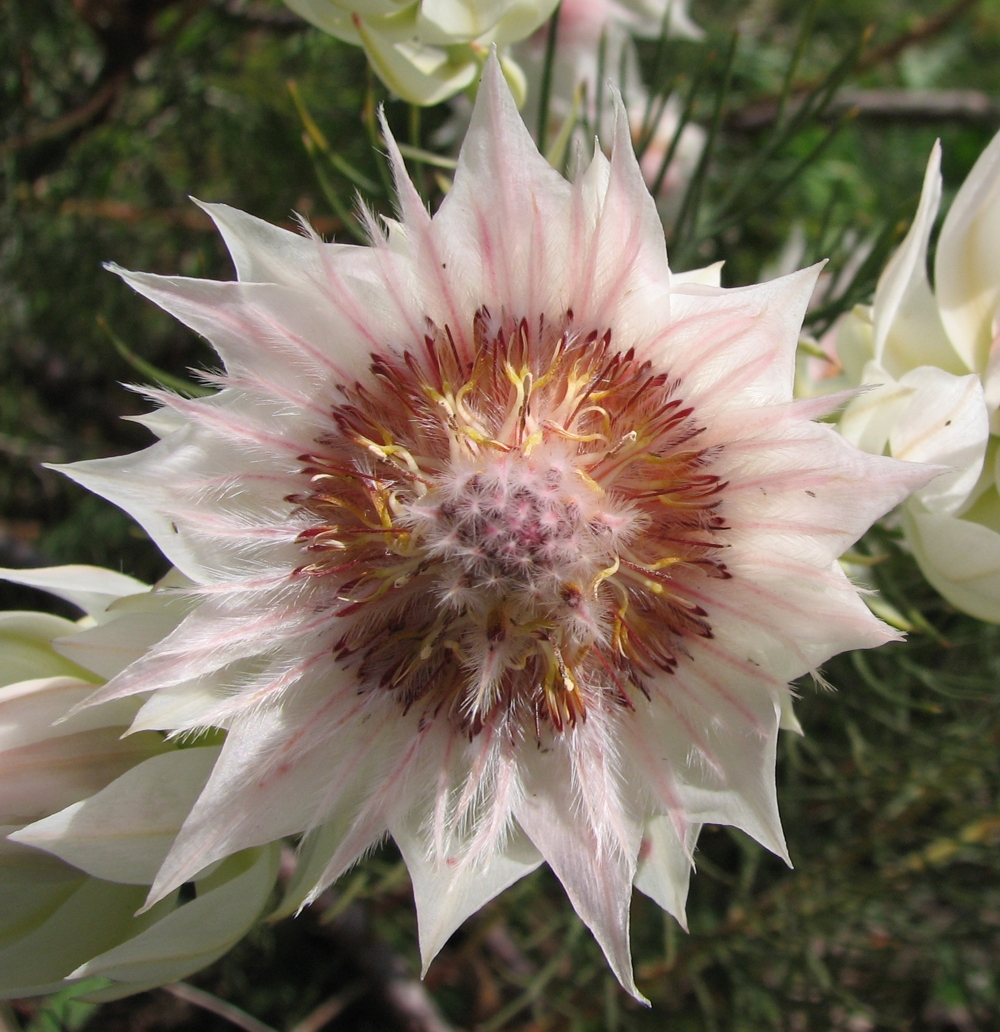
Serruria is a genus of flowering shrubs in the family Proteaceae, comprising around 70–78 recognized species. All members of the genus are endemic to South Africa, where they form a characteristic element of the Cape Floristic Region's fynbos vegetation. The genus is commonly known as "spiderhead" in English and "spinnekopbos" in Afrikaans — both names alluding to the finely divided, silky foliage that gives the plants a delicate, cobweb-like appearance.
Plants in the genus are typically compact to medium-sized shrubs bearing intricate, much-divided leaves and flower heads surrounded by papery, often colorful bracts. Flowers are generally small, ranging from white to pink, and are arranged in dense, rounded heads that make several species popular in the ornamental and cut flower trades. Serruria florida, commonly called the blushing bride or pride of Franschhoek, is the most widely cultivated member and is prized by florists worldwide.
Because the genus is endemic to the Cape Floristic Region — one of the world's biodiversity hotspots — many species face significant conservation pressures from habitat loss, invasive species, and altered fire regimes. Serruria florida itself is classified as Critically Endangered on the IUCN Red List, with its natural occurrence restricted to a small area within the Hottentots Holland Nature Reserve in the Cape Province.
Etymology
The genus name Serruria honors Joseph Serrurier, a professor of botany at Utrecht University during the early eighteenth century. The English common name "spiderhead" and the Afrikaans equivalent "spinnekopbos" both derive from the plant's most striking visual feature: the finely divided, silky leaves that give the foliage a gossamer, cobweb-like appearance. This foliar character also underpins the genus's broader appeal in horticulture and floristry.
Distribution
All species of Serruria are endemic to South Africa and are concentrated within the Cape Floristic Region, a global biodiversity hotspot. The genus is a component of the fynbos biome — a fire-adapted shrubland found in the Western Cape and adjacent areas. Individual species often have very restricted ranges: Serruria florida, for example, occurs naturally only within the Hottentots Holland Nature Reserve in the Cape Province. This pattern of narrow endemism is typical of Proteaceae genera in the Cape region.
Ecology
Serruria species flower primarily in the Southern Hemisphere winter and spring, with Serruria florida blooming from July to October in the wild. The plants are adapted to the nutrient-poor, well-drained soils of the fynbos and can tolerate seasonal drought. Like other Cape Proteaceae, members of the genus are intimately associated with fire-driven ecosystem dynamics, with flowering and seed release often cued to post-fire conditions.
Conservation
Several Serruria species face serious conservation threats due to the highly restricted nature of their ranges and ongoing pressures within the Cape Floristic Region. Serruria florida (blushing bride) is listed as Critically Endangered on the IUCN Red List. The genus as a whole is vulnerable to habitat degradation, agricultural expansion, invasive alien plants, and disruption to natural fire regimes. Conservation efforts in South Africa have focused on protected areas such as the Hottentots Holland Nature Reserve.
Cultivation
Serruria species, particularly Serruria florida, are cultivated as ornamental garden plants and are important in the commercial cut flower industry globally. They perform best in a well-drained position in full sun and are tolerant of dry conditions once established. Like most Cape Proteaceae, they are sensitive to phosphorus-rich fertilizers, which can be lethal — low-phosphorus, slightly acidic soils closely mimicking the native fynbos substrate produce the best results.
Propagation
Serruria can be propagated from cuttings or from seed. Seed propagation is possible but can be challenging, with seeds often requiring specific conditions for reliable germination. Cutting-propagation is more commonly practiced in commercial production of Serruria florida for the cut flower trade.
Taxonomy
The genus Serruria was described by Burm. ex Salisb. and published in Paradisus Londinensis (Sub T. 67) in 1807. It is placed in the family Proteaceae, subfamily Proteoideae, tribe Leucadendreae, order Proteales. GBIF records 78 descendant taxa within the genus. The basionym of the most commercially important species, Serruria florida, is Protea florida Thunb., later transferred to Serruria by Knight.










