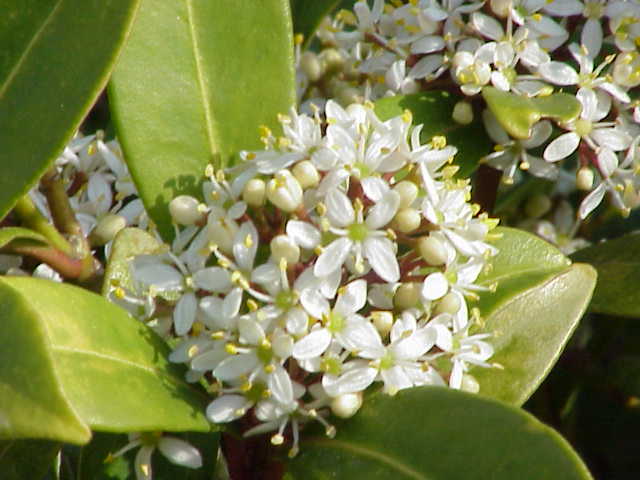
Skimmia is a small genus of evergreen dioecious shrubs and small trees in the rue family Rutaceae, order Sapindales. All species are native to warm temperate regions of Asia, with the genus's range extending from Afghanistan and the western Himalayas eastward through Nepal, China, and Japan to southeast Asia.
The leaves are clustered at the ends of the shoots, simple and lanceolate, typically 6–21 cm long and 2–5 cm broad, with a smooth margin. When crushed, all parts of the plant release a distinctive pungent aroma. The flowers are borne in dense panicle clusters; each flower is small, 6–15 mm in diameter, with 4–7 petals. Plants are dioecious, meaning male and female flowers occur on separate individuals, so both sexes are required for fruiting. The fruit is a fleshy drupe, red to black, 6–12 mm in diameter, containing a single seed.
The genus comprises four accepted species. Skimmia japonica, native to Japan and China, is the most widely cultivated and can reach 7 m as a shrub. Skimmia arborescens, from the eastern Himalayas to southeast Asia, is the tallest, capable of growing as a small tree to 15 m. Skimmia laureola ranges from Nepal to Vietnam and China and also attains tree stature. Skimmia anquetilia is a compact shrub to 2 m from the western Himalayas and Afghanistan.
Etymology
The botanical name Skimmia is a Latinization of shikimi (シキミ, 樒), the Japanese name for Illicium religiosum. The word also appears as an element in miyama shikimi (ミヤマシキミ, 深山樒), the Japanese common name for Skimmia japonica itself.
Distribution
Skimmia is entirely Asian in distribution, with species native to warm temperate zones spanning from Afghanistan and the western Himalayas east through Nepal, China, Japan, and into southeast Asia. Individual species have more restricted ranges: S. anquetilia is confined to the western Himalaya and Afghanistan, while S. arborescens and S. laureola extend into southeast Asia, and S. japonica is centred on Japan and China.
Ecology
Skimmia species are dioecious, requiring separate male and female plants for fruit set; the red to black drupes are likely dispersed by birds. Known invertebrate feeders include aphids, Horse Chestnut Scale (Pulvinaria regalis), Garden Leafhopper, and Southern Red Mite.
Cultivation
Skimmia japonica and its subspecies are the most commonly cultivated members of the genus, valued in temperate gardens for their year-round evergreen foliage, fragrant spring flowers, and persistent red berries. Because plants are dioecious, gardeners typically grow one male plant alongside several females to ensure reliable fruiting. Skimmias generally prefer partial shade, moist well-drained acidic soils, and shelter from harsh winds; they are tolerant of urban pollution, making them popular choices for courtyard and container planting.

