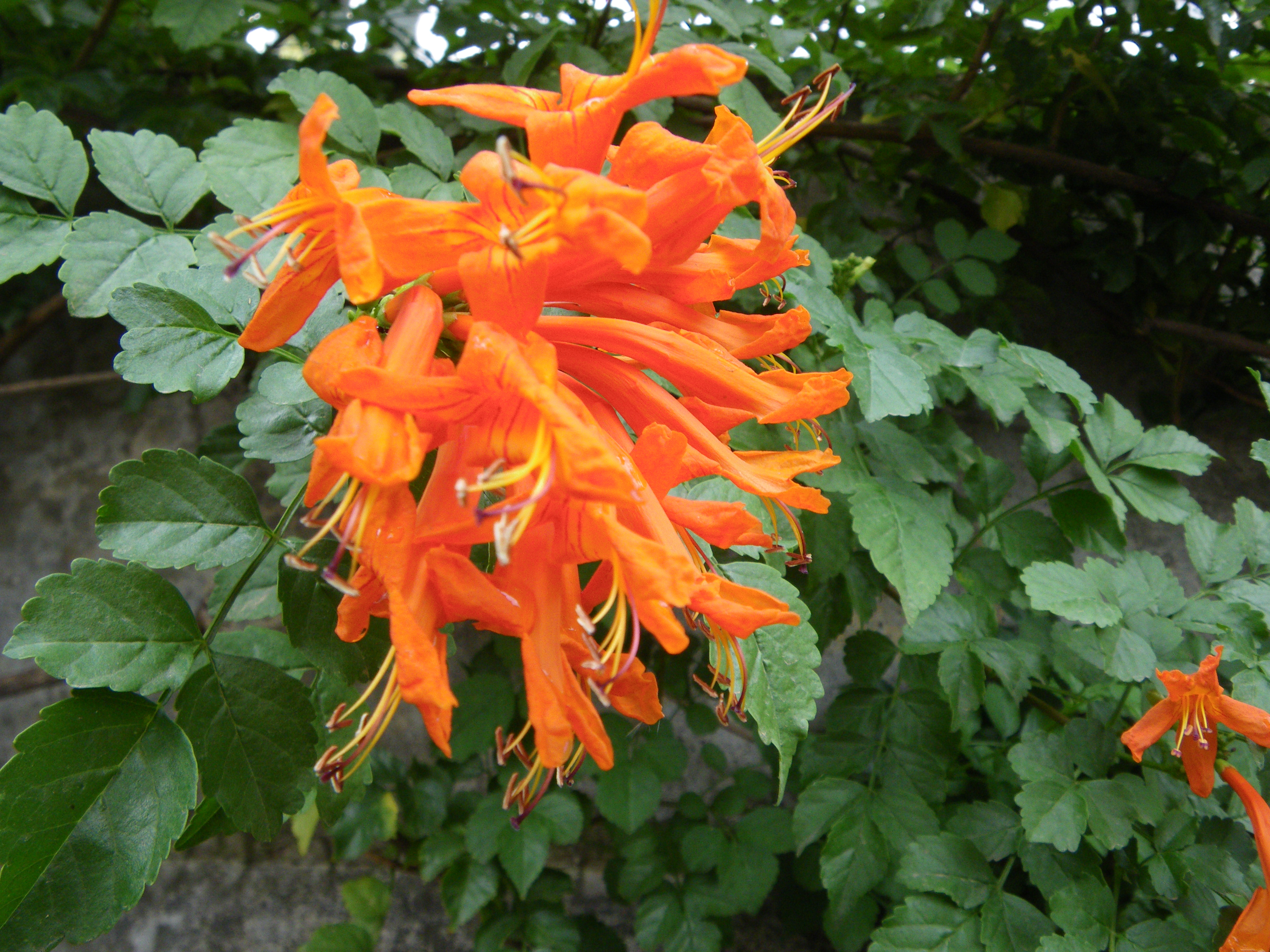
Tecomaria is a small genus of flowering shrubs and trees in the family Bignoniaceae, order Lamiales. It comprises two species native to sub-Saharan Africa, with a range extending from Angola, the Democratic Republic of the Congo, and Tanzania southward through Malawi, Mozambique, Zambia, and Eswatini to South Africa.
The genus was briefly folded into the closely related genus Tecoma in the early 1980s, when botanists judged the floral differences between the two groups insufficient to maintain them as separate genera — Tecomaria capensis was accordingly reclassified as Tecoma capensis. Subsequent molecular phylogenetic studies overturned this arrangement, demonstrating that Tecomaria is in fact most closely related to Podranea rather than to Tecoma. This finding — an example of DNA evidence revising conclusions drawn from morphology alone — led to the restoration of Tecomaria as a distinct genus.
The best-known member is Tecomaria capensis, the Cape honeysuckle, a vigorous scrambling shrub widely cultivated across warm-temperate and subtropical regions for its showy tubular flowers.
Distribution
Tecomaria is native to sub-Saharan Africa. T. capensis ranges across Angola, the Democratic Republic of the Congo, Tanzania, Malawi, Mozambique, Eswatini, and South Africa; T. nyassae extends across Angola, the DR Congo, Tanzania, Mozambique, Malawi, and Zambia.
Taxonomy Notes
Tecomaria has a contested taxonomic history. In the early 1980s the genus was subsumed into Tecoma on morphological grounds, with T. capensis renamed Tecoma capensis. Molecular studies later showed Tecomaria is most closely related to Podranea, not Tecoma, and the genus was restored — a case where DNA evidence overturned morphology-based groupings.










