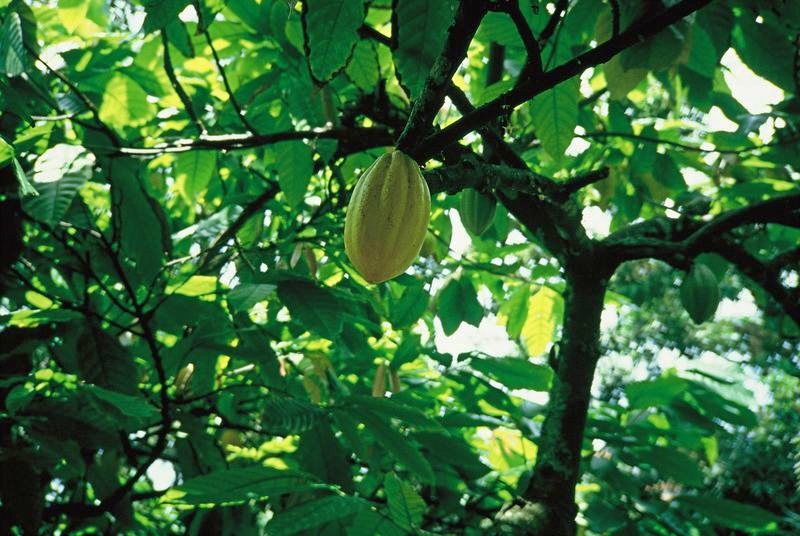
Theobroma is a genus of approximately 41 species of small understory trees belonging to the mallow family Malvaceae (order Malvales). The genus was established by Carl Linnaeus in 1753 and was previously placed in the family Sterculiaceae, which has since been incorporated into Malvaceae to create a monophyletic grouping. The lectotype, Theobroma cacao L., was formally designated in 1929.
All species are native to the tropical forests of Central and South America, where they grow as understory trees beneath the forest canopy. The genus is best known for Theobroma cacao, the cacao tree, whose seeds are the source of cocoa and chocolate — one of the most economically and culturally significant crop plants in the world. Other members of commercial and regional importance include Theobroma grandiflorum (cupuaçu), Theobroma bicolor (mocambo), and Theobroma speciosum (capacui), all of which produce edible fruits or seeds used in food and beverages across Amazonia and beyond.
Several Theobroma species serve as food plants for the larvae of moths in the genus Endoclita (E. chalybeatus, E. damor, E. hosei, and E. sericeus), as well as Hypercompe muzina, whose larvae feed exclusively on T. cacao. The alkaloid theobromine, a notable active compound in cacao with stimulant properties, takes its name directly from the genus.
Etymology
The name Theobroma is derived from the Greek words θεός (theos, meaning "god") and βρῶμα (broma, meaning "food"), together translating as "food of the gods" — a fitting epithet for the genus that gives us chocolate.
Distribution
All ~41 species of Theobroma are native to the tropical forests of Central and South America, growing as small understory trees in humid lowland rainforest environments.
Cultivation
Theobroma cacao is cultivated throughout tropical regions worldwide for cocoa production. Theobroma grandiflorum (cupuaçu) is commercially grown in Brazil and other parts of tropical South America for its fruit pulp and seeds. Other species such as T. bicolor are harvested from wild or semi-cultivated trees in Amazonia.
Cultural Uses
Cacao (Theobroma cacao) has been central to Mesoamerican and South American cultures for millennia, used as food, currency, and ritual offering long before European contact. The genus name itself — "food of the gods" — reflects the reverence in which cacao was held by pre-Columbian civilizations. Today, cacao remains one of the most economically important tropical crops globally, underpinning the multibillion-dollar chocolate and confectionery industry. The alkaloid theobromine, named for the genus, is the primary stimulant compound in chocolate.
Taxonomy Notes
Theobroma was published by Linnaeus in 1753, with the cacao tree (Theobroma cacao L.) serving as lectotype (designated 1929). The genus was long placed in the family Sterculiaceae; modern phylogenetic analyses led to Sterculiaceae being subsumed into a broadly circumscribed Malvaceae (order Malvales) to restore monophyly. Plants of the World Online accepted 41 species as of November 2025.










