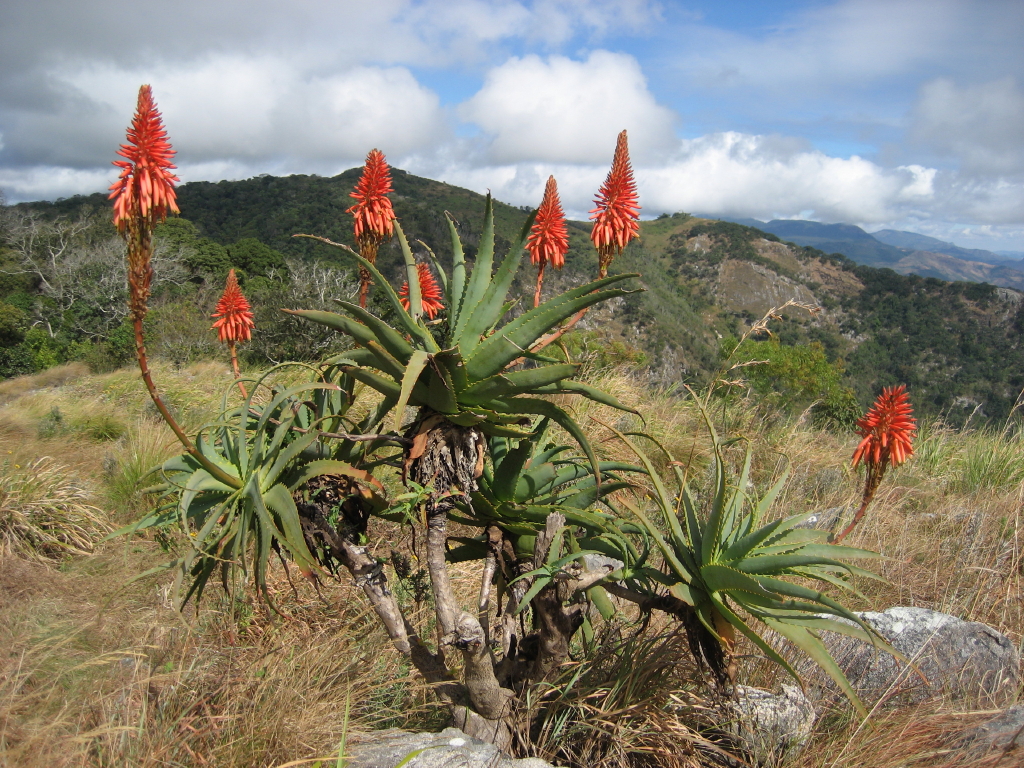
Aloe is a large genus of succulent flowering plants in the family Asphodelaceae (order Asparagales), comprising over 650 accepted species. Formally described by Carl Linnaeus in Species Plantarum (1753), the genus encompasses an extraordinary range of forms — from small, almost stemless rosette plants to towering arborescent specimens several metres tall. The characteristic fleshy, lanceolate leaves are arranged in tight rosettes and range in colour from grey-green to bright green, sometimes striped or mottled with white spots. The leaves' enlarged tissue stores water, allowing aloes to thrive in the arid and semi-arid environments they call home. When conditions allow, dense clusters of pendant tubular flowers appear on simple or branched leafless stems, typically in shades of yellow, orange, pink, or red — a vital nectar source for pollinators.
The genus is native to tropical and southern Africa, Madagascar, the Arabian Peninsula (including Jordan and Yemen), India, and numerous islands of the Indian Ocean. Many species have also naturalized far beyond this original range, establishing themselves in Mediterranean basin countries, Australia, parts of the Americas, and the Hawaiian Islands. This wide distribution reflects both the genus's ecological resilience and thousands of years of deliberate human cultivation.
Aloe is one of the most economically and ethnobotanically significant succulent genera in the world. Approximately 75% of species have documented local medicinal uses. The clear inner leaf gel, most famously from Aloe vera, has been applied to wounds, burns, and skin ailments since antiquity — ancient Greek, Roman, and medieval physicians all recorded its use. The yellow subdermal sap, rich in anthraquinone glycosides, has long served as a purgative. Today, the genus underpins a global industry in cosmetics, pharmaceuticals, and functional foods.
In horticulture, aloes are prized as ornamental plants for gardens and containers worldwide, valued for their striking architectural form, low water requirements, and vivid flower spikes. Taxonomic understanding of the genus has evolved considerably: molecular studies published in 2014 proposed splitting the traditional broad Aloe into six segregate genera (including Aloidendron, Kumara, Aloiampelos, Aristaloe, and Gonialoe), though many authorities continue to treat these taxa within an expanded Aloe.
Etymology
The genus name Aloe derives from the Arabic word al'uluh, meaning "bitter and shiny substance," a direct reference to the plant's acrid, resinous latex. Some scholars also trace a connection to the Hebrew word ahal (אוהל), used in ancient texts to refer to fragrant aloe wood. Both roots point to the genus's long history of use as a medicinal and aromatic substance in the ancient Near East and Mediterranean world.
Distribution
Aloe is native to tropical and southern Africa (its centre of diversity), Madagascar, the Arabian Peninsula including Jordan, India, and various islands of the Indian Ocean such as the Socotra Archipelago. The genus achieves its greatest species richness in southern and eastern Africa, with South Africa, Ethiopia, and Madagascar each hosting high numbers of endemic species.
Beyond its native range, numerous aloe species have naturalized extensively. Mediterranean-climate regions, parts of Australia, the Americas, and the Hawaiian Islands all have naturalized populations, principally of widely cultivated species such as Aloe vera and Aloe arborescens. Aloe vera itself is considered native or archaeophytic in the Canary Islands and has spread throughout Mediterranean maritime habitats.
Taxonomy
Aloe L. was formally established by Carl Linnaeus in Species Plantarum (1753), authorship abbreviated as "L." Under the APG IV classification system (2016), the genus is placed in family Asphodelaceae, subfamily Asphodeloideae, tribe Aloeae, within order Asparagales. It had previously been assigned variously to the segregate family Aloaceae and to the broadly circumscribed Liliaceae before molecular systematics clarified its relationships.
GBIF records 912 descendant taxa under the accepted genus key (2770879). Molecular phylogenetic analyses published in 2014 revealed that the traditional genus as broadly circumscribed is not monophyletic, leading to a proposal to recognise six segregate genera: Aloidendron (tree aloes), Kumara, Aloiampelos (climbing aloes), the core Aloe, Aristaloe, and Gonialoe. Acceptance of this split varies among treatments; some global checklists have adopted the segregates while others maintain the broader genus.
Ecology
Aloes are quintessential succulents, storing water in their enlarged fleshy leaves, stems, or roots to endure prolonged drought. They occur across a broad range of arid and semi-arid habitats — from coastal dunes and rocky hillsides to savanna margins and montane grasslands — wherever drainage is rapid and rainfall is seasonal or unreliable.
Their tubular, nectar-rich flowers are adapted for pollination by birds (particularly sunbirds in Africa) and bees, and the bright flower spikes often bloom in winter or dry-season months when competing floral resources are scarce. The anthraquinone glycosides (aloin) concentrated in the sub-epidermal leaf tissue serve as a deterrent to herbivory, giving the yellow sap its characteristic bitterness.
Cultivation
Aloes are among the most widely grown succulent ornamentals in the world, valued for architectural form, low maintenance, and colourful flower spikes. They perform best in full sun (at least six hours of direct light daily) in well-draining, coarse, cactus-type soil; clay pots with multiple drainage holes are ideal for container culture. The key watering principle is to allow the medium to dry fully between waterings, then water thoroughly and allow complete drainage — consistent moisture causes root rot.
Most aloe species are frost-tender; Aloe vera is rated hardy to UK Zone 8 and USDA Zones 9–11. In colder climates they are grown as houseplants or moved indoors for winter. Growth rate is slow. The cultivar Aloe 'Lizard Lips' has received the Royal Horticultural Society Award of Garden Merit.
Propagation
The primary propagation method for aloes is division of offsets (pups), which most species produce freely around the base of the mother plant. Offsets can be detached and potted at virtually any time of year provided temperatures are warm enough. Allow the cut surface to callus for a day or two before potting into dry, well-draining medium, then begin watering after a week.
Propagation from seed is also possible: germination requires warmth (around 16°C / 61°F) and takes between one and six months. Seed-grown plants take several years to reach maturity and may not reproduce the parent's characteristics if hybrids are involved.
Cultural Uses
Aloes have been medicinally and economically important to human cultures across Africa, the Arabian Peninsula, and Asia for millennia. The ancient Greeks and Romans documented aloe's use for wound care and skin ailments; medieval European pharmacopoeias relied on the dried yellow latex as a purgative and general tonic. Today approximately 75% of all Aloe species have documented local medicinal uses within their native ranges.
Aloe vera dominates modern commercial applications. Its clear inner leaf gel is widely used in wound and burn treatment, skin-care formulations, cosmetics, and hair-care products. The gel is also consumed as a beverage ingredient after removal of aloin (the bitter anthraquinone fraction). In traditional Indian medicine (Ayurveda), aloe is prescribed for constipation, colic, skin diseases, and parasitic infections; in traditional Chinese medicine it is used for fungal conditions. The plant contains a range of amino acids and vitamins (A, B-complex, C, E) as well as minerals.
It is important to note that anthraquinone glycosides in the latex are toxic — causing abdominal cramping, diarrhoea, and potential kidney and cardiac complications with prolonged oral use — and long-term internal consumption is not recommended without medical supervision. Current scientific consensus finds no evidence that aloe preparations prevent or treat cancer.










