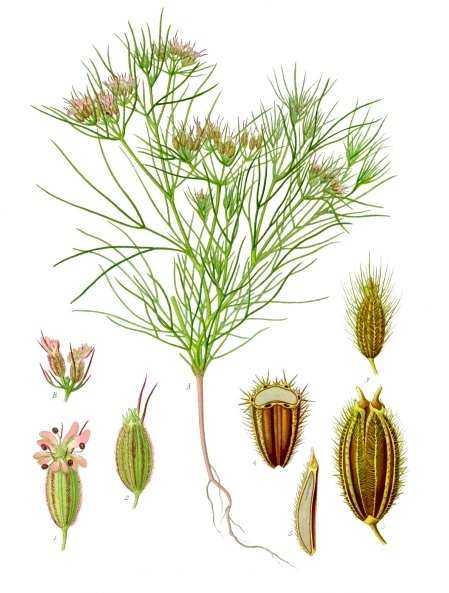
Cuminum is a small genus of flowering plants in the carrot family, Apiaceae (order Apiales), formally described by Tournefort ex Linnaeus in Species Plantarum (1753). Wikipedia describes it as containing four species, though the GBIF backbone lists five descendant taxa including synonyms; by far the most economically and culturally significant member is Cuminum cyminum, the source of cumin seed.
Plants in the genus are annual herbs. Cuminum cyminum grows 30–50 cm tall from a slender, glabrous, branched stem, with pinnate to bipinnate leaves made up of thread-like leaflets. Small white or pink flowers are borne in compound umbels of five to seven umbellets, giving way to ridged, fusiform to ovoid achene fruits about 4–5 mm long — the "seeds" harvested as the spice. The fruit's ridged, oil-canalled structure resembles that of other Apiaceae spices such as caraway, parsley, and dill.
The genus is native to the Irano-Turanian region of Central and Southwestern Asia and the Eastern Mediterranean, but cumin has been cultivated and traded so widely and for so long — with archaeological evidence stretching back to the 6th millennium BC — that it now grows as an introduced species in many parts of the world. Today it is produced at large commercial scale, led by India, alongside Syria, Turkey, and Iran, and reaches home cooks worldwide as one of the most widely used culinary spices.
Etymology
"Cuminum" traces through Latin cuminum and Ancient Greek κύμινον (kúminon) to a Semitic source related to Hebrew כמון (kammōn) and Arabic كمون (kammūn), ultimately from Akkadian kamūnu and Sumerian gamun — reflecting the spice's ancient trade history across the Near East.
Distribution
Native to the Irano-Turanian region spanning Central and Southwestern Asia and the Eastern Mediterranean. Long-distance cultivation and trade in bird food have naturalized it as an introduced species in many other territories; India is now the largest producer (about 70% of world output), followed by Syria, Turkey, the UAE, and Iran.
History
Cumin is one of the oldest spices in continuous use: wild seeds have been excavated at the submerged Neolithic site of Atlit-Yam (early 6th millennium BC) and at Syrian sites dated to the 2nd millennium BC, and it appears at New Kingdom Egyptian sites, where it served as both a spice and a mummification preservative. It was significant to the Minoans (recorded in Linear A tablets), a table staple for the ancient Greeks, and heavily used in Roman cuisine, and it has been a foundational spice in Indian cooking for millennia. Spanish and Portuguese colonists later introduced it to the Americas.
Cultivation
Cumin is a frost-sensitive annual grown from seed, needing 2–5 °C for emergence and an optimum of 20–30 °C for growth; growers guard against frost with sulfuric-acid sprays, pre-frost irrigation, windbreaks, or smoke cover. It prefers fertile, well-drained sandy loam with a pH of 6.8–8.3 and is sensitive to salinity and heavy soils. Its open, low canopy makes it prone to weed competition, and it is vulnerable to Fusarium wilt (up to 80% yield loss), Alternaria blight, powdery mildew, aphids, and mites.
Propagation
Plants are raised from seed, sown by broadcasting or in furrowed lines spaced 20–25 cm apart at a depth of 1–2 cm. Soaking seed for 8 hours before sowing improves germination; recommended sowing density is 12–15 kg/ha, targeting roughly 120 plants per square meter.
Cultural Uses
The dried seed is a staple spice worldwide, used whole or ground in chili powder, achiote blends, adobos, sofrito, garam masala, curry powder, bahaarat, some cheeses (e.g. Leyden), traditional French breads, and — combined with coriander — the North Indian/Pakistani blend dhana jeera. It also has a long history in traditional medicine, though current evidence does not support therapeutic efficacy.
Taxonomy Notes
The genus was described by Tournefort ex Linnaeus in Species Plantarum (1753) and sits in family Apiaceae, order Apiales. Sources differ slightly on species count: Wikipedia describes the genus as containing four species, while the GBIF backbone lists five descendant taxa (likely including synonyms).










