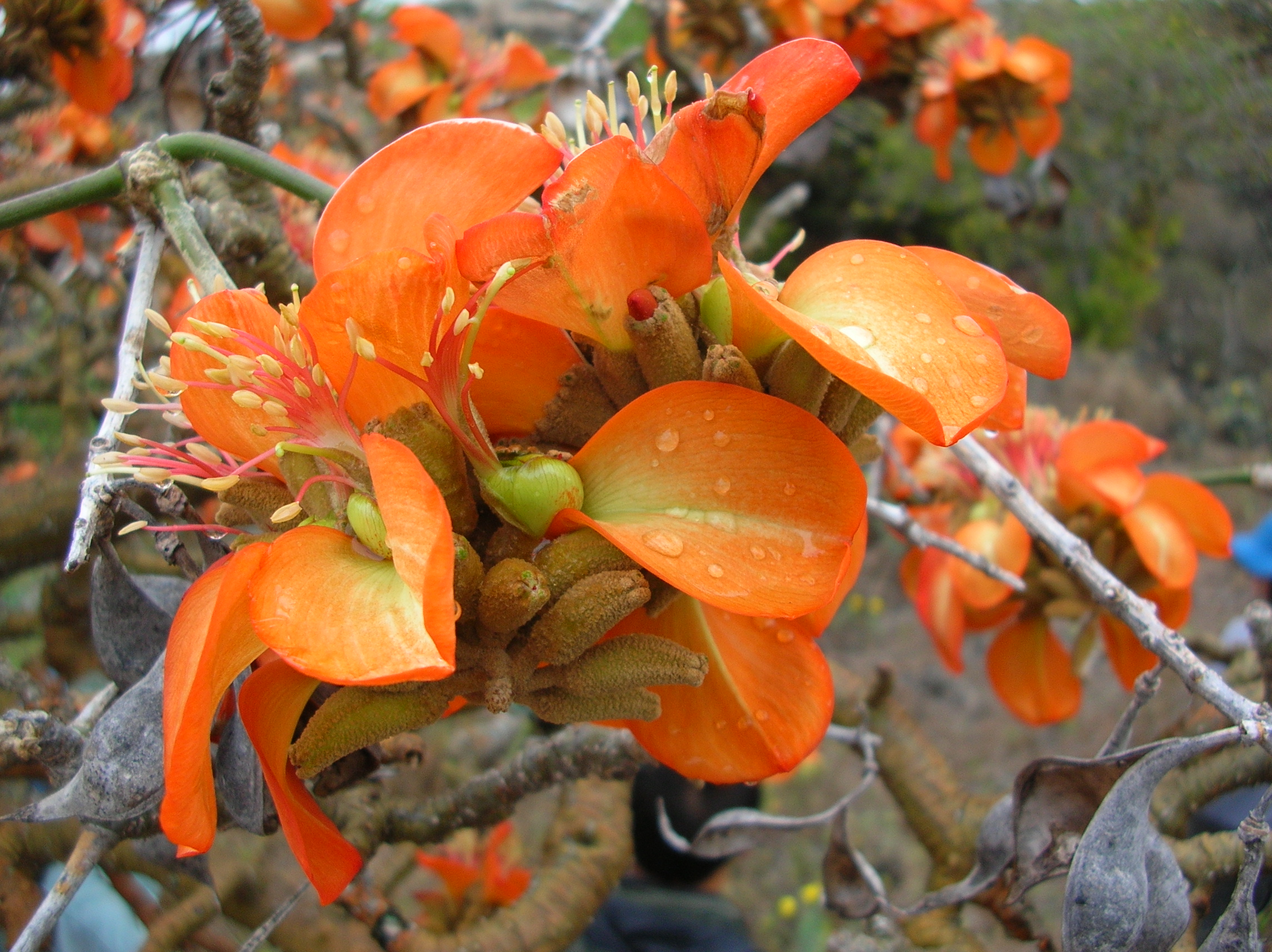
Erythrina is a pantropical genus of trees and shrubs in the legume family (Fabaceae), placed in subfamily Faboideae and tribe Phaseoleae. The genus contains roughly 124–130 accepted species and is best known for its showy red or orange flowers, which give it both its scientific name — from the Greek erythros, "red" — and the widely used common name coral tree. Other vernacular names include flame tree, bucaré, frejolillo, porotillo, and kafferboom, reflecting the genus's broad reach across the Americas, Africa, Asia, and the Pacific.
Coral trees typically grow as small to large trees reaching about 30 m in height, often armed with corky spines on the trunk and branches. Their trifoliate leaves are characteristic of the bean family, and the inflorescences carry tubular, papilionaceous flowers with elongated standard petals in shades of red, scarlet, orange and — in some species — yellow, salmon, greenish or white. The flowers are rich in nectar and adapted for bird pollination: hummingbirds service Neotropical species while lorikeets, mynas, drongos and other passerines visit Old World species. After flowering, plants produce legume pods containing bright, hard seeds; in many coastal species these seeds are buoyant and travel long distances on ocean currents as so-called "sea beans," which helps explain the genus's pantropical distribution.
Like other legumes, Erythrina forms symbiotic nodules with nitrogen-fixing bacteria, and this trait has made several species favourite shade and "nurse" trees in coffee, cocoa and other agroforestry systems. The genus is also chemically distinctive: about a third of its species accumulate erythrina alkaloids — including erysodine, erysovine and erythravine — that have curare-like neuromuscular effects and anxiolytic activity in laboratory studies. Seeds of essentially all species are reported to be poisonous, and several have caused fatal human and livestock poisonings. Despite this, coral trees occupy a prominent place in human culture: Erythrina crista-galli is the national flower of Argentina and Uruguay, the genus serves as the official tree of Los Angeles, and in Hawaiʻi the endemic wiliwili (E. sandwicensis) provided lightweight wood for surfboards, outrigger-canoe parts and fishing-net floats, while its seeds were strung into lei.
Etymology
The genus name Erythrina was coined by Linnaeus from the Greek erythros, "red," in reference to the brilliant red flowers that characterize most species. Many of the vernacular names used around the world — coral tree, flame tree, kafferboom — likewise focus on the colour of the inflorescence rather than on the tree's growth form.
Distribution
Erythrina has a pantropical native range, with species found across tropical and subtropical regions on every inhabited continent. Plants of the World Online lists the genus as native to more than 100 territories spanning Africa (from Senegal to Zimbabwe), tropical Asia (India, Southeast Asia, the Philippines), the Americas (from the southern United States south through Central and South America) and Pacific islands including Hawaiʻi, Fiji and the Solomons. A handful of species reach as far north as the US Southwest — Erythrina flabelliformis, for example, ranges through Arizona and New Mexico. Beyond its native distribution, the genus has been introduced and naturalized in additional warm regions such as Cape Verde, Mauritius, New Zealand, Madeira and Egypt.
Ecology
Coral trees are quintessentially bird-pollinated plants: their tubular, nectar-rich flowers attract hummingbirds in the Neotropics and lorikeets, mynas, black drongos and other passerines in the Old World tropics. Most species are deciduous and tend to flower while leafless, putting their conspicuous red inflorescences in clear view of pollinators. As legumes, Erythrina species form nodules with symbiotic nitrogen-fixing bacteria, which makes them ecologically important pioneers and underpins their use as shade and "nurse" trees in coffee, cocoa and other tropical agroforestry systems. Coastal species produce buoyant seeds — sometimes called "sea beans" — that disperse on ocean currents and have helped establish the genus on islands across the Pacific and Indian Oceans.
Cultivation
Erythrina species thrive in moderately fertile, well-drained soils in full sun and are widely grown as flowering ornamental trees in frost-free climates. Reported cold tolerance varies by species, but most are happiest in USDA zones 9–12; the hardier members tolerate brief exposure to about -5 °C when sited against a sheltered south- or southwest-facing wall and given a thick winter mulch over the roots. Plants raised from seed typically take three to four years to begin flowering. Beyond ornamental planting, several species are widely used as shade trees in coffee and cocoa plantations, taking advantage of the genus's nitrogen-fixing ability to enrich plantation soils.
Propagation
Erythrina is propagated either by seed or by stem cuttings. Seeds have a hard, water-impermeable coat and germinate much more reliably after pre-soaking; freshly collected seed of most species will sprout readily once scarified or soaked. Stem cuttings — often quite large — root easily, which is why many ornamental coral trees in cultivation are clonal lines maintained vegetatively.
Cultural uses
Coral trees occupy a prominent place in the cultures of the regions they inhabit. Erythrina crista-galli, the cockspur coral tree, is the national flower of both Argentina and Uruguay, and the genus is the official city tree of Los Angeles. In Hawaiʻi, the endemic wiliwili (E. sandwicensis) supplied lightweight wood for surfboards, the ʻama (outrigger floats) of canoes and floats for fishing nets, while its bright seeds were strung into lei. Across the tropics, coral trees are commonly planted as ornamental street and garden trees for their spectacular flowering, and several — including E. variegata (Indian coral tree) and various African coral trees — double as live fence posts, fodder sources and shade for coffee, cocoa and other crops. A few species, notably Erythrina edulis (balu, or Andean tree bean) of the South American Andes, produce seeds that are eaten as a cooked vegetable, an unusual exception in a genus whose seeds are otherwise considered toxic.
History
The genus was formally established by Carl Linnaeus in Species Plantarum (page 706) on 1 May 1753, with Erythrina corallodendron L. designated as the lectotype species. Linnaeus's name has remained accepted ever since, with ten heterotypic genus-level synonyms — including Corallodendron and Chirocalyx — folded into Erythrina by later workers.
Taxonomy notes
Erythrina belongs to the legume family Fabaceae (order Fabales), within subfamily Faboideae and tribe Phaseoleae. Authoritative checklists differ slightly on species totals: Plants of the World Online (Kew) currently accepts 124 species while Wikipedia cites a round figure of about 130, the discrepancy reflecting ongoing synonymy and segregations. GBIF, ITIS and POWO all treat Erythrina L. as the accepted name with Erythrina corallodendron L. as the lectotype, and modern circumscriptions absorb ten heterotypic synonym genera including Corallodendron and Chirocalyx.










