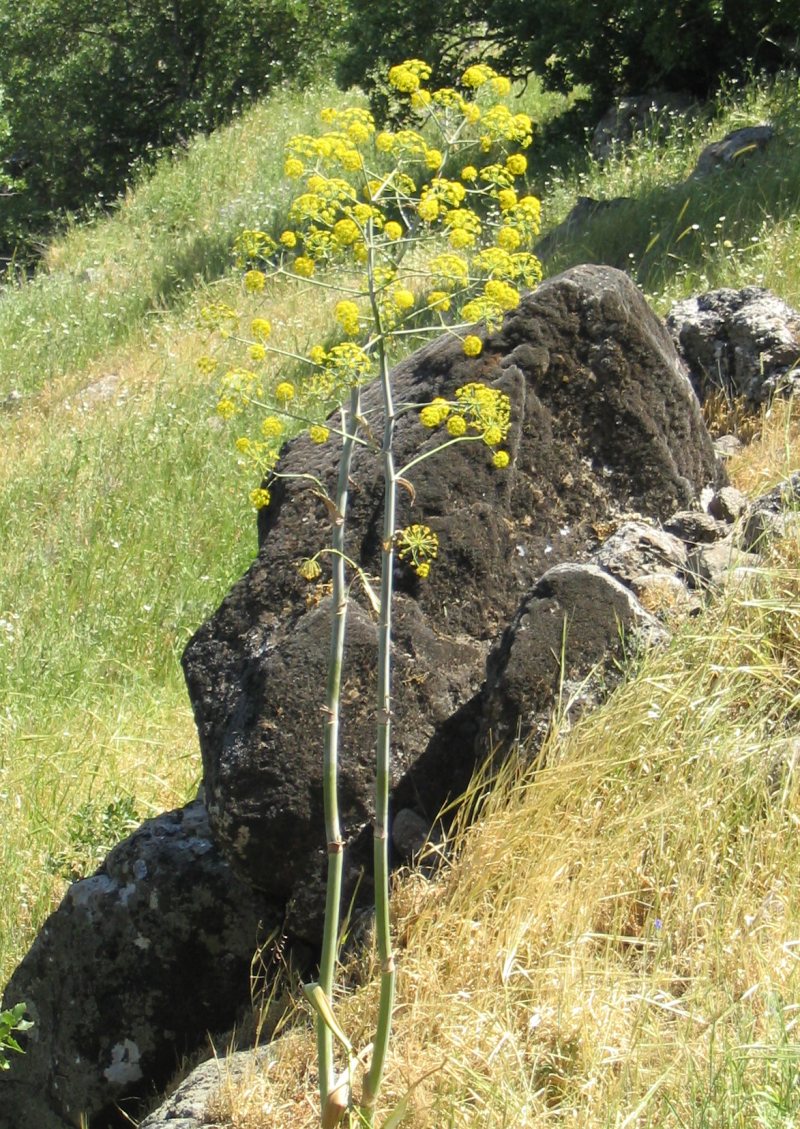
Ferula is a large genus of herbaceous perennial plants in the carrot family (Apiaceae), comprising approximately 170–220 accepted species native to arid and semi-arid landscapes stretching from the Mediterranean basin eastward through the Middle East and Central Asia. Plants are typically imposing in stature, reaching 1–4 metres in height, with stout hollow stems, finely divided tripinnate leaves, and substantial basal sheaths that clasp the stem — in some species these sheaths grow large enough to collect rainwater. Flowers are small and typically yellow, massed into large compound umbels that top the branching stems in a broadly spreading canopy.
The genus is monocarpic in many species: a plant grows for several years as a vegetative rosette before sending up a single spectacular flowering stem, setting seed, and dying. This strategy, combined with a deep, stout taproot, suits the dry rocky hillsides, steppe grasslands, and desert margins where Ferula thrives across its range.
Ferula is best known to the wider world through a handful of species with outstanding economic or cultural importance. Ferula assa-foetida yields asafoetida, the pungent gum-resin that is a cornerstone condiment in South Asian and Persian cooking. Ferula gummosa produces galbanum, an aromatic resin prized in perfumery and traditional medicine. In antiquity, the genus played a larger role still: the hollow stems of Ferula communis served the Greeks and Romans as walking rods, splints, and — according to myth — as the vessel in which Prometheus smuggled fire down from the gods to humanity. The thyrsus, staff of Dionysian ritual, was fashioned from the same plant.
Etymology
The genus name Ferula is taken directly from classical Latin, where ferula denoted a rod or cane cut from a plant — the same word that gives us the English ferule (a flat ruler used for punishment). Romans fashioned the lightweight, hollow stems of giant fennel into walking sticks, splints for broken bones, stirring rods, and instruments of corporal correction. The same stem gave rise to the Swedish word färla via the disciplinary rod sense. Linnaeus applied the Latin name formally when he described the genus in the eighteenth century, cementing an association that stretches back to the classical world.
Distribution
Ferula is centred on the arid and semi-arid belt running from the Canary Islands and the Mediterranean basin — including North Africa, southern Europe, and the Levant — eastward through Anatolia, the Caucasus, Iran, Afghanistan, and into Central Asia as far as the steppes of Kazakhstan and Uzbekistan. A handful of species extend into East Africa. The genus reaches its greatest species diversity in the mountains and steppes of Central Asia and in the floristically rich regions of Iran and Turkey.
Within this broad range, some species are highly localised endemics: Ferula mikraskythiana is confined to Romania's Dumbrăveni Forest Nature Reserve, and Ferula sadleriana is a narrowly distributed Pannonian endemic found mainly in Hungary. Ferula communis, by contrast, spans the full Mediterranean and ranges south through East African woodlands and shrublands from the Canary Islands to the Arabian Peninsula and Tanzania, encompassing five subspecies.
Ecology
Ferula species occupy dry, open habitats: stony hillsides, rocky slopes, steppe grasslands, scrubland edges, and desert margins. Most species are highly adapted to summer drought and poor soils, rooting deeply with a stout taproot that resists disturbance and allows plants to survive prolonged dry periods. The genus tolerates light, medium, and heavy soils provided drainage is adequate, and it typically requires full sun, being unable to persist under shade.
Many species are monocarpic — remaining in vegetative rosette form for five or more years before flowering once and dying. This delayed reproduction is coupled with large seed production when flowering occurs. The hollow stems of Ferula communis show notable biochemical diversity: two chemotypes have been documented on Sardinia, one poisonous to livestock and one non-poisonous, illustrating the chemical variability within even a single species.
Cultivation
Ferula thrives in full sun with deep, fertile, free-draining soil and tolerates a wide range of soil textures from light sand to heavy clay. Most cultivated species are frost hardy to approximately −5 to −10°C (USDA hardiness zones 7–10). The key cultural constraint is root disturbance: Ferula develops a deep, stout taproot that resents transplanting, so plants should be moved while small or sown directly in their permanent position. In British conditions, Ferula assa-foetida typically requires around five years before it flowers.
Propagation
Seed is the primary method of propagation. Sow in autumn or in April under glass; germination is typically reliable when seed is fresh. Transplant seedlings to their final position as early as possible to minimize root disturbance. Division of established plants in autumn is technically possible but generally inadvisable because the taproot is easily damaged, leading to poor re-establishment or plant loss.
Cultural uses
The most commercially important product of the genus is asafoetida, a gum-resin tapped from the roots of Ferula assa-foetida and related species. The resin is harvested by making incisions in the root crown and collecting the hardened exudate; it functions as a pungent garlic substitute in South Asian vegetarian cooking and is used in Worcestershire sauce. Ferula gummosa produces galbanum, an aromatic resin with uses in perfumery, incense, and traditional medicine.
Across the genus, young leaves and shoots are cooked as vegetables and shoot heads are eaten raw in parts of the Middle East. The root, once steeped to reduce bitterness, is cooked in some traditions. Medicinally, preparations from Ferula species have been used for digestive complaints including bloating, wind, indigestion, and constipation, as well as for respiratory conditions such as bronchitis and asthma. The gum-resin also finds use in essential oil production.
In classical antiquity, the hollow stems of Ferula communis had multiple practical roles: walking staves, bone splints, and implements for stirring and transferring fire. In Greek mythology, Prometheus concealed stolen fire inside a ferula stalk to bring it to humanity, and the thyrsus — the ceremonial staff of Dionysus and his followers — was traditionally made from Ferula communis.
History
Ferula species appear throughout the ancient Mediterranean record. The Greek name narthex for Ferula communis passed into architecture — the narthex of a church is named after the plant because early basilicas were built on a plan compared to the hollow stem. Romans knew the plant well enough to name the genus after its most obvious property — the rod-like, hollow stalk — and put both the word and the plant to widespread practical use.
The most historically contested member of the genus is the lost ancient spice silphion (silphium), native to the Greek colony of Cyrene (present-day Libya) and apparently harvested to extinction in antiquity. Modern scholars have proposed Ferula drudeana and Ferula tingitana as possible identities, though the question remains unresolved. Asafoetida (Ferula assa-foetida), first encountered by Alexander the Great's soldiers in Persia, was used by Romans as a partial substitute after silphion disappeared and continues to be traded globally today.
Taxonomy notes
Ferula was described by Linnaeus in 1753 (Species Plantarum) and is placed in the family Apiaceae (formerly Umbelliferae), order Apiales. The GBIF backbone records 289 descendant taxa under the genus; estimates of accepted species count range from approximately 170 to over 220 depending on the treatment applied. Several formerly separate genera have been reduced to synonymy with Ferula, including Dorema, Narthex, and Scorodosma. The genus is closely related to other resin-producing umbellifers in the tribe Scandiceae / subtribe Ferulinae. Within Ferula communis, five subspecies are currently recognised, distributed across a wide Mediterranean and East African range.










